? I need HELP please!! 11/2/2020 New Member - Human Glucose Monitoring Kit

Status
Not open for further replies.

Susi G

Member Since 2020
Hi! My cat Peter was diagnosed with diabetes a few weeks ago. I use Vetsulin and did his first blood glucose monitoring on 10/21 using the Human Monitoring kit "EVO Embrace" by Omnis Health. I sent the data to my vet; he informed me that in order for him to be able to interpret it, I need to do a one time monitoring with Alpha Trak as well, so he can calculate the readings with EVO Embrace properly, since the calibration is different between the two. I am really trying to avoid buying Alpha Trak! I am hoping I can find help here on how to interpret Peter's readings. A friend of mine with a diabetic cat told me about your FB page, and I am looking forward to being part of this forum! Thank you!
 
WELCOME TO FDMB Susi and Peter! We are glad you fund us! Using the AT meter is good but the strips are not cost effective for a newly DX'd cat. There are ways to make comparison between a human ans pet meter. (You may want to tell your vet you just simply cant afford the AT system) Most here with newly Dx'd cats use the AT for their vets (curves) and a human meter for everyday monitoring. While I'm tracking down a member who uses the AT system, please go here and get acquainted with how everything works around here:
New? How You Can Help Us Help You!

Theres a ton of information here with good people to help you navigate it all

WELCOME TO OUR FAMILY :bighug:

FDMB is the best darn site on this planet to learn everything you need to know about feline diabetes!
jeanne
 
You don't need an AlphaTrak.
It is impossible to compare the two meters. Believe, me. Quite a few people have tried. It's like comparing apples and Volkswagons. They are calibrated differently but both do the job intended. Both types of meters are used on this forum.
This is what we know:
The numbers at the lower end of the meters are closer together.
The "take action" on a human meter is 50.
The "take action" on a pet meter is 68.
The higher the number, the further apart the meters are. But high numbers are high numbers on any meter. As long as you and the vet know that 50 on a human meter is fine, you should have no problems.
Some people buy an AlphaTrak meter and use it only for curves to get to a vet.
Some people say straight up that they cannot afford the AlphaTrak strips.

If you can set up a spreadsheet, we can help. We are very data driven and the spreadsheet is the first place we look.

If you need help setting up a spreadsheet, there are a couple of people here who love doing it for you.
 
Hi Susi,

A hearty welcome to yourself and Peter. :)

There is no direct relationship between the readings on human and pet meters. Instead one needs to apply the reference range appropriate to the meter type when interpreting BG readings.

Key BG ranges for Pet Meters:

Normal BG Range: 3.9-8.3mmol/L (international units) | 70-150mg/dL (US units) [Range provided to me by my vet for use with an Alphatrak pet meter.]

Renal Threshold: 14-16mmol/L | c.250-290mg/dL [Range given by online Merck Veterinary Manual.]

Key BG ranges for Human Meters:

Normal BG Range:
2.8-6.7mmol/L | 50-120mg/dL [Range used at FDMB, based on Roomp-Rand study into management of diabetic cats with human meters.]

Renal Threshold: Rough estimate 11-13mmol/L | 200-230mg/dL

(Renal threshold is where BG is so high that blood glucose starts tipping over into the urine. Actual threshold varies from cat to cat.)


Mogs
.
 
I published the conversion chart for human to cat glucose values. But I do not know whether it translated properly. In some pictures the text for data points is way too large. On my end, I can easily read the values for the data points without them sitting on top of eachother.
How does it appear to you?
Does it look different on screen than when printed?

Conversion Chart:
https://docs.google.com/spreadsheet...5Rd-PlFW/pubchart?oid=1817781568&format=image
 
I published the conversion chart for human to cat glucose values. But I do not know whether it translated properly. In some pictures the text for data points is way too large. On my end, I can easily read the values for the data points without them sitting on top of eachother.
How does it appear to you?
Does it look different on screen than when printed?

Conversion Chart:
https://docs.google.com/spreadsheet...5Rd-PlFW/pubchart?oid=1817781568&format=image
you need to "share" it. its locking people out
 
I tried publishing again. I hope it works this time. Let me know.

This is the conversion chart for human to cat glucose values. But I do not know whether it translated properly. In some pictures the text for data points is way too large. On my end, I can easily read the values for the data points without them sitting on top of each other.
How does it appear to you?
Does it look different on screen than when printed?

@jt and trouble (GA)
@Susi G

Conversion Chart: Human to Cat Glucose Values:
https://docs.google.com/spreadsheet...lFW/pub?gid=1936191885&single=true&output=pdf
 
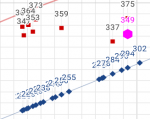
Thanks! Looks great except for one part where the numbers bunch up:
upload_2020-11-4_17-49-36.png
 

Attachments

  • upload_2020-11-4_17-49-36.png
    upload_2020-11-4_17-49-36.png
    16.6 KB · Views: 265
Thanks Wendy 17. Poor Oliver is doing much better. I ran out of Alpha strips to give the vet comparable numbers but she was good with the ReliOn numbers. (Glad to have lots of Relion strips on hand, thanks to the wise encouragement of the forum members!) But I'm a bit confused between the two numbers being used back and forth over the last few days, so your work is greatly appreciated.

Thank you for your concern for Oliver. He had 1.8 for ketones in blood where normal is 0.5. I test his urine daily and he was always negative but Vet said the urine test strips can't always catch ketones because a diabetic cat can be burning them for fuel. His WBC's were high and so he's on antibiotics (Unasyn, ampicillin) and vet said it could be infection in pancreas &/or UTI. He's eating and drinking again and so far no nausea. He's stopped with the diarrhea and vomiting (fingers crossed) but thanks for the Cerenia tip!
 
I created a graph that shows human numbers (Relion Prime) and the equivalent in cat numbers (Henry Schein Vet GlucoGauge).
I want to post it but do not know how to go about it. I created it in Excel as XLS file. I tried to put it in Google but it did not convert properly.
I’m really curious ... what procedure did you use to get these numbers? Test the same drop of blood with both meters? Was this all on one day or multiple days? How many different vials of test strips were used?

I might be misunderstanding what the graph represents, so hence the questions. Even human meters can give significantly different readings from each other. For example, my “go to” meter was a One Touch Ultra that tested very close to laboratory values, whereas my Asencia Elite tested consistently lower, the Coutoir tested in the middle, and later tests with my Relion also tested low (years ago various members did direct comparisons of different human meters so we to see how the meters compared and plotted them). So comparing results from different meters is an interesting exercise and might give a general comparison but it’s certainly only a snapshot in time and NOT something you can use to “convert” numbers going forward. Even different vials of test strips will give variances (I always double-test when switching vials using the last strip from a the old vial and the first strip from the new vial).
 
The Conversion Graph of Blood Glucose Data: Human vs. Cat Meter is intended to give a rough idea between human and cat glucose readings. It is not an exact, predictable conversion. Otherwise, there would be no outlying points for the cat meter, and all the points would fall on a perfect line.

For the graph, please see the link in my signature
or
Updated Conv. Graph of 11-8-20 w/ linear trendline:
https://docs.google.com/spreadsheet...Ton8_hcqmvESKeWsF6yOzjmgk/edit#gid=1936191885

(Conv chart orig., log trendline): https://docs.google.com/spreadsheet...NWnRd-PlFW/pubhtml?gid=1936191885&single=true


The same drop of blood was tested on a human and cat meter just seconds apart. The data were collected over a period of about 2 weeks in September 2020. I recorded the data in an Excel SS whenever I tested Merlin. Then I sorted the table in increasing order of the human test results vs. the corresponding cat meter number. I let Excel create a LOG trendline for the cat meter. Alternately, one could create a Linear trendline, which seems to work better at human values above 100.

I started Merlin on ProZinc at the end of August 2020 and used a human (Relion Prime) and vet meter (Vet GlucoGauge from Henry Schein set to "cat" reading) to see how they compared for my own information. My vet only uses the readings from the AlphaTrak with its very expensive test strips. I will continue to use the human meter because of much lower cost for the test strips. I gave my vet the conversion chart to be able to roughly translate my data into theirs. I also let the vet test venous blood one time with my two meters and their AlphaTrak. Result: Relion 284, Vet GlucoGauge 375, AlphaTrak 349.

I used the same vial of test strips for the vet meter. I might have used 1 or 2 vials for the human meter, I am not sure.

If other people have data for human and cat on the same drop of blood, it would be interesting to compare and maybe add them to the chart.

Wendy and Merlin
 
Last edited:
The Conversion Graph of Blood Glucose Data: Human vs. Cat Meter is intended to give a rough idea between human and cat glucose readings. It is not an exact, predictable conversion.
Hey, thanks for taking the time provide details.

I think my stumbling block was the term “conversion” — perhaps a more appropriate term would be “comparison.”

This is a discussion that we’ve had many times on the board over the years. There’s no good way to convert numbers, but many (myself included) have wanted to know how the meters “read” and trend compared to each other and to lab values.

As long as everyone understands comparisons of this type can’t be used to actually convert BG values, it’s fine, and an interesting academic exercise. The problem lies in trying to report “converted” data to one’s vet or apply it to the spreadsheet in order to make dosing decisions.

Nice effort, by the way. It’s always interesting to see how various meters compare.
 
@Wendy 17 That correlates to roughly what I was seeing when I was using the AlphaTrack in tandem with my Relion Prime for a few days. I had always wanted to do a side by side myself, but I always ran out of the AlphaTrack strips too fast. Thanks for graphing it out!
 
JL,
Thanks for your input. I followed your suggestion and changed the name of the graph linked in my signature from "Conversion" to "Comparison" [Comparison Graph of Blood Glucose Data: Relion Prime (Human) Meter and Henry Schein Vet GlucoGauge (for Cats)].
Anyone who wants to show their vet human data can provide the vet with the link (or printout) to make the human data more understandable (https://docs.google.com/spreadsheet...Ton8_hcqmvESKeWsF6yOzjmgk/edit#gid=1936191885).
I selected to put a Linear Trendline in the graph that works best for data over 100 mg/dL. A Log Trendline (curved) works best for data below 100 mg/dL.
@JL and Chip
@Polgeria
@Susi G
@Cat Caregiver
@jt and trouble (GA)
@Critter Mom
@Red & Rover (GA)
 
Status
Not open for further replies.
Back
Top