Having tons of trouble with blood testing (first timer)

Status
Not open for further replies.

VeePepp

Member Since 2020
Hi! Our cat Peppurr was just diagnosed with diabetes and we started him on insulin last Monday. Needless to say we are brand new at this. We got the AlphaTrack and tried yesterday and today many times to get a proper blood reading but are having loads of trouble. Even when it looks like enough blood the reader doesn't seem to work (it just times out or shows an error). We finally got it to read once today and it read low (62). Note this was about 6 hours after insulin. However he is not showing any signs of hypoglycemia. So we tried the control liquid and it read low too (68)! We did the control liquid again (note we even had trouble getting it to read the control liquid even with using multiple drops!) and this time it read in range (145). Did it once more just in case and 145 again. Then tried cat twice again and got an error.
We've already pricked him at least 10 times today and wasted so many strips. We are following the instructions about warming up the ear, tried vaseline, tried paw pad, followed tips from this forum about where to prick, tried setting lancet from 2-4mm, using code 37 as indicated, etc. but still having so much trouble and feeling frustrated and terrible for our kitty for having to endure this. I tried calling AlphaTrak support but they are closed until Monday.
We really need to do our first full curve tomorrow (Sunday) so wanted to have this sorted out by then. Any advice is greatly appreciated. Thanks in advance!
 
Last edited:
WELCOME TO FDMB We are glad you are here! I must ask what gauge lancet are you using? I think the proper gauge is 29 The lower the number the bigger the gauge. It may be a simple fix in that regard. If they are the larger gauge... I will tag someone to come help.
I havent had a diabetic kitty in many years.
I would like to direct you here :
New? How You Can Help Us Help You!

To get you acquainted with how things work around here. Please pay particular attention to the "Profile/ Signature" section.

We are dedicated to helping anyone that needs help with their diabetic kitty. We strive to help you over the learning curve.
You HAVE landed in a safe place for Peppurr (very cute name btw) and we look forward to getting to know you both!

WELCOME TO OUR FAMILY:bighug:

FDMB is the best site on this planet to learn everything you need to know about feline diabetes and beyond!

I must step away to start fixing dinner. I will be back to check on you in a little while;)
jeanne
 
Hi! The troubles you are describing makes me worried that you have technical issues. I'll shoot some random questions, which I am sure you did... but just in case:

1) Are you sure you are using the correct strips for your meter (they should have a butterfly on it)?
2) Are you sure you calibrated the alphatrack to the correct code on your strips?
3) Are you sure you are pushing the strip all the way in before collecting blood?
4) You are touching the strip sideways (not at the front)?

If all the above is correct, I wouldn't get anymore blood from kitty until you can get strips giving you the correct number for control. three more giving the wrong value and I will send back the meter....
 
Last edited:
Welcome to the Board. I'm Enid, and that's Lola in my avatar. Your experience sounds just like my early days with the AT2. Out of the bottle of 50 strips, 22 were errored out or otherwise wasted. And then I found FDMB (3 weeks ago, today) and I found the information I needed to have successful tests.

.. tried setting lancet from 2-4mm....

Tip #1: Ditch the lancing device. You'll have far greater control using the lancet alone and you'll be able to adjust the angle of the poke. The device shoots straight down but you'll have much better luck going in at an angle near 45 degrees.

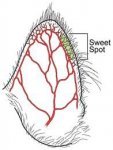
Tip #2: The "sweet spot" (image below). (I don't think I ever managed to get sufficient blood from her paw and since finding the sweet spot diagram I've never tried the paw again.)

Tip #3: I don't plug the strip into the meter until I'm certain that I have enough blood for the sample. Once I'm confident it's enough, then I reach over with one hand and push the strip into the meter and wait for the indication from the meter that it's ready to test, then I bring the meter over to her ear to test. (One kind member told me that once she has a sufficient sample she scoops the blood onto her thumbnail and tests from there. I used that method once when my first test didn't work -- wasn't the equipment's fault, I neglected to plug the strip into the meter! That trick worked for me because I was able to insert a second strip into the meter and test the blood that I had "harvested" on my thumbnail.)

Tip #4: Vaseline is a great tool. But be sure you don't use too much of it; it should just be a thin film. You don't want it getting onto the strip which would then block the strip from absorbing the blood. (I smear the Vaseline with my left hand, and use only my right hand to handle the meter & strip.)

You'll note that all the guidelines here are geared around readings taken from a human meter, not a pet meter like the AT2. I eventually ended up buying a human meter for daily testing because it was SO much cheaper than the AT2, and I will use the AT2 only for tests whose results I send to the vet. (I bought the Walmart ReliOn Premier Classic model ($9). One hundred test strips cost $18.00. And I like the shape of the test strips - the test pad is at the bottom of a pointed strip instead of being on the side and I can watch the blood being sucked up into the test pad. And they're available to purchase locally; I don't have to wait days to receive them in the mail.)

Don't give up. The arguments for home testing are too compelling. You'll get far more accurate readings than the vet would get from a stressed out cat, and you'll get real-time measurements that will tell you exactly how the insulin acts in your cat (especially the point where his BG is at its lowest point) and can alert you to life-threatening events. And, you'll save a TON of money. My vet charges $180 for a day-long curve -- something I can do at home for $1 - $10, depending on which meter I use and how many hourly tests I run.)

I think most of us arrived here exhausted and overwrought. I know I did. Keep with it. Once you have a successful test you'll be able to determine what worked and replicate that technique.

I love the name Peppurr. (We have a Purrseus.)

Enid
 

Attachments

  • sweet spot.jpg
    sweet spot.jpg
    5.6 KB · Views: 157
Thanks all so much for the help!!! Some replies below:

what gauge lancet are you using?
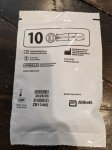
We are using the ones that came with the AlphaTrak kit (https://www.chewy.com/alphatrak-2-blood-glucose-monitoring/dp/262434). I can't find where it says the gauge but I've attached a photo of the bag they come in. I'm assuming they are the right ones since they came with the kit?

To get you acquainted with how things work around here. Please pay particular attention to the "Profile/ Signature" section.
Thanks for the info! I updated my signature. Sorry for missing that earlier.

4) You are touching the strip sideways (not at the front)?
Regarding #1-3, yes I think we are good there as we are using the strips that came with the kit, and matching to code 37 as listed on the strips bottle, and pushing in the strip fully. Regarding #4, to confirm, by "sideways" do you mean we should be collecting the blood on the thin side of the strip on either side, but not the front flat tip? We've tried collecting from every angle of the strip, but this is great to know to focus on the side as we have not been doing that!

Tip #1: Ditch the lancing device. You'll have far greater control using the lancet alone and you'll be able to adjust the angle of the poke. The device shoots straight down but you'll have much better luck going in at an angle near 45 degrees.
Thanks for this tip and the others! We were able to get more blood to come out by poking directly without the device. He did flinch somewhat but probably just need more practice. The sweet spot diagram is very helpful as well, that is even closer to the edge of the ear than I thought! It's good to hear I'm not the only one that experienced these kinds of issues and that there is hope!

We were not able to pull off the full curve today but did get a couple solid readings, which is definitely progress!! His ears look beat up which is killing me but we will persevere. I will have to take some time off this week to attempt the curve again.
For today, he read 89 at around 5:20pm and we are supposed to give him a 1.5 dose of insulin (Lantus) around 8:30pm (Pacific). That reading seems pretty low so we'll try to test him again right before giving insulin and possibly reduce the dose or skip depending on the result (I'm reading up on this now).

Really appreciate all the help getting through this and the warm welcome to the forum!!


PXL_20201101_214246258.jpg
 

Attachments

  • PXL_20201101_214246258.jpg
    PXL_20201101_214246258.jpg
    44.4 KB · Views: 150
Last edited:
Regarding #4, to confirm, by "sideways" do you mean we should be collecting the blood on the thin side of the strip on either side, but not the front flat tip?

Here's an enlarged pic of an Alphatrak test strip:


upload_2020-11-2_12-14-15.png

The circled areas are where the strip takes in blood for the test. As you can see above, there is a little pointy protrusion on each test area.

When doing a test:

1. Push the test strip part way into the meter but not far enough to switch it on.

2. Do the poke and let the blood droplet bead up (see my next post). Keep hold of the ear to make sure your kitty doesn't shake his head and send the sample flying across the room. (Happens!)

3. With your free hand ease the strip the rest of the way into the meter.

4. When the meter shows it's ready to take the reading, gently touch the pointy bit on the side of the test strip to the blood droplet. The strip will 'sip up' the amount of blood it needs and beeps when it has drawn up enough.


Mogs
.
 

Attachments

  • upload_2020-11-2_12-14-15.png
    upload_2020-11-2_12-14-15.png
    53.5 KB · Views: 262
Last edited:
Here is the testing method I used. Perhaps it might give you some ideas to add to your own testing technique.
  1. Fold a sheet of kitchen paper in four lengthwise and cut it up into 1" strips. You will use these to cushion and support the ear during the test.

  2. Put a thin film of Vaseline or Neosporin ointment (not the cream!) onto the edge of the ear to help the blood sample bead up instead of wicking into the fur. (Wipe off any excess.)

  3. To get a blood sample you need to increase the blood flow to the ear, so make sure the ear is really, really, really warm (but not hot) - especially in the early days of testing. (Note: With repeated 'poking', more capillaries form in the test area, so it becomes easier to get samples reliably.)

  4. Once you have the testing area of the ear well warmed, wrap a strip of folded kitchen paper round your index finger then place finger under the sweet spot area of the ear you're testing to support it during the poke.

  5. Use your thumb and middle finger to lightly but firmly grip the ear and paper strip in place so that the edge of the ear is taut but not overstretched; the little bit of tension will make it easier for the lancet to break the skin surface (and it helps to keep kitty's head from moving around too much).

  6. When using a lancet 'freehand', make sure the bevelled side of the lancet is facing upwards. Hold the lancet at a slight angle to the ear similar to the way you hold a pen when writing, not perpendicular (easier to see where you're aiming and also makes skin prick easier).

  7. When it comes to the actual poke, prick the sweet spot on the edge of the ear in a similar way to how you might quickly prick a balloon with the tip of a needle to make it pop. If you aim as close to the edge of the ear as possible you are less likely to hit the marginal ear vein.

  8. When using the glucometer, bring the test strip to where it j-u-s-t comes into contact with the blood droplet and hold it there. The strip should then 'sip up' the amount it needs to run a valid test. Most meters beep or give a visual cue to let you know that enough blood has been collected on the strip.

    If your cat is a wriggler, try collecting the blood sample on the back of your (clean) fingernail and test it from there.

    If a test fails and you still have a lot of blood on the strip from the failed test, don't throw it away. Instead, you could pop another strip into the meter and test using the blood on the strip from the first test. (Saves an additional poke so also helpful for wriggly kitties!)

  9. After the test, fold the paper strip over the edge of the ear and apply gentle pressure to the test area for about 20-30 seconds to minimise bruising.

  10. Keep praising your cat throughout the process and reward with a favourite diabetic-friendly treat or favourite activity (e.g. brushing).
With a bit of time and practice you'll be able to work out a technique and a routine that works best for you and Peppurr.


Mogs
.
 
try collecting the blood sample on the back of your (clean) fingernail and test it from there.

If a test fails and you still have a lot of blood on the strip from the failed test, don't throw it away.
Excellent tips!
Yesterday I tried the fingernail method but my nail apparently has an affinity for blood so it spread out all over the nail (yuck!) leaving no BEAD to test. So this morning I took a plastic fake fingernail and used it to scoop the blood. Bead stayed put and worked perfectly. Now I see Mogs' tip about using the previous strip's blood: great idea.
 
Wanted to give another update here. We were able to do a full curve earlier this week! Could not have done it without the great advice you all gave!!! We did still have some rough moments and definitely felt bad for Peppurr by the end of the day, but his ears are fine now and he still loves us so all is well ;)
I will post up the standard spreadsheet in my signature soon but the vet said the results are looking good so far (he stayed under 200 most of the day and never dropped too low) so we are very relieved. She asked for another curve in about a week so we will probably do it on Sunday. Hopefully will go smoothly since we are getting the hang of it. Thanks again!
 
Last edited:
Alphatrack meters like a nice round sample. We have gotten some silly BGs when I don't wait for a good sample.
I use rear paw pads and not eats, so it's a bit easier to wait it out. My cat tolerates paw pads better since I've been cutting his nails for about a decade. On one of my pet sitting clients, I use baby food. I open a jar and set it in front of him, poke the back side of his ears and while his head is down trying to get food out the blood pools a bit better.
You will figure out something that works...random testing and random rewards for your kitty will help !!! :):bighug:
 
Status
Not open for further replies.
Back
Top