Results of first At Home Curve

Status
Not open for further replies.

Douglas_my ginger cat

Member Since 2020
Hi,

I have completed my first at home blood glucose curve and before I send my results to the vets, I would love some advice on the results. (My spreadsheet has been updated).

After the first curve (at the vets), my vet said to raise the insulin units to 3. I decided to raise it to 2.5 after speaking with people on the forum as I didn't want to jump up so quickly (my vet does not know this ....yet).

Anyway, following the results and the extremely high numbers, I think I should increase the dosage to 3IU? What do you think?

Also, as most of his numbers are black - should I be really worried that they are so high? What could happen if they continue to stay high? Douglas sleeps a lot but there is really no change to his behaviour in the last 3 months.

Any advice/thoughts/happy vibes are very gratefully received :D
 
I cannot give dosing advice but wow you've really caught on to testing GOOD FOR YOU AND DOUGLAS! Way to go!
He sure is a handsome lil devil! Scritches to him!
Is that happy enough? :p
I think I do happy quite well :bighug::D:smuggrin:
Absolutely, it actually bought a tear to my eye, but tears of joy! Thank you.

I seriously cannot believe how far Douglas and I have both come in such a short space. You guys are absolutely amazing with this support! :bighug:
 
Absolutely, it actually bought a tear to my eye, but tears of joy! Thank you.

I seriously cannot believe how far Douglas and I have both come in such a short space. You guys are absolutely amazing with this support! :bighug:
It is an amazing site. I found it back in 2008. and its still rollin stronger. Stronger than ever I think! Its every person who posts here. We are FAMILY!;):)
 
Gosh yes, you seem to have mastered testing very quickly indeed, well done! That in itself is a huge step forward.

Those are very high numbers, yes, and the aim is to lower them in a sensible and safe way. Cats do seem to cope remarkably well with high bg but if numbers stay high for too long it can cause organ damage. That’s why people are so passionate about testing, dosing and getting numbers down.

I’m not a dosing expert either but it’s hard to say much without more bg data. Do you know what Douglas’s numbers were like when he had his first curve at the vet? What dose was he on then? It does look as if an increase is needed but it would be interesting to see what bg was like on a lower dose. Another thought also - has Douglas been checked for any kind of infection? That can raise bg, and diabetics are prone to infections of various kinds, such as UTIs (especially male cats). And has the vet looked at his teeth recently?

Maybe @Elizabeth and Bertie or @Critter Mom - both very experienced UKers - have some thoughts for you. Meanwhile, you’re right to increase in small increments - vets tend to suggest increases of 1u at a time quite quickly, but remember that insulin is a powerful substance and and although an increase of 1u doesn’t sound much, it is. Best to go slow and increase by 0.25u or 0.5u to stay safe and make sure you’re not skipping over the “ideal” dose. That said, you don’t want to hang around too long on one dose if numbers are stubbornly high.

See what the others say.
 
Thanks @Diana&Tom, the first line on my spreadsheet is the one taken from the vets.

Would it be an idea to do another curve sooner than 10 days (vet has said it takes about 7-10 days to know if the insulin is working)?
Sorry, I missed the dates on the ss. It doesn’t look as if much has changed so I’d be inclined to increase. Yes it can take several days for a change of dose to “settle” if that makes sense so try another curve a week or so after an increase. But I’d like to see what the others say - Eliz has many years’ experience treating two diabetic cats and Mogs too has a vast amount of knowledge.
 
Hi there,

Well-executed curve. Gold star. Top o' the Class! :D

Textbook response to Caninsulin (bucket-shaped curve).

Couple of questions:

1. What weight was Douglas? What is his ideal weight.

2. Do you know the carb values of the Royal Canin Diabetic Wet and Dry diets?

3. Was Douglas started on 2 units of Vetsulin?


Mogs
.
 
Hi there,

Well-executed curve. Gold star. Top o' the Class! :D

Textbook response to Caninsulin (bucket-shaped curve).

Couple of questions:

1. What weight was Douglas? What is his ideal weight.

2. Do you know the carb values of the Royal Canin Diabetic Wet and Dry diets?

3. Was Douglas started on 2 units of Vetsulin?


Mogs
.
Hi Mogs,

1. He has been a steady 4.25kg (9.36lbs) for the last few months, but I've weighed him this morning and he has lost weight, he is now 3.81kg (8.4lbs). His ideal weight should be between 5-5.5kg (11-12lbs).

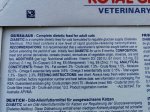
2. I don't know the carb content, it doesn't seem to show on the box. But I've just looked and protein only accounts for 9%?! Surely that can't be right. Ive attached a photo.

3. He started on 2IU on 24th July this year.

Any help would be much appreciated. I am now really concerned about his weight. Should I up his food? He has 2x 100g sachets and 40g dry of Royal Canin Diabetic in a 24 hour period. With a small plate of tuna during his shot (as a positive association). The royal canin he eats 20-30mins before his shot and smaller meals throughout the day.

Thank you!
 

Attachments

  • 1597903210896301513333409132105.jpg
    1597903210896301513333409132105.jpg
    148.8 KB · Views: 219
Royal Canin Diabetic

If you can get the dry completely out of his diet, it will really help. The RC Glycobalance is very high carb. The ME profile comes out to be about 24% of calories from carbs. We want them eating less than 10% carbs.

The canned RC is better, but not much. It's about 12% if I remember right.

BUT, don't change the food quickly and be ready to test often. Lowering the carb percentage in the food can drastically lower the need for insulin.
 
Last edited:
Hi! Fellow Caninsulin user here!

Our numbers didn't budge for ages...see SS....but changing over to just wet food really made a huge difference. I had to wait a week or two to do it to make sure I was up to speed with the home testing. Our old vet would up by half units but our last half increase (from 4.5 to 5) by our new vet really shook something up and we are currently testing out 2 units and will only be increasing and decreasing by .25 units.

Congrats on the home test!!!!! It really is such an achievement! :)
 
If you can get the dry completely out of his diet, it will really help. The RC Glycobalance is very high carb. The ME profile comes out to be about 24% of calories from carbs. We want the eating less than 10% carbs.

The canned RC is better, but not much. It's about 12% if I remember right.

BUT, don't change the food quickly and be ready to test often. Lowering the carb percentage in the food can drastically lower the need for insulin.

I was about to say exactly this. Try to remove the dry completely and you should see a lowering of bg from that alone. Vets are very fond of prescribing “special” food but you should be able to get all the necessary nutrients from a good-quality commercial cat food. Many of us here in the UK use Zooplus, or something like Natures Menu from www.fetch.co.uk - that’s what I feed and I increase protein intake by adding small amounts of something like the shredded Applaws chicken or just human cooked chicken. As Chris says though, if you do cut out the dry do so over a period of a few days and make sure you’re testing enough to catch any surprising drops.

This is very much a learning curve, we’ve all been there, trust me! You’re doing really well, probably better than you think :)

As for the weight loss - if that’s due to Douglas eating less, by all means feed him more. Unregulated diabetics are often very hungry - don’t withhold food.
 
@Diana&Tom @KyraCat @Chris & China (GA)

Thanks guys! I think my next step will be to remove the dry food and have it completely on wet. Then look at changing the wet food to a lower carb. I didn't realise RC was so high in carb.

Is there an easy way to calculate what the carb % is? I can't seem to decipher it on the cat food which unlike human food seems to show the carb %.

@Critter Mom, do you think I should still increase the dosage to 3IU? I ideally want to go back to the vet with a plan in place and then get his advice on it as oppose to him dictating the next step (in the nicest possibly way, of course :D)
 
Hi Anna, yes, for those of us in Europe there is an easy way to calculate the percentage of calories from carbs. You can just use this little online calculator (link below).
(Calculating carbs is harder for people in the US because the data on their pet foods isn't as accurate as European data).
https://secure.balanceit.com/tools/_gaconverter/index.php

I did take look a the Royal Canin foods and the dry is around 26% calories from carbs, and the wet around 14.7% calories from carbs (using data from Animed).
We do recommend that diabetics have diets with less than 10%, and many cats do best on diets with no more than, say, 4 - 6%. There are lots of options in the UK. Do take a look at the list in my signature.

Well done for doing that curve. Excellent job! :bighug:
The numbers are high. And there are two things you can do to try to bring that down at this point. You could increase insulin dosage. Or you could lower the carb content of the diet. But don't do both at once...

My suggestion would be that you first get more comfortable with testing on a routine basis, and then phase out the high carb food. You could, as I think you said above, start by phasing out the dry, and then lower the carb content of the wet food.
You 'do' need to be hometesting while you do this because it's not known how the change in diet would affect Douglas's blood glucose (and the dose may even need to be reduced). So, you'd need to get at least a couple of tests every day....
How do you feel about trying to get a test before every insulin shot..?
And might you be able to get another test at some point in the day, preferably in the first half of an insulin cycle? ...I know you're new to testing, so please don't feel under pressure. But this would be a really useful thing to aim to do...

And then, once the diet change is done, you could increase the insulin dosage - if that is still necessary.

Eliz
 
Last edited:
do you think I should still increase the dosage to 3IU? I ideally want to go back to the vet with a plan in place and then get his advice on it as oppose to him dictating the next step (in the nicest possibly way, of course :D)
I think if I were where you are at the moment, I'd arrange a consult with the vet to say I wanted to remove the dry food from Douglas' diet and that for safety reasons I would prefer to hold off on the dose increase until the move to an all-wet, low carb food has been completed and the impact on Douglas' BG levels could be properly gauged. Then continue the discussion from there.


Mogs
.
 
OMG what invaluable information, thank you! The carb calculator looks amazing and will definitely be using that. I have some Applaws food that I had bought in bulk prior to his diagnosis so will check that value of that. But agree to phase out dry, then change wet to lower carb.

How do you feel about trying to get a test before every insulin shot..?
And might you be able to get another test at some point in the day, preferably in the first half of an insulin cycle? ...I know you're new to testing, so please don't feel under pressure. But this would be a really useful thing to aim to do...
I think I could do the test prior to his feeding prior to his shot. This weekend, I will try to do a few more tests throughout the day. Do I record this all on the spreadsheet? If I do some couple throughout the day are there any better times to do this (ie, not a full curve)

How much is he drinking and peeing at the moment?
He actually decreased his water intake and outtake, although it has slightly increased recently.

As for the weight loss - if that’s due to Douglas eating less, by all means feed him more. Unregulated diabetics are often very hungry - don’t withhold food
PS: I agree with Diana: you need to give Douglas more food (preferably the lower carb wet variety). With the range his BG is running in he won't be getting the full benefit from his grub yet.

By how much should I increase his food? Whats a safe amount or should I let him dictate to me?

I know I keep saying it but this is an absolute revelation and am feeling more and more confident going back to the vet!
 
By how much should I increase his food? Whats a safe amount or should I let him dictate to me?
I'd let him eat what he wants throughout the day. Just remember to remove all food for the two hours before AMPS and PMPS BG tests to make sure they're not food influenced. He needs to get back to ideal weight.

Thanks for the info about Douglas' fluid intake and output. Given that it seems to be increasing a little, I'd take that as a flag to get a bit of a motor on WRT the diet modifications - safely! He needs to get his BG under better control.

When I was using Caninsulin, for safety I tested every day at AMPS, AM+3, PMPS, PM+3 (before bed check). I'd then do additional spot checks at different times during the period when the Caninsulin was at its most active to check whether Saoirse might go lower than +3 (she tended to nadir early, but nadirs can move around) and also later in the cycle to check when the dose had pooped out. It worked well, and I'd recommend it as a test strategy. Note: +2 tests are also very valuable because they can give an early warning of bigger drops to come later in the cycle.


Mogs
.
 
Last edited:
I'm gonna start phasing out the dry from tomorrow over the course of 6 days with preshot tests and other tests when I can
Because removing dry food from a cat's diet can have such a big - and fast! - impact on a cat's insulin needs, I'd hang fire for a little bit longer before removing the dry food, Anna. Not too much longer, but to be safe it would be better if you had some more BG test data before starting. Again for safety, when you do start the transition to all low-carb wet food you'll need to be in a position to check how low Douglas goes on each cycle as more and more of the dry is removed from the diet because the insulin dose may very well need to be reduced alongside the reduction in dry foods.

At the following link there's good advice from vet Dr. Lisa Pierson on how to safely transition to an all low-carb wet diet:

catinfo.org - Feline Diabetes Page


Mogs
.
 
Because removing dry food from a cat's diet can have such a big - and fast! - impact on a cat's insulin needs, I'd hang fire for a little bit longer before removing the dry food, Anna. Not too much longer, but to be safe it would be better if you had some more BG test data before starting. Again for safety, when you do start the transition to all low-carb wet food you'll need to be in a position to check how low Douglas goes on each cycle as more and more of the dry is removed from the diet because the insulin dose may very well need to be reduced alongside the reduction in dry foods.

At the following link there's good advice from vet Dr. Lisa Pierson on how to safely transition to an all low-carb wet diet:

catinfo.org - Feline Diabetes Page


Mogs
.
Thank you, that makes sense. I will collect some more BG data first.

Sometimes I can jump in head first wanting to make the change asap! Must remembe, slow and steady wins the race
 
So just an update, I emailed my vet the results and my plan of moving Douglas to low carb food before changing dosage.

He agreed but wants me to stay on diabetic food so has offered Hills and Purina as alternatives. Whilst I didn't say no, I did say that I would be doing some research on low carb food this weekend and will email him what I decide. This conversation was through his nurse (not direct with him) but they seemed adamant about sticking with Royal Canin, Hills or Purina diabetic. Im not convinced and will pick a low carb food.

Now I really want Douglas's numbers to drop from the change of food alone to show the vet that diabetic food isn't always the way!
 
Thank you, nice to know I'm not just being difficult!

Not at all. We can choose to feed our cats with whatever we like, according to our own research. Stick to what you believe to be best for Douglas. Vets don’t always know much about the content of foods and automatically think prescription stuff must be superior. If you don’t want to get into an argument you can always say that you simply can’t afford the expensive prescription stuff on top of insulin etc - say you can buy good quality food in bulk online which is just as good, end of :)
 
Glad it went well with the discussion re overall strategy, Anna.

WRT the insistence on the diabetic Rx diet choices, I suppose like all the rest of us vets probably like to stick to what's familiar and what has worked for other of their diabetic patients (in the sense that they stayed alive).

I have no idea how great a percentage of caregivers of diabetic cats are as proactive and hands-on as we are here at FDMB. Many caregivers don't home test, possibly because they're not educated about it - and are in many instances actively warned against it - by their vets. In such cases the only way to protect the cat as much as possible from hypos is to have it 'run hot' through dietary manipulation. A carbed-up cat may thus be kept at a fair distance from the hypo threshold but unfortunately it tends to push the cat toward the renal threshold. I think many in the veterinary profession - even some feline specialists - consider the gold standard of feline diabetic regulation to be a cat that doesn't hypo and who doesn't tip glucose into its urine. Hardly ambitious.

Some caregivers are advised by their vets that all they need to do is get occasional curves done at the vet's surgery, feed a high-carb diet, or even an ultra-high-carb diet, dose blind every day, monitor water consumption, and hope that they can spot a hypo in time to administer honey.

The 'running hot' / minimal monitoring treatment approach may not be ideal but, rather ironically, it may be responsible for saving the lives of many animals whose owners would choose not to treat their diabetics at all if presented with a more demanding regimen at time of diagnosis.

Unfortunately I think sometimes problems arise when people with more ambitious treatment goals for their cats and who wish to be more hands-on as caregivers come up against vets who are reluctant or unwilling to deviate from practices that they are more familiar with. Vets also legally have a duty of care to their patients and may be nervous about more progressive treatment protocols. Fear of the new and different? We're all guilty of that to some degree.

Just my two penn'orth.


Mogs
.
 
Last edited:
@Critter Mom, definitely food for thought. And makes sense with regards to 'covering all bases', ie, higher carb food to avoid hypo.

As they say, sometimes ignorance is bliss. If I had not been wanting to find out more except what the vet told me then I would be in that category as I thought 'vets know best' and I wouldn't have thought I was doing anything wrong. By knowing more opens us up to a whole degree of consequences but also real rewards when things are going well.

Like you say, those that choose to find out more then those who don't (not in a bad way but could be restrictions on resources etc).

I just hope my vet doesn't think I am trying to 'outdo him' but to take more responsibility in the duty of care for Douglas. One way to convince will be the numbers and I hope I can :cool:
 
Glad it went well with the discussion re overall strategy, Anna.

WRT the insistence on the diabetic Rx diet choices, I suppose like all the rest of us vets probably like to stick to what's familiar and what has worked for other of their diabetic patients (in the sense that they stayed alive).

I have no idea how great a percentage of caregivers of diabetic cats are as proactive and hands-on as we are here at FDMB. Many caregivers don't home test, possibly because they're not educated about it - and are in many instances actively warned against it - by their vets. In such cases the only way to protect the cat as much as possible from hypos is to have it 'run hot' through dietary manipulation. A carbed-up cat may thus be kept at a fair distance from the hypo threshold but unfortunately it tends to push the cat toward the renal threshold. I think many in the veterinary profession - even some feline specialists - consider the gold standard of feline diabetic regulation to be a cat that doesn't hypo and who doesn't tip glucose into its urine. Hardly ambitious.

Some caregivers are advised by their vets that all they need to do is get occasional curves done at the vet's surgery, feed a high-carb diet, or even an ultra-high-carb diet, dose blind every day, monitor water consumption, and hope that they can spot a hypo in time to administer honey.

The 'running hot' / minimal monitoring treatment approach may not be ideal but, rather ironically, it may be responsible for saving the lives of many animals whose owners would choose not to treat their diabetics at all if presented with a more demanding regimen at time of diagnosis.

Unfortunately I think sometimes problems arise when people who are more ambitious in their treatment goals for their cats and who wish to be more hands-on as caregivers come up against vets who are reluctant or unwilling to deviate from practices that they are more familiar with. Vets also legally have a duty of care to their patients and may be nervous about more progressive treatment protocols. Fear of the new and different? We're all guilty of that to some degree.

Just my two penn'orth.


Mogs
.

That’s an excellent summary of the situation, Mogs - would bear repeating in its entirety elsewhere every time the issue of prescription diets comes up.
“Carbed-up cat” though - I’ve never heard it put like that before and have to laugh!
 
So just an update, I emailed my vet the results and my plan of moving Douglas to low carb food before changing dosage.

He agreed but wants me to stay on diabetic food so has offered Hills and Purina as alternatives. Whilst I didn't say no, I did say that I would be doing some research on low carb food this weekend and will email him what I decide. This conversation was through his nurse (not direct with him) but they seemed adamant about sticking with Royal Canin, Hills or Purina diabetic. Im not convinced and will pick a low carb food.

Now I really want Douglas's numbers to drop from the change of food alone to show the vet that diabetic food isn't always the way!

My vet recommended Purina Pro Plan DM - she said it was much better than either Royal Canin or Hill's, and looking at the numbers I have to agree. By my calculation, Purina PP dry is 13.3% carb calories, which is nearly as good as the RC wet, and Purina PP wet is only 4.6%. We foolishly bought ours from the vet at full RRP, but you can get it much cheaper at ZooPlus. Also, ZooPlus has a discount club that costs something like £2.99 a year and gives you 3% off all orders, so if you're getting all your food, cat litter, etc from them it soon pays off the annual fee.

FWIW (for what it's worth), Maddie much prefers it to her old kibble, and I was able to transition her onto it in only a few days. I want to move her onto wet food, but that's more of an uphill struggle so we're taking it slowly. I've also ordered some other good-quality lower-carb foods from ZooPlus (Integra Protect diabetic, Feringa, Mac's, Porta 21 and Wild Freedom) to see which one she likes best.

Good luck with Douglas - getting an underweight diabetic cat onto a better diet is a bit of struggle, but we're in it together!
 
My vet recommended Purina Pro Plan DM - she said it was much better than either Royal Canin or Hill's, and looking at the numbers I have to agree. By my calculation, Purina PP dry is 13.3% carb calories, which is nearly as good as the RC wet, and Purina PP wet is only 4.6%. We foolishly bought ours from the vet at full RRP, but you can get it much cheaper at ZooPlus. Also, ZooPlus has a discount club that costs something like £2.99 a year and gives you 3% off all orders, so if you're getting all your food, cat litter, etc from them it soon pays off the annual fee.

FWIW (for what it's worth), Maddie much prefers it to her old kibble, and I was able to transition her onto it in only a few days. I want to move her onto wet food, but that's more of an uphill struggle so we're taking it slowly. I've also ordered some other good-quality lower-carb foods from ZooPlus (Integra Protect diabetic, Feringa, Mac's, Porta 21 and Wild Freedom) to see which one she likes best.

Good luck with Douglas - getting an underweight diabetic cat onto a better diet is a bit of struggle, but we're in it together!
Oh wow, thank you. I was gonna assume that Purina and Hill's would've been the same carb content so glad I assumed wrong. Will definitely check it out.

Btw thank you for including the meaning of the abbreviation :D
 
Oh wow, thank you. I was gonna assume that Purina and Hill's would've been the same carb content so glad I assumed wrong. Will definitely check it out.

Btw thank you for including the meaning of the abbreviation :D

No worries. I'm not completely certain about the numbers, as each manufacturer lists things differently and the RC percentages total more than 100%, but looking at the ingredients list on ZooPlus, RC dry has 18.8% starch whereas PP has 12.5%. Hill's is also lower in starch but has vegetable protein as its first listed ingredient, which is not good for cats - plus the last thing you need for an underweight diabetic cat is a formula designed for obesity management!
 
WRT the insistence on the diabetic Rx diet choices, I suppose like all the rest of us vets probably like to stick to what's familiar and what has worked for other of their diabetic patients (in the sense that they stayed alive).

I have no idea how great a percentage of caregivers of diabetic cats are as proactive and hands-on as we are here at FDMB. Many caregivers don't home test, possibly because they're not educated about it - and are in many instances actively warned against it - by their vets. In such cases the only way to protect the cat as much as possible from hypos is to have it 'run hot' through dietary manipulation. A carbed-up cat may thus be kept at a fair distance from the hypo threshold but unfortunately it tends to push the cat toward the renal threshold. I think many in the veterinary profession - even some feline specialists - consider the gold standard of feline diabetic regulation to be a cat that doesn't hypo and who doesn't tip glucose into its urine. Hardly ambitious.

Some caregivers are advised by their vets that all they need to do is get occasional curves done at the vet's surgery, feed a high-carb diet, or even an ultra-high-carb diet, dose blind every day, monitor water consumption, and hope that they can spot a hypo in time to administer honey.

The 'running hot' / minimal monitoring treatment approach may not be ideal but, rather ironically, it may be responsible for saving the lives of many animals whose owners would choose not to treat their diabetics at all if presented with a more demanding regimen at time of diagnosis.

Unfortunately I think sometimes problems arise when people who are more ambitious in their treatment goals for their cats and who wish to be more hands-on as caregivers come up against vets who are reluctant or unwilling to deviate from practices that they are more familiar with. Vets also legally have a duty of care to their patients and may be nervous about more progressive treatment protocols. Fear of the new and different? We're all guilty of that to some degree.

Just my two penn'orth.
An excellent post, Mogs.
Edited to add: This actually reminds me of something that happened shortly after my first diabetic, Bertie, was diagnosed. I asked the vet how long a diabetic cat could expect to live. He cheerfully said that, "About two years is average". And when I asked if I should test blood glucose at home he said, "You shouldn't need to do that." ....Hmmm... o_O ...My cat was 8 at the time. And I really hoped he'd have more than two years... I got online, found FD groups, and started learning. And the vet was amazed over the years that Bertie lived so long with diabetes...
 
Last edited:
Status
Not open for further replies.
Back
Top