? Preparing insulin ahead of time

Status
Not open for further replies.

Tom & Monty

Member Since 2020
Hi there,

Is there any reason I can't prepare a few insulin syringes ahead of time and store them in the fridge? My cat keeps waking me up at 5am to beg for food. To combat this I've done a few things:

1) took a urine sample to my vet
2) bought an auto-feeder and modified his feeding times

He's currently fed at 7am and 7pm and received 4UI caninsulin with each meal from a U40 syringe.

I'm changing his times to feeding him 90% of his food at the existing times and having the auto feeder make the remaining 10% available at 2pm and 2am to keep him from having 12 hour stretches with no food.

Part of this is training him to beg the feeder and not me if it's purely a behavioural problem, but he associates me preparing the syringe with feeding time so it's hard to train him - if I can I'd prefer to batch prepare a few when he's asleep.
 
It's not something you want to do; the plastic in the syringe can affect the insulin.

Your kitty needs to be having several meals a day (and night). Most of us feed 4-6 times per 12-hour cycle. If kitty isn't the kind to inhale food all at once you can leave food out all day. We pick up food two hours prior to shot times just so the food doesn't affect the pre-shot reading, but there's no reason not to feed him more, especially a new diabetic who will need more food than usual.
 
Thanks for the info on preparing the syringe, I won't do that.

My vet advised me months ago to feed him twice a day and administer caninsulin during or within 30 minutes of feeding - is that not correct?

He doesn't have issues eating and if allowed would eat far more than he needs. I've got him on 320 calories a day at the moment and he's maintaining the same weight.
 
It's common but a lot of vets aren't well-versed in feline diabetes. For one thing, Caninsulin is not recommended for cats - kitties have a faster metabolism than dogs (what Caninsulin was made for - hence the "canin") and it usually doesn't last more than 6-8 hours, depending on the cat. So it's going to be difficult to regulate him. Lantus does an exceptional jobs in cats; Prozinc is also good. My cat was on all three and the good numbers really showed their colors once she got on Lantus. Second, on Caninsulin food needs to be given 20-30 mins prior to giving insulin. Caninsulin hits hard and fast so food needs to already be on-board. You also want to be giving another meal 1-2 hours after injection, when the drop usually hits. If you are testing daily you can see when the drop hits exactly (every kitty reacts differently, and it doesn't always stay the same) and how long of duration your cat gets out of Caninsulin. It may peter out in 4, 6, or 10 hours.

How much does your fella weigh? My girl was eating double the amount of her normal meal for a long time and there wasn't anything wrong with feeding her that much.

I saw you said you have difficulty home-testing as well, and saw he's on 4 units. That's a lot for a new diabetic. Start Low, Go Slow, is a protocol we use for Caninsulin which makes us able to increase in 0.25 increments in order to avoid missing the perfect dose. It's possible he's being given too much (which will also make it hard to get his appetite in check) but we can't be sure without daily testing.

There is a learning curve, but there's no caregiver here who hasn't been able to get their kitty to cooperate for tests. Positive reinforcement and LOTS of treats. You want to associate testing with food (you are at an advantage right now because he's so hungry!). Simply start touching his ears and rewarding with treats. Could take a couple times, could take a few days. And then you'll do the same for all the elements of testing in general. There are many kitties here who look forward to test time because that means treat time! :)
 
I believe prozinc was authorised for use in the UK recently so I'll ask my vet about that on Monday when I collect his urine results.

He's been known to be diabetic for around 3 months now and initially he was on 2 units, but it's gradually increased as fructosamine tests I've had done as well as an in clinic curve showed he needed more.

He was recently switched to 4 units and anecdotally he's drinking a bit less, but still far more than my other cat.

I suppose I should use my enforced working from home to practise more with testing :)
 
I believe prozinc was authorised for use in the UK recently so I'll ask my vet about that on Monday when I collect his urine results.

He's been known to be diabetic for around 3 months now and initially he was on 2 units, but it's gradually increased as fructosamine tests I've had done as well as an in clinic curve showed he needed more.

He was recently switched to 4 units and anecdotally he's drinking a bit less, but still far more than my other cat.

I suppose I should use my enforced working from home to practise more with testing :)

Is there Lantus in the UK? I second Panic Lantus has been great for Minnie :cat:
 
Some members have prefilled syringes with food coloring or even KoolAid to show a temporary caretaker what X units of insulin in a syringe looks like.
Other than that it's what everyone else said. The plastic barrel can leach into the insulin, the rubber seal and the lubricant can break down. Whatever can go wrong will go wrong.
 
The Royal Veterinary College did a study on diabetic cats a few years ago proving that Prozinc is better than Caninsulin in cats, you may want to forward/send/give this to your veterinarian of they refuse to switch.
https://www.rvc.ac.uk/Media/Default/small-animal/documents/feline-diabetes-guide.pdf

My girl was barely 2 kg and eating 12oz of food, but that also accounts for the weight loss. Keep that in mind!

Fructosamine tests are pretty useless to be honest, they can make numbers look better than they really are too. Deb, a great member here, gave me a good summary of the tests, so I'll just copy-paste that here:

Fructosamine is an average of a couple of weeks. Not affected by stress.
It measures one of the proteins in the blood, measuring mean (average) glucose concentration.
Some resources say the average is about 2 weeks, other sources says the average is 3-4 weeks.

Remember, if you take 30 and 100, the average is 65.
If you take 200 and 100 and 50 the average is 116.
If you take 300 and 100 and 50 and the average is 150.
If you take 500 and 100, the average is 300.

So those averages can make things look better than they really are, which is why blood glucose testing is also key to determining what is going on. BG testing tells you more in real time what is happening with your cat. It helps with catching those daily swings in the BG levels.

Basically, the Fructosamine is equivalent to the A1C test in human diabetes, which averages a humans glycemic control over 2-3 months. Gives an idea of how the diabetes is being controlled over a period of time. But no human diabetic would ever rely on an A1C average to help them know how much daily insulin to give themselves.

Same thing for cats. No way to know how much insulin a cat needs, based on the Fructosamine. Nor does the fructosamine test alone tell a vet a cat is diabetic. Vets need to take other signs and symptoms into consideration, to diagnosis a feline diabetic and to see how well the diabetes is being controlled and regulated.
 
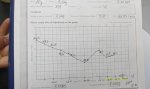
This is the in clinic curve that was performed 3 weeks ago, numbers will be higher because he was pretty stressed.
 

Attachments

  • IMG_20200421_193541.jpg
    IMG_20200421_193541.jpg
    61.5 KB · Views: 156
I have spoken to my vet on the phone today. He says Lantus is not liscenced for cats (in the UK?) but mentioned they they will sometimes use it in clinic. He is willing to provide me with a prescription for Lantus and source it for me provided I'm willing to sign a document accepting the risks of using the unliscenced insulin.

Otherwise we can try prozinc.
 
I'm going with Lantus.

My vet would like him to remain in clinic for the day so they can monitor him on his first lantus dose and perform a curve. He told me whether or not it will be 1 injection per day or 2 depends on how many hours after the injection he reaches his lowest blood sugar, they will determine this during his visit.

I'm going to end up with a few hundred U40 syringes I won't need that I'm happy to give away in a few weeks if the lantus sticks if anyone wants them.
 
I'm going with Lantus.

My vet would like him to remain in clinic for the day so they can monitor him on his first lantus dose and perform a curve. He told me whether or not it will be 1 injection per day or 2 depends on how many hours after the injection he reaches his lowest blood sugar, they will determine this during his visit.

I'm going to end up with a few hundred U40 syringes I won't need that I'm happy to give away in a few weeks if the lantus sticks if anyone wants them.
Hi,

great about Lantus, but don’t let him tell you once a day. Lantus needs to be administered every 12 hours so the depot gets replenished

http://www.felinediabetes.com/FDMB/threads/lantus-levemir-what-is-the-insulin-depot.72214/

The BG level will continue to be irregular if kitty only gets Lantus once a day no matter the dose. It just doesn’t last that and the depot will be continuously empty. I’m sure others here will say the same :cat:
 
Status
Not open for further replies.
Back
Top