? Is it normal for ketones to go from 1.5 (scary) to .4

Status
Not open for further replies.
Ketones are influenced by the food Smokey is eating, the fluids he is drinking and the insulin he is getting. That is why it is so important that we make sure they are eating and drinking and getting the correct dose of insulin.
 
I think Ann (@Ann & Scatcats) misread your post. Having ketones drop back to what may be trace levels is a good thing. And yes, ketone levels can change relatively quickly. Please stay diligent. Just like you saw the numbers drop, they can jump up quickly, too. I can't tell from the note on your spreadsheet if you took back-to-back readings. If you thought you had a bad reading or strip, I'd get another test.

Also, since you're using Lantus, you may want to start posting on the Lantus board. People are around 24/7 and there's lots of Lantus specific help available.
 
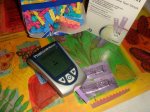
C32BEF4F-2098-4B31-B038-8FD35782AD1B.jpeg
Here is Abbott's Blood B Ketonmeter since 2008. Neither our Animal Hospital or I has missed a DKA Emerg with it.
 

Attachments

  • C32BEF4F-2098-4B31-B038-8FD35782AD1B.jpeg
    C32BEF4F-2098-4B31-B038-8FD35782AD1B.jpeg
    134.3 KB · Views: 242
I'm just going by my meter. .0- .6 is a normal reading with my blood meter. It's not "trace" it's normal. No action needed.
.6 - 1.5 is considered small to moderate. This is where on a urine strip it would be "trace". This is where they recommend frequent monitoring and looking for symptoms.
1.6 - 3 is high, seek immediate medical attention.

This is the same chart that can also be found here.
What is the name of your meter Juls? @Juls and Billy
Can you show the chart that goes with your meter please giving the ketone reading to be concerned about? Thanks
 
I'm just going by my meter. .0- .6 is a normal reading with my blood meter. It's not "trace" it's normal. No action needed.
.6 - 1.5 is considered small to moderate. This is where on a urine strip it would be "trace". This is where they recommend frequent monitoring and looking for symptoms.
1.6 - 3 is high, seek immediate medical attention.

This is the same chart that can also be found here.

I have a Precision Xtra Blood ketone meter. I'm just quoting myself so I don't have to type it again, because the above is what the booklet that came with the meter says, and the chart from the Diabetic Cat International article on ketones can be found at that link (and it says the same as my meter booklet). It's a good chart. It includes what to expect from a urine test strip compared to a blood meter reading.
 
I have a Precision Xtra Blood ketone meter. I'm just quoting myself so I don't have to type it again, because the above is what the booklet that came with the meter says,
@Juls and Billy What you are quoting for ranges is for humans, correct? If you look in the post on Blood Ketone Meters part way down under the picture, there is a link to a couple of articles that tested using the blood ketone meters on cats. The second article is about a study using the Precision Xtra and says blood ketones started to show up in cats at 2.55.
 
From what I read in the second article, they found the Precision Xtra to be very accurate for measuring cats until the cats got into range over 2.55. It is only 65% accurate for ketone level over 2.55. It is 94% accurate for levels under 2.55. Honestly, by the time a cat owner sees a reading anywhere near 2.55, they should be driving to the emergency vet anyway.
 
@Juls and Billy What you are quoting for ranges is for humans, correct? If you look in the post on Blood Ketone Meters part way down under the picture, there is a link to a couple of articles that tested using the blood ketone meters on cats. The second article is about a study using the Precision Xtra and says blood ketones started to show up in cats at 2.55.
And those links are as outdated as the thread we have about the correct fructosamine levels.

Idexx changed the ranges last year. Our article does not reflect those changes.
 
And those links are as outdated as the thread we have about the correct fructosamine levels.

Idexx changed the ranges last year. Our article does not reflect those changes.
What makes you say the papers on ketones are outdated? The papers on ketone levels in cats is based on research on cat ketones and have nothing to do with fructosamines. Other than the first one saying the cats in the study had "elevated fructosamine" and the ones in the second paper had "fructosamine above 340" which is still diabetic, regardless of Idexx changing their reference values for fructosamines. The main point is that ketones 1.5 and below as this caregiver was seeing may indicate trends and warrant repeat testing, but doesn't mean you should be on your way to the vet. We should use data on ketones levels in cats, not humans, for our furry friends.
 
We should use data on ketones levels in cats, not humans, for our furry friends.

Using your same logic Wendy, no one should be using a human glucose meter on a diabetic cat. After all, there have been pet specific glucose test meters since 2006. http://www.diabetesincontrol.com/ab...-glucose-monitoring-system-designed-for-diab/

And the components of feline blood are in different concentrations than in human blood. As there are with most animals versus humans. Yet we still tell people that human meters are "just fine to use with a cat." Often without pointing out the differences beyond telling people "the test strips are cheaper."

"Selection of an appropriate glucometer is important because devices designed for the human market are variably discrepant when used on canine and feline patients."
"Consequently, gluco- meters designed for use in humans tend to underreport plasma/serum levels in dogs and cats.18,19 When BG concentrations are high, this error has little clinical impact, but it becomes more significant when BG is below 200 mg/dl. This can have a critical impact on identification of the BG nadir and may result in inappropriate insulin dose reduction."

"Handheld glucometers targeted for veterinary use have appeared on the market. A species-specific code is used to adjust the algorithm for the patient in question, thereby improving reliability and accuracy. Pet owners should be encouraged to use a device that is validated and approved for the species in question. Peer-reviewed studies have supported the use of these monitors in veterinary patients.20,21"
source https://www.ncbi.nlm.nih.gov/pmc/articles/PMC3440050/

Other sources that list the discrepancies for human meters in various species, including monkeys.
https://www.ncbi.nlm.nih.gov/pmc/articles/PMC4865699/ 3 monkey species
https://www.ncbi.nlm.nih.gov/pmc/articles/PMC5875097/ mice
https://www.ncbi.nlm.nih.gov/pubmed/26442786/ cats and dogs
https://veterinaryrecord.bmj.com/content/167/12/438.long cats
https://www.ncbi.nlm.nih.gov/pmc/articles/PMC3440050/ cats monitoring methods

And do we ever mention that stress hyperglycemia can happen from a caregiver testing their cat at home? Rarely.

Nor should people be using urine ketone test strips (which test for acetoacetate) made for humans with a cat. Human urine and animal urine have different compositions. People should be using a veterinary product, such as VET 10 dipsticks.

Nor should they be using a human ketone meter (which tests for serum BHB) meant for humans with a cat. That study from 2012 you pointed to has this to say " In a previous study, it was shown that in cats a portable ketone meter was accurate for the quantitative measurement of β-HB concentrations <4 mmol/l.22 Values higher than 4 mmol/l β-HB concentrations were underestimated.However, data from the portable ketone meter tested cannot be extrapolated to other instruments; each portable device has to be evaluated individually."

DM is not the only disease that can produce ketones. CKD (chronic kidney disease), HyperT (hyperthyroidism), HL (hepatic lipidosis). https://www.ncbi.nlm.nih.gov/pmc/articles/PMC4913593/ (Study specifically excluded diabetic cats.)

So for someone with an overweight diabetic cat, who is slowly and safely trying to get their cat to lose weight, there may be ketones being produced as part of the catabolization of the excess fat. Any time a cat is not eating enough, and fat is being burned off to produce energy, ketones can be produced. Does this mean the cat is in DKA or might become DKA? Not necessarily.
 
Status
Not open for further replies.
Back
Top
