Hi all I m a new member not sure how to do this, the sugar cat is Patù and we discovered he was diabetic only recently 2 weeks ago. he is now on canin insulin but we should move to Lantus and he is eating Royal canin Diabetic dry and wet. How can I transition to a wet canned food low in cabs? thanks

You are using an out of date browser. It may not display this or other websites correctly.
You should upgrade or use an alternative browser.
You should upgrade or use an alternative browser.
Hi I m new...
- Thread starter Tiziana
- Start date
- Status
- Not open for further replies.

Nan & Amber (GA)
Member Since 2016
Hello and welcome!
If you haven't already, check out the two yellow stickies from Dr. Lisa Pierson on cat food and feeding. She has a document on Tips for Transitioning Dry Food Addicts to Canned Food in the second sticky, with lots of good ideas. Her food chart gives the info for carbs and calories for hundreds of foods. For a diabetic cat, you should choose foods with less than 10% carbs for everyday feeding.
VERY IMPORTANT: since you are already giving insulin to Patù, DO NOT do the food transition without home monitoring his blood glucose. Switching to a low-carb diet can lower BG by a hundred points (mg/dL) or more. That means that a "good dose" today might be much too much insulin after the switch to low-carb.
Where are you located? We can help with tips for both home-testing and food choices, depending on where you are.
If you haven't already, check out the two yellow stickies from Dr. Lisa Pierson on cat food and feeding. She has a document on Tips for Transitioning Dry Food Addicts to Canned Food in the second sticky, with lots of good ideas. Her food chart gives the info for carbs and calories for hundreds of foods. For a diabetic cat, you should choose foods with less than 10% carbs for everyday feeding.
VERY IMPORTANT: since you are already giving insulin to Patù, DO NOT do the food transition without home monitoring his blood glucose. Switching to a low-carb diet can lower BG by a hundred points (mg/dL) or more. That means that a "good dose" today might be much too much insulin after the switch to low-carb.
Where are you located? We can help with tips for both home-testing and food choices, depending on where you are.
Last edited:

Chris & China (GA)
Member Since 2013
Hi Tiziana!! Glad to see you over here from the Facebook group!! (For those of you coming in later, she's in Italy)
Here are some Tips on Transitioning for you to read
It's great that you're going to switch to Lantus! It's a much better insulin for most cats. How much Caninsulin are you currently on?
One thing to be sure to remember...do the food change slowly. If it's the Royal Canin Glycobalance, the canned is 14% carbs and the dry is a lot higher so you want to be home testing first before starting to change the diet. Some cats even become diet controlled once you switch to a low carb diet (less than 10%)
When you're ready to switch to Lantus, let us know so we can help you with a good starting dose.
Here are some Tips on Transitioning for you to read
It's great that you're going to switch to Lantus! It's a much better insulin for most cats. How much Caninsulin are you currently on?
One thing to be sure to remember...do the food change slowly. If it's the Royal Canin Glycobalance, the canned is 14% carbs and the dry is a lot higher so you want to be home testing first before starting to change the diet. Some cats even become diet controlled once you switch to a low carb diet (less than 10%)
When you're ready to switch to Lantus, let us know so we can help you with a good starting dose.

Welcome to FDMB!
I'm tagging one of our members who's in Europe (Spain). @Gill & George may be familiar with low carbohydrate foods that are available in the EU.
I'm tagging one of our members who's in Europe (Spain). @Gill & George may be familiar with low carbohydrate foods that are available in the EU.
Chris & China (GA)
Member Since 2013
low carbohydrate foods that are available in the EU.
I gave her the link to the food chart for the UK (and most of Europe) in the FB group so she has some idea's on what to look for
Hi Amber I m based in Italy so not sure how you can help but I m willing to be helped... if this makes senseHello and welcome!
If you haven't already, check out the two yellow stickies from Dr. Lisa Pierson on cat food and feeding. She has a document on Tips for Transitioning Dry Food Addicts to Canned Food in the second sticky, with lots of good ideas. Her food chart gives the info for carbs and calories for hundreds of foods. For a diabetic cat, you should choose foods with less than 10% carbs for everyday feeding.
VERY IMPORTANT: since you are already giving insulin to Patù, DO NOT do the food transition without home monitoring his blood glucose. Switching to a low-carb diet can lower BG by a hundred points (mg/dL) or more. That means that a "good dose" today might be much too much insulin after the switch to low-carb.
Where are you located? We can help with tips for both home-testing and food choices, depending on where you are.

I m having trouble in trying to test BG as Patù is not willing to have his ears pinched...how do yo do it?
thanks
Thanks I will read the notes now, I still have a month worth of canininsulin so I will finish that one and then start wit Lantus.Hi Tiziana!! Glad to see you over here from the Facebook group!! (For those of you coming in later, she's in Italy)
Here are some Tips on Transitioning for you to read
It's great that you're going to switch to Lantus! It's a much better insulin for most cats. How much Caninsulin are you currently on?
One thing to be sure to remember...do the food change slowly. If it's the Royal Canin Glycobalance, the canned is 14% carbs and the dry is a lot higher so you want to be home testing first before starting to change the diet. Some cats even become diet controlled once you switch to a low carb diet (less than 10%)
When you're ready to switch to Lantus, let us know so we can help you with a good starting dose.
he is doing 1.5 or 1.8 canin insulin, not sure it is correct because it's difficult to measure the correct amount from the sirynge.
thanks
yes thanks I can buy many from zooplus or bitiba!I gave her the link to the food chart for the UK (and most of Europe) in the FB group so she has some idea's on what to look for
I read the notes but my cat has no problem in eating can food as before he was mostly on a wet diet and kibble was there as he peased.Hello and welcome!
If you haven't already, check out the two yellow stickies from Dr. Lisa Pierson on cat food and feeding. She has a document on Tips for Transitioning Dry Food Addicts to Canned Food in the second sticky, with lots of good ideas. Her food chart gives the info for carbs and calories for hundreds of foods. For a diabetic cat, you should choose foods with less than 10% carbs for everyday feeding.
VERY IMPORTANT: since you are already giving insulin to Patù, DO NOT do the food transition without home monitoring his blood glucose. Switching to a low-carb diet can lower BG by a hundred points (mg/dL) or more. That means that a "good dose" today might be much too much insulin after the switch to low-carb.
Where are you located? We can help with tips for both home-testing and food choices, depending on where you are.
What I d like to know is how to move from Royal canin diabetic kibble to wet food again in concern with his diabetes...
thanks
Nan & Amber (GA)
Member Since 2016
Hi Amber I m based in Italy so not sure how you can help but I m willing to be helped... if this makes sense
I m having trouble in trying to test BG as Patù is not willing to have his ears pinched...how do yo do it?
thanks
The two most important things:
-- establish a routine. Set up a "testing area" of the house where it all happens, and get him used to it gradually. Start by just calling him over and petting him, letting him go. Then call him over and play with his ears a little, once he is used to that, then try poking. Try to stay calm-- if you are stressed, he will be too! Some people find that singing (even if, or especially if, you can't sing!) helps calm everybody down.
-- treats treats treats! Give him a treat he really loves, every time. Even if you didn't get a successful test, or even try. Soon he will associate the testing spot and the materials with the treat, and come running! I don't think they ever love the pokes, but they are very quick to learn that, if they sit still for a poke, they get something good!
When you do the poke itself, try to go in at an angle, so you don't just poke straight through. You are aiming for the edge of the ear, not on a vein. Here's a picture of the "sweet spot" you want to aim for:
Lots more information here: http://www.felinediabetes.com/FDMB/threads/hometesting-links-and-tips.287/
Nan & Amber (GA)
Member Since 2016
Oh! One more important thing: always apply pressure on the poke site after you have gotten the blood (use a piece of tissue or cotton round). It not only helps stop the bleeding quickly, it helps to prevent bruising. You can also apply a little antibiotic ointment to help healing.

Diane Tyler's Mom GA
Member Since 2018
You can get neosporin plus pain relief ointment, make sure its the ointment and NOT the cream
Chris & China (GA)
Member Since 2013
What I d like to know is how to move from Royal canin diabetic kibble to wet food again in concern with his diabetes...
If you're already giving insulin, do it slowly. The reduction of carbs in the diet can make a big difference in the blood glucose numbers.
Maybe give a little canned first with just a little kibble to go with it and gradually reduce the amount of kibble. Test often! Some cats are more carb sensitive than others
The two most important things:
-- establish a routine. Set up a "testing area" of the house where it all happens, and get him used to it gradually. Start by just calling him over and petting him, letting him go. Then call him over and play with his ears a little, once he is used to that, then try poking. Try to stay calm-- if you are stressed, he will be too! Some people find that singing (even if, or especially if, you can't sing!) helps calm everybody down.
-- treats treats treats! Give him a treat he really loves, every time. Even if you didn't get a successful test, or even try. Soon he will associate the testing spot and the materials with the treat, and come running! I don't think they ever love the pokes, but they are very quick to learn that, if they sit still for a poke, they get something good!
When you do the poke itself, try to go in at an angle, so you don't just poke straight through. You are aiming for the edge of the ear, not on a vein. Here's a picture of the "sweet spot" you want to aim for:
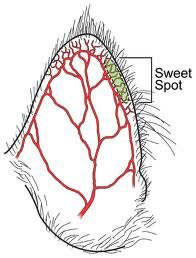
Lots more information here: http://www.felinediabetes.com/FDMB/threads/hometesting-links-and-tips.287/
Nan & Amber (GA)
Member Since 2016
How is Patù?
sorry I wasnt much on the internet lately..we are a bit confused we spoke to several vets and they say he may need to do further exams and investigations also about thyroid as from the blood test it seems there may be other issues apart from diabetis.
Still we cant manage to do home testing, the other day we took him to the vet to have the test done and he had 29 of glicemia which is very low and near a collapse. The vet administered sugar and water through the mouth... yesterday he was very still so I didnt do the insulin as the vet told me not to do it if I saw him very still or not responding.... today he was better and we did one unit of insulin but honestly I m not sure whether it would be best to take him to a vet clinic and have him checked completely 100% or else... it's a very difficult situation also because financially I m not in a good position right now and we already spent more than 400 euro or pounds if you like, dont know what to say...
Still we cant manage to do home testing, the other day we took him to the vet to have the test done and he had 29 of glicemia which is very low and near a collapse. The vet administered sugar and water through the mouth... yesterday he was very still so I didnt do the insulin as the vet told me not to do it if I saw him very still or not responding.... today he was better and we did one unit of insulin but honestly I m not sure whether it would be best to take him to a vet clinic and have him checked completely 100% or else... it's a very difficult situation also because financially I m not in a good position right now and we already spent more than 400 euro or pounds if you like, dont know what to say...

Ann & Scatcats
Member Since 2009
Ciao Tiziana! Come stai?
Io es Ann e Svedese.
We have another Italian with her diabetic cat here too.
Io es Ann e Svedese.
We have another Italian with her diabetic cat here too.
Nan & Amber (GA)
Member Since 2016
Still we cant manage to do home testing, the other day we took him to the vet to have the test done and he had 29 of glicemia which is very low and near a collapse.
Wow, that is absolutely terrifying! I hope he has recovered since then.
What kinds of problems are you having with the home testing right now? Maybe someone will have more ideas to help. I do think that home testing will help you a lot, both saving money and making sure that Patu is getting the right amount of insulin. With the food change, I am worried that he went so low at the vet-- it sounds like he may need a lot less insulin than he is getting. It's really hard to judge that just from outward signs (although that of course is better than just shooting no matter what!).

Deb & Wink
Member Since 2013
Sienne and Gabby (GA) has suggested that there are many more experienced users of Lantus on the Lantus ISG. You may want to think about posting over there.
Lantus / Basaglar (glargine) and Levemir (detemir)
Lantus / Basaglar (glargine) and Levemir (detemir)
- Status
- Not open for further replies.