

Matthijs
Member Since 2019
Last week I introduced Cedric and myself on the FDMB.
On November 2nd, we started giving Cedric 1,5 IU insuline (Caninsulin), twice a day. At 7:30 and at 19:30.
His response to insuline seems good. We measured his BG a few times, 4 hours after his morning dosage and we were happy to see a blood glucose level of 5,6 mmol/l.
More problematic is that Cedric appears to stay extremely hungry. With the exception of the short duration of peak insuline effect, he is constantly scavenging for bits of food.
Current diet: Royal Canin Veterinary Diet - Urinary S/O Moderate Calorie (dry food)
@07:30 - 24 grams
@15:00 - 16 grams
@19.30 - 24 grams
Total food: 64 grams per day. Cedric weighs about 5KG.
I must note that Cedric needs this special diet food because he had urinary bladder problems (struvite) in the past. We definitely don’t want to have those issues again, it was very painful for him.
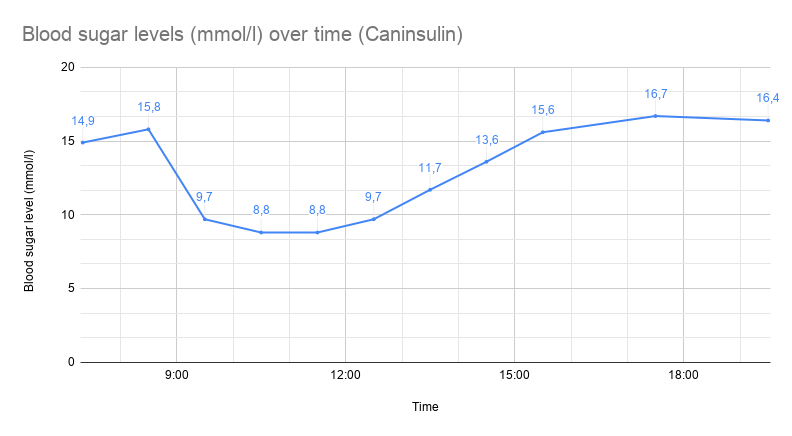
This is a day curve from last week, when we experimented with a lower insuline dosage of 1 IU. Currently with a 1,5 IU dosage, the lowest BG point measures 5,6 mmol/l instead of 8,8 mmol/l.
It does align with the behavior that we are seeing: After he finishes his meal, he continues to search for more food. It takes about three hours until he calms down and finds a cozy spot to lay in the sun (like any normal cat). At least one and a half hours before his evening meal, he starts crying and meowing loudly for food again.
Normally he would lie sleeping on a blanket for hours. Now the best he can do is to lie down on the blanket, but fully awake, with big eyes, waiting for someone to walk towards the kitchen and take a sprint to be first.
This evening Cedric is outside for the first time in weeks. I see that as a good sign, he must be starting to feel more comfortable.
Still I am curious what we can do to extend the duration of the acceptable blood glucose levels?
Much appreciated.
Oh, almost forgot: Cedric keeps drinking a lot of water as well. What can we do to check if he has acromegaly?
I read somewhere that 25% of the diabetic cats have acromegaly, so that worries me a bit.
On November 2nd, we started giving Cedric 1,5 IU insuline (Caninsulin), twice a day. At 7:30 and at 19:30.
His response to insuline seems good. We measured his BG a few times, 4 hours after his morning dosage and we were happy to see a blood glucose level of 5,6 mmol/l.
More problematic is that Cedric appears to stay extremely hungry. With the exception of the short duration of peak insuline effect, he is constantly scavenging for bits of food.
Current diet: Royal Canin Veterinary Diet - Urinary S/O Moderate Calorie (dry food)
@07:30 - 24 grams
@15:00 - 16 grams
@19.30 - 24 grams
Total food: 64 grams per day. Cedric weighs about 5KG.
I must note that Cedric needs this special diet food because he had urinary bladder problems (struvite) in the past. We definitely don’t want to have those issues again, it was very painful for him.
This is a day curve from last week, when we experimented with a lower insuline dosage of 1 IU. Currently with a 1,5 IU dosage, the lowest BG point measures 5,6 mmol/l instead of 8,8 mmol/l.
It does align with the behavior that we are seeing: After he finishes his meal, he continues to search for more food. It takes about three hours until he calms down and finds a cozy spot to lay in the sun (like any normal cat). At least one and a half hours before his evening meal, he starts crying and meowing loudly for food again.
Normally he would lie sleeping on a blanket for hours. Now the best he can do is to lie down on the blanket, but fully awake, with big eyes, waiting for someone to walk towards the kitchen and take a sprint to be first.
This evening Cedric is outside for the first time in weeks. I see that as a good sign, he must be starting to feel more comfortable.
Still I am curious what we can do to extend the duration of the acceptable blood glucose levels?
Much appreciated.
Oh, almost forgot: Cedric keeps drinking a lot of water as well. What can we do to check if he has acromegaly?
I read somewhere that 25% of the diabetic cats have acromegaly, so that worries me a bit.
Attachments
Last edited:





