

Caninsulin question

Status
Not open for further replies.

Tilou

Member Since 2018
Hi - I'd be interested in comments from anyone using Caninsulin three times a day, as they find it doesn't last 12 hours, on what's happening with Bob's glucose readings...

We've been using this regime for a couple of days now, dividing Bob's injections (from 3ui in morning, 2ui at night) into 2ui in the morning (around 6am French time), 2ui eight hours later (2pm), then 1ui at 10pm.

However on checking his blood glucose, four hours after his 2pm shot, yesterday and today, we've had readings of 19 and 23 mmol/l, respectively.

I thought that we'd see a dip in glucose levels by that time, especially as his last meal had been mid morning, so can't work out why it's staying so high.

I don't want to increase his next dose (1 ui at 10pm) in case of any problem overnight while we're sleeping.

Is this usual in newly diagnosed diabetic cats?

One thing to note, Bob is no longer spending any significant time at the water bowl and has become quite active again, spending time in the garden in the early hours on mouse hunts!
 
Welcome from neighbouring francophone Switzerland!

Less drinking and more active is indeed an encouraging sign :-)

I think it would be interesting to get a more close watch on his BG. Would it be possible for example to monitor every two hours for the whole day? Or get enough spot checks that a picture starts forming?

It helps to put all your measurements in a spreadsheet like this one: http://www.felinediabetes.com/FDMB/threads/fdmb-spreadsheet-instructions.130337/

This is what most people around here used and we're used to reading and interpreting numbers in that format. If you need any help setting one up just send me a PM (click on my name, Start Conversation). I have a French version but despite the France address you seem to be an English-speaker ;-)

A few questions that might give useful information:
- when was Bob diagnosed?
- did he develop diabetes following pancreatitis or cortisone use or any identifiable "cause"?
- what food is he eating?
 
Welcome from neighbouring francophone Switzerland!

Less drinking and more active is indeed an encouraging sign :)

I think it would be interesting to get a more close watch on his BG. Would it be possible for example to monitor every two hours for the whole day? Or get enough spot checks that a picture starts forming?

It helps to put all your measurements in a spreadsheet like this one: http://www.felinediabetes.com/FDMB/threads/fdmb-spreadsheet-instructions.130337/

This is what most people around here used and we're used to reading and interpreting numbers in that format. If you need any help setting one up just send me a PM (click on my name, Start Conversation). I have a French version but despite the France address you seem to be an English-speaker ;-)

A few questions that might give useful information:
- when was Bob diagnosed?
- did he develop diabetes following pancreatitis or cortisone use or any identifiable "cause"?
- what food is he eating?

Bonjour Stephanie

Thank you for your reply. We are Brits resident in France (near Calais), hence the use of English ;)

I've seen mentions of the s/s on the forum and having read through the link you kindly provided I will make a copy on my laptop to use. Unfortunately it would be quite difficult to get two hourly blood tests from Bob, as he retains an element of his feral nature that he arrived here with and it would be more likely that I'd be the one donating the blood!

I am though building up a picture of the effectiveness (or otherwise) of the insulin - although his three times a day regime has only been running for three days now - by taking the chance to do a test when he's sleeping. I have to use his pads as he does not like his ears being touched.

Bob was officially diagnosed only three weeks ago, although I'd had my suspicions since before Xmas. Unfortunately he was ill with an infection that masked the diabetes when we took him to the vet back in November, so was only treated for that. It was a weekend of incontinence in January that saw us back at the vet, where the blood test revealed his diabetes.

The cause was most definitely his being overweight. He weighed 8.5kg last January, so we'd had him on a controlled diet. By July he was down to 7.5kg, then in November he dropped to 6.5kg with an infection, but by January he was down to 5.5kg (again this rang alarm bells). He's now stabilised at 6kg.

Bob's always been principally a wet food eater, who takes a munch at some biscuits. The vet, naturally, played on our ignorance and sold us a bag of Royal Canin diabetes biscuits and decreed that was what Bob had to eat for the rest of his life! But he wouldn't eat them, so having found this forum, I discovered the recommended wet food and initially got him some Almo Nature tins and RC diabetes wet sachets, as that was the only thing locally available.

I have since ordered a variety of tinned low carb wet food (via ZooPlus) and both Bob and our non-diabetic cat, Joey, are happily testing the different varieties. Favourites are the Almo Nature (chicken and tuna) along with the meat varieties of the Integra diabetic range. They've turned their noses up at the Fine Food and Granata tins!

Apologies for the ramble - but hopefully this will give you an idea of how we're getting on. (Btw, husband is diabetic too, so I'm now watching the pair of them for potential hypos!)

Best wishes, Tilou
 
NOTE: I've just input Bob's data into the WRONG SS! Tried to copy and paste into the Worldwide one and it's a total mess. Blast!

UPDATE: SS now available. Please read the Remarks column as Bob's current insulin regime is three injections a day, not two as per the SS format. Thanks.
 
Last edited:
Well done on the spreadsheet! That will definitely help.

The problem you'll have with the SS is that it's designed for injections 12 hours apart. If you're doing three injections a day it would be good to try and make that visible on the spreadsheet by moving the PM columns to be at +16 and adding a +8 injection one in the middle. I'm not sure how to read it at this point.

Here we try to at least test before injecting insulin (like humans... you don't want to inject a cat whose BG is too low!), and try and get at least another test somewhere in the day, and do a curve every now and again (every two hours, though I'm not sure with caninsulin).

Completely appreciate the challenge of having a tricky cat to poke and having to balance that with how much data you want/need. Some ideas:
- have you been working on desensitising his ears? when he's relaxed or getting scritches, try and involve the ears. Stay below his "no way!" threshold and back off if you hit it, but continuing with the pleasant stuff. The worst part of testing for the cat is not so much the prick as the fiddling with the ears, but if you can work on that multiple times a day in tiny doses (baby steps), you'll probably be able to get somewhere
- are you treating after you test? this helps create a positive association. Most people have a small ritual. Same place, same sequence of events, ends with a lovely treat.

I don't have direct experience with caninsulin, so really not sure if people here have tried the 3x/day regimen or not. Hopefully some of the vetsulin/caninsulin people will chime in.

FWIW, if your vet is open to discussion, you might want to see if you can get him switched to ProZinc or Lantus/Levemir, where you'll manage with only two injections per day, and where (it seems to me based on hanging out here and doing some research) you'll get better results.

Caninsulin was developed for dogs. Cat metabolism is faster, so the effect of the insulin is often shorter, which is probably why you're on a three-per-day regimen.
 
Oh, forgot: are you familiar with bouncing? Keep it in mind when you see high numbers, that they could be there because they are following low numbers. Hence the interest in testing.

Quoting from a sticky in the LL forum:
  • Bouncing - Bouncing is simply a natural reaction to what the cat's system perceives as a BG value that is "too low". "Too low" is relative. If a cat is used to BGs in the 200's, 300's, or higher for a long time, then even a BG that drops to 150 can trigger a "bounce". Bouncing can also be triggered if the blood glucose drops too low and/or too fast.The pancreas, then the liver, release glucogon, glycogen and counter-regulatory hormones. The end result is a dumping of "sugar" into the bloodstream to save the cat from going hypoglycemic from a perceived low. The action is often referred to as "liver panic" or "panicky liver". *Usually*, a bounce will clear kitty's system within 3 days (6 cycles).
 
And another thing (goldfish brain day): usually the idea is to try and find a dose you can use consistently from cycle to cycle rather than varying greatly (4ui once, 1ui after). I think if you go to the caninsulin forum you might find instructions on how to deal with finding the right dose. It's also important to feed consistently over each cycle, as food input is the other part of the equation.

With caninsulin I think the best is to test and feed, then wait 20-30 minutes before shooting to make sure food is "on board".

http://www.felinediabetes.com/FDMB/forums/caninsulin-vetsulin-and-n-nph.19/
 
Thank you again for the information. Despite living with a human diabetic for 35 years I'm currently finding this whole experience a veritable mine field and very stressful :banghead:

I've tried to take a glucose test before Bob's 2pm shot and, despite having a good drop of blood, I had three strips come up with error! I'm really not impressed with my machine's failure on this, given the price of the strips, and am considering returning it and sourcing a cheaper human variety.

I tried to put an extra column in the SS to reflect the additional insulin shot, but failed miserably. I actually managed to corrupt my original copy of the SS :(

Our vet is good but he's not receptive to being questioned or taking on-board alternative suggestions. He falls into the stereotypical French man "I'm in charge, you know nothing" category. He sent us away after the follow up blood test last week with a "see you in a few months" after telling us to alter Bob's insulin according to our meter readings. I got the impression he was not happy with us home testing as that loses him €40 every time.

Interesting info re the "bounce". I'll have to ensure that is not what we are experiencing and try to get some more tests done - once I can resolve this meter/strip problem.

I will soldier on using the information you have provided.

Merci bien ;)
 
Courage et bonne chance!

You can use a human meter. I’ve heard ear is less painful than paw, so I’d work on getting friendly with those ears. Recipe for cats: lots of repeated small events that go well.

Humans vs cats: humans can tell you they are starting to feel off when they drop. Cats can go from fine one second, seizing the next. Also, more complicated to control the cat’s food intake than the human’s (normally...).

Sorry about your vet. I’m working with a group of francophones on this board, from France, and it seems caninsulin is the gospel and me vets are indeed quite firm in their beliefs. We had a kitty diagnosed diabetic right behind a pancreatitis without a fructosamine test. 1ui caninsulin morning and evening, don’t test, come back in a week. By the time we talked the C.G. into testing the cat was giving 0.9g/l whenever they tested. No, it’s not that the meter didn’t work, it was that the cat wasn’t diabetic, like we thought from the start. The vet actually said the meter had to be wrong — only to backtrack when he did a curve (er... line) at his clinic.

Not to bash vets, they need to know everything about everything and not just for cats, but it seems diabetes is really a poor parent here.

A French vet friend and I have been digging around for sources since Quintus was diagnosed, and honestly, we didn’t find much in French that was up-to-date (not surprising, most research is in English...). It saddens me once again to see what serious consequences a language barrier can have.

Sorry, got lost in my musings here!

Keep us posted on the progress and fiddle with those ears (while you do something pleasant, then treat!)
 
Merci!

I know how difficult it is here in France, as I've had to source all the equipment from the UK - even the urine strips. I can understand their protectionism, but it is a little frustrating. In general our vet is brilliant - he's had to deal with all eight of our cats over 14 years - but he is very set in his ways.

I shall have to try and get Bob used to having his ears played with. He's never been a "treats" cat, unfortunately. He arrived here as very nearly feral in 2006 and spent 5 years having to be kept separate from the other cats. Eventually we got him to integrate - as the others got older and no longer cared too much to defend their territory from him. We don't even really know how old Bob is, so we are just grateful for every day we have with him.

Love your musings - mine tend to be more on a par with ranting, LOL
 
Just venting my frustration...

Another two Alphatrak strips wasted! Plenty of blood from Bob's pad, but strips came back with error! I'm beginning to suspect I have a batch of "bad" strips. They are the ones that came with the machine, are dated July 2018. I have four left, only got 11 readings from the rest. I've made a request to the Amazon marketplace seller to see if I can return the machine. Really annoying as I've ordered a new pack of strips (ÂŁ50 for 50!) so I'll have to return them as well.

:mad:
 
I know how difficult it is here in France

Imagine Switzerland! Can't even get stuff shipped from http://www.vetboutiquedupiemont.fr -- cheapest AT strips I've found. Luckily I'm not far from the border and have friends on the other side.
He's never been a "treats" cat, unfortunately.
Is there anything he likes? A special scratch, rub, pet? toy? have you tried stuff like tiny bits of chicken?
Plenty of blood from Bob's pad, but strips came back with error! I'm beginning to suspect I have a batch of "bad" strips.
So, first thing, just to make sure because I missed the obvious for quite a while and it resulted in a lot of wasted AT strips: are you clear that the little pointy things on the side of the strips are designed to puncture the membrane of the blood drop? There is a tiny canal in them that aspirates the blood. Once I understood that it completely changed the angle with which I approached the blood drop, aiming to "lance" the drop with the pointy thing rather than "apply" the side of the strip to the drop. Tell me if it makes sense.
 
Wow, that is a better price for the strips given I've just ordered them from UK at ÂŁ47 + ÂŁ4 postage. If you ever need anything from here and your friends are unavailable to help let me know.

Bob is such a funny creature, he really doesn't have any little foibles that can be exploited, apart from a love of butter!

Re the strips, I've been putting the pointy bit right onto the blood drop and getting no reading. Then when I reset and try again the strip fails with the error message. I've had an email from the seller with a helpline number to call tomorrow, so am hoping they can resolve the problem.

I'll let you know how I get on :)
 
Thank you again for the information. Despite living with a human diabetic for 35 years I'm currently finding this whole experience a veritable mine field and very stressful :banghead:

I've tried to take a glucose test before Bob's 2pm shot and, despite having a good drop of blood, I had three strips come up with error! I'm really not impressed with my machine's failure on this, given the price of the strips, and am considering returning it and sourcing a cheaper human variety.

I tried to put an extra column in the SS to reflect the additional insulin shot, but failed miserably. I actually managed to corrupt my original copy of the SS :(

Our vet is good but he's not receptive to being questioned or taking on-board alternative suggestions. He falls into the stereotypical French man "I'm in charge, you know nothing" category. He sent us away after the follow up blood test last week with a "see you in a few months" after telling us to alter Bob's insulin according to our meter readings. I got the impression he was not happy with us home testing as that loses him €40 every time.

Interesting info re the "bounce". I'll have to ensure that is not what we are experiencing and try to get some more tests done - once I can resolve this meter/strip problem.

I will soldier on using the information you have provided.

Merci bien ;)
I see you use the Alphatrak. Be sure you are dipping the small protrusion off the edge where the black dot is. That's the straw that sucks the blood in. You don't put the drop on the dot, and you only use one side, not both.
 
Wow, that is a better price for the strips given I've just ordered them from UK at ÂŁ47 + ÂŁ4 postage. If you ever need anything from here and your friends are unavailable to help let me know.

Bob is such a funny creature, he really doesn't have any little foibles that can be exploited, apart from a love of butter!

Re the strips, I've been putting the pointy bit right onto the blood drop and getting no reading. Then when I reset and try again the strip fails with the error message. I've had an email from the seller with a helpline number to call tomorrow, so am hoping they can resolve the problem.

I'll let you know how I get on :)
Once the strip has touched blood you can't reuse it. You have like 30 seconds to add additional blood if you didn't get enough the first time.
 
Once the strip has touched blood you can't reuse it. You have like 30 seconds to add additional blood if you didn't get enough the first time.

Hi Janet - I've been dipping the pointy bit in the blood but nothing happens. If I do it again (even quickly to beat the 30 seconds) I get the error message. I shall be calling the company who sold me the machine today, as the strips were part of the starter pack and I suspect there's a fault in the batch. I've ordered a new pack of strips, which I hope will work.
 
Hi Janet - I've been dipping the pointy bit in the blood but nothing happens. If I do it again (even quickly to beat the 30 seconds) I get the error message. I shall be calling the company who sold me the machine today, as the strips were part of the starter pack and I suspect there's a fault in the batch. I've ordered a new pack of strips, which I hope will work.
And you aren't dipping until you see the little blood drop symbol on the screen, and you are holding it in place in the drop until you hear the beep, correct?
 
That's correct. I wait until the screen shows the blood drop symbol and then I hold it in place. So far only 11 of 21 strips have beeped and given me a reading. The rest have not beeped but given an error message.
 
Hello from a fellow Brit (in Surrey) - I try to at least say hi to UK newbies here and the clue was in the thread title... Caninsulin.... so you're not actually in the UK at present but many of us in the UK and mainland Europe have experience of working with it, so you're in the right place.

Forgive me if I've missed earlier info, but I would just say that three weeks after dx is not long at all to see appreciable progress in diabetes treatment. Yes, the insulin should be working, but it may take a while for a cat's system to adjust to exogenous insulin and you may not see the results you want or expect for a little while. It's excellent that you've got Bob on a wet diet though - that's a great head start and should make a difference to bg in itself.

It's very brave of you to attempt three times daily dosing - the times you've worked out seem very manageable - and I wish you the best of luck with that. Many people find it's tricky because if you get an unexpectedly low pre shot number it may throw you and you have to decide whether to dose then, not dose, or stall - in which case the routine goes out the window. My suggestion is to continue if that's what you've decided on, but don't get into a pickle with it if it doesn't quite work out - you can always switch to twice daily dosing which may or may not work for both you and Bob's bgs. It's true that Caninsulin doesn't usually last 12 hours in cats, but unfortunately there are no "definites" in FD and ECID (every cat is different) as we say here.

I sympathise with the issue of testing equipment and the concern of bad strips - it will be interesting to see what the helpline people say. Hopefully they'll send you another tub as a gesture of goodwill. Meanwhile you can always use a human meter as a temporary measure at least, to gauge what effect the insulin is having. It's a personal choice of course but at least with a human meter you might find it easier to obtain strips, and they're cheaper? The only thing of course is not to mix readings from both types of meter on your spreadsheet - it's one or the other. Sorry if this is obvious - it is I know, and you sound very clued-up already, but that's for the benefit of anyone else reading this thread (on which topic - that's what we try to do here, cover all bases, because some people do tend to "lurk" for a while before posting, so giving a full picture is for the benefit of everyone).

I think that's all I can say at the moment but just wanted to wish you good luck! Keep posting here - FDMB is a real goldmine of experience and working in conjunction with a good vet, can save lives and sanity!!

Diana
 
Hello Diana, thank you for your message - it is much appreciated.

We've been in France since 2006 and Bob joined us shortly after, as an abandoned cat who was on the verge of becoming feral. I think it was his survival instinct that has caused his insatiable desire over the years to eat everything he could (basically the food from our other seven cat's bowls) that resulted in his diabetes due to becoming overweight. If nothing else, his diagnosis has brought home the truth about the unsuitability of so many cat food products on the market!

Thankfully Bob has always been a wet food eater, so we haven't had to battle any change in feeding habits, apart from buying the low carb products recommended by others on this wonderful forum.

I did wonder if I was setting the goal a little high in thinking that we might see a quick response to the insulin. Probably because our vet suggested that after two weeks of Bob being on 2ui in the morning and evening he would look to lower the dosage to 1ui. I think the vet got a bigger shock than we did on Bob's return visit to see his BG had gone up.

I'm quite happy with the three doses a day regime (husband has been diabetic for 35 years) as we don't think the Caninsulin was effective after 8 hours. This was noticeable even before getting the blood meter, as Bob went back to hugging the water bowl as the effects of the insulin was wearing off.

Our vet is quite happy for us to increase and reduce dosage according to the readings we get and he laughed when we said about monitoring for the possibility of hypos, as he considers Bob's BG be be too high at the moment to worry about that. But having a husband who can have a BG reading in the 400s one minute and then be hypo-ing at 35 the next, we are being extra vigilant with Bob - hence my frustration at the strips failing.

I've had a message from the seller of the Alphatrak telling me to contact the USA help line (!!) and no offer of a replacement pot of strips. But I suspect it is the strips and have ordered a new batch - due for delivery next week, so with only three left I might have to resort to using hubby's meter (but won't muddle the numbers on the SS).

I hope our messages are helpful for any lurkers and that they dive in and join the conversation. The vast amount of information I have found on the forum is proving invaluable - as are those people, like yourself, who are all experiencing FD.
I appreciate all the help I've been given.

:bighug:
 
Hi again Tilou
Just one other thing ... I'm sure you know that all sorts of things can elevate blood glucose and give a "false" reading - vet stress (bg at the vet's is commonly higher than at home) as well as infections, commonly UTIs. I just wonder if Bob's initial dx and insulin dose was based on a single reading at the vet when he had a UTI, which prompted the vet to prescribe the higher than usual 2u starting dose? Most cats start on 1u and the dose is increased as necessary, not reduced. It is *possible* that the 2u is more than he needs and that could be causing a bounce and those very high numbers... I'm certainly not saying that this *is* the case but it's the sort of thing we mull over here and every now and then it turns out that a kitty is simply on a wrong starting dose... just something to think about!
 
I'll bear all this in mind, especially the "bounce" that was brought to my attention yesterday. I did wonder if the experience of being at the vet would elevate the results. Bob's original blood test threw up some very strange numbers!
 
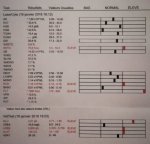
Bob's original blood test attached.
 

Attachments

  • IMG_20180120_205723.jpg
    IMG_20180120_205723.jpg
    53.2 KB · Views: 183
GLU 4.21 g/l => 421
Of course, silly me! I should have realised. So 421 in "non-US" numbers (ie what the rest of the world uses) is about 23, which certainly looks like a diabetic number BUT if Bob had a UTI at the time that number could be higher than it might have been if he hadn't had a UTI. But then I was only guessing at a UTI, diabetics are prone to urinary issues anyway with or without infection and obviously, if Bob was drinking a lot (def sign of diabetes) he's going to pee a lot too.

Sorry - just thinking aloud really. It seems as if the vet's dx was most probably right, but I'd still say the starting dose is too high. But then maybe that's how vets in France are taught, using a different system to the UK and other places we're used to hearing about here.
 
Last edited:
But I suspect it is the strips and have ordered a new batch - due for delivery next week, so with only three left I might have to resort to using hubby's meter (but won't muddle the numbers on the SS).
You know, most people here use human meters. If your hubby has a meter (does he have to pay the strips) you might just want to steal it for a bit. With the SS you're looking for trends. Pet and human meters get close on low numbers ("take action" for hypo prevention is 68 on the AT and 50 on a pet meter -- divide by 18 to get mmol/l). They diverge more with higher numbers. But mainly you're looking at the shape of the curve, and making sure your cat stays safe from hypos. If you use the human meter just put a big red block or something in the SS to indicate where the change is. (You can look at what I did with Quintus's for strip change, it's not pretty but it makes things visible.)
 
That's correct. I wait until the screen shows the blood drop symbol and then I hold it in place. So far only 11 of 21 strips have beeped and given me a reading. The rest have not beeped but given an error message.
Just know that is not the norm. I can count on one hand the number of times my alpha have me an error that was not user error.
 
Of course, silly me! I should have realised. So 421 in "non-US" numbers (ie what the rest of the world uses) is about 23, which certainly looks like a diabetic number BUT if Bob had a UTI at the time that number could be higher than it might have been if he hadn't had a UTI. But then I was only guessing at a UTI, diabetics are prone to urinary issues anyway with or without infection and obviously, if Bob was drinking a lot (def sign of diabetes) he's going to pee a lot too.

Sorry - just thinking aloud really. It seems as if the vet's dx was most probably right, but I'd still say the starting dose is too high. But then maybe that's how vets in France are taught, using a different system to the UK and other places we're used to hearing about here.


Just to say that vets in France do have their own way of doing things. Starting dose of 2ui am and pm changed to 3ui am and 2ui pm when second BG test was higher two weeks later. We were also told Bob had to eat Royal Canin biscuits only, no wet food - and he sold us a big bag, saying that our other cat, Joey, was not allowed to eat them, which he promptly wolfed down the minute I put them in Bob's bowl!
 
You know, most people here use human meters. If your hubby has a meter (does he have to pay the strips) you might just want to steal it for a bit. With the SS you're looking for trends. Pet and human meters get close on low numbers ("take action" for hypo prevention is 68 on the AT and 50 on a pet meter -- divide by 18 to get mmol/l). They diverge more with higher numbers. But mainly you're looking at the shape of the curve, and making sure your cat stays safe from hypos. If you use the human meter just put a big red block or something in the SS to indicate where the change is. (You can look at what I did with Quintus's for strip change, it's not pretty but it makes things visible.)

Hubby gets his strips free, so I might have a go with his meter, although the Amazon marketplace seller who sold me the AT is not going to refund, so I'm landed with it anyway.
 
Well, it's not our place to question a particular method of treatment just because we're not familiar with it, and doing so would only muddy the waters for you, Tilou. The way forward is probably to read here as much as you can to familiarise yourself with how all the aspects of treating FD come together (type of insulin, dose of insulin, food) and use that knowledge to discuss anything you're concerned about with your vet.

Have you read the beginner's guide to Caninsulin on that forum? It was updated only recently by a group of us here working together to make it as useful as possible to everyone.

And do keep asking questions. We are all rooting for you and hoping you can get those high numbers down soon.
 
I wondered that. Tilou, if you don't know - tbis test checks blood glucose over a period of two or three weeks, as opposed to a single spot test, and for that reason is used by vets as an indication of diabetes.

Hubby had one years ago :) but nothing even suggested on that front by our vet. There are cultural issues at play here. In general cats in France do not receive the attention that dogs do. On receipt of the original blood results the vet said Bob's kidney's were "very, very bad". Of course, with that diagnosis the vet also sold us a bottle of Semintra (€38), which we'd used before with a cat that did have severe kidney problems and only lived for two months after diagnosis. Needless to say I was devastated that Bob was going to endure the same fate.

However on checking the results back at home we could see his creatinine clearance was normal and there was nothing to indicate a problem with the kidneys - that's also when I find this forum, posted the results and members with animal veterinary backgrounds were able to tell me that they could not see anything indicating kidney problems either.

Hubby has monthly creatinine clearance blood tests and his comment was "I wish my results were as good as Bob's on that issue".

Unfortunately we have always been seen as a "cash cow" by the vet due to our attention to the health of our cats, which is not the norm within our local rural population.

Apologies for the gripe.
 
Well, it's not our place to question a particular method of treatment just because we're not familiar with it, and doing so would only muddy the waters for you, Tilou. The way forward is probably to read here as much as you can to familiarise yourself with how all the aspects of treating FD come together (type of insulin, dose of insulin, food) and use that knowledge to discuss anything you're concerned about with your vet.

Have you read the beginner's guide to Caninsulin on that forum? It was updated only recently by a group of us here working together to make it as useful as possible to everyone.

And do keep asking questions. We are all rooting for you and hoping you can get those high numbers down soon.


This forum is proving invaluable. Twenty years of owning nine cats and we are learning something new everyday.

Yes, I read the Caninsulin guide, which is excellent. I'd previously read the company's guide on their site but they tend to keep the info for the public quite basic and only allow veterinary professionals access to the nitty gritty (I was a researcher in a previous life and happily spend my days trawling for info on anything I'm interested in or need to know about).

Don't worry, I'll have plenty of questions (and moans) ;)
 
Hubby had one years ago :) but nothing even suggested on that front by our vet. There are cultural issues at play here. In general cats in France do not receive the attention that dogs do. On receipt of the original blood results the vet said Bob's kidney's were "very, very bad". Of course, with that diagnosis the vet also sold us a bottle of Semintra (€38), which we'd used before with a cat that did have severe kidney problems and only lived for two months after diagnosis. Needless to say I was devastated that Bob was going to endure the same fate.

However on checking the results back at home we could see his creatinine clearance was normal and there was nothing to indicate a problem with the kidneys - that's also when I find this forum, posted the results and members with animal veterinary backgrounds were able to tell me that they could not see anything indicating kidney problems either.

Hubby has monthly creatinine clearance blood tests and his comment was "I wish my results were as good as Bob's on that issue".

Unfortunately we have always been seen as a "cash cow" by the vet due to our attention to the health of our cats, which is not the norm within our local rural population.

Apologies for the gripe.
I get what you're saying - not an easy situation for you and such a shame that the vets don't understand that cats are as dearly-loved parts of the family as dogs. I guess you just have to plough on and inform yourself as much as possible as I suggested earlier so you are in the best position possible to communicate with the vet.
 
Whoo hoo! Just got my first urine strip test done for Bob. No ketones but was showing high glucose (qualifying the blood test I did half hour earlier, another high one at 32).

Sounds silly to be whooping at this but Bob is an outdoors cat and when I realised where he was heading I had to use a lot of stealth to follow him, slide a tray underneath then pour the pee into a pot. Tray was a hastily grabbed ice cream container lid (it was washed clean), pot was a lid from something of hubby's in garage. Bob was happily relieving himself onto a pile of wood shavings in the wood shed!
 
No ketones is great news and it's important to celebrate victories in the midst of the stress of all this. Now to attempt some more tests - use DH's meter and strips, I would - and try to collect enough data to form a picture of what the doses you're giving are doing.
 
Update on the AlphaTrak meter problem:

Have just come off the phone from Zoetis, the UK supplier. Great customer service (unlike the Amazon marketplace seller who has washed their hands of the problem). They did acknowledge that the strips in the starter pack had been "hanging around a bit", as they are only dated until July and said if they weren't stored correctly (extreme temperatures) that could cause a problem. But they thought it is more likely to be a machine issue than the strips. They will take a look at the machine (and replace if necessary) if it continues to fail with the new strips (due to arrive in the next few days).

Onwards and upwards!
 
Merci :) I did manage to get it all over my hands, but avoided spillage on my clothes! Now I know where he heads for I've got an appropriate tray and pot at the ready.

Also, I've just tested Bob on hubby's meter... 347 mg/dl, 19.2 mmol/L by my calculation - that's 5 hours after his 14h dose of 2ui.

He was 32.2 mmol/L this morning, 5 hours after his 6h 2ui shot. So seems to be moving in the right direction.

He's due 1ui at 22h to keep within the vets recommended 5ui per day.

The one thing we've realised is that the way we are currently allocating the 5ui over the three 8 hour periods might not be conducive to Bob's eating pattern. He is eating more during the late evening and early morning (wakes me at 4am, then 6am) than he does in the afternoon (virtually nothing as he sleeps most of the day) to a little munchie during the early evening before sleeping again until we go to bed, which is when he starts his night patrol.

I'm beginning to think that he should have 2ui in the evening slot (22h) to cover his eating through the night* before his 2ui shot at 6 in the morning, and reduce him to 1ui in the afternoon slot (14h) - although he's prone to these high 30s at around midday, which is why we've been giving him the 2ui in the 14h time slot.

Any thoughts on this conundrum would be appreciated.

*We've never had set feeding times for our cats, as empty bowls just meant I was up all night feeding whoever wandered in and started wailing, so even though the others have all gone OTRB, we continue to leave food out for Bob and Joey, a veritable "help yourself buffet" for grazing on.
 
When dosing twice a day, I think we usually try to make each "cycle" (from one injection to the next) the same: same amount of insulin, same amount of carbs in. I think caninsulin works best with proper "meals" before the injection.

Lantus or Levemir, which provide flatter curves, are (again, I think) maybe better suited to grazers.
 
food and insulin are the two sides of the equation. you need to balance the two. that means that as you control insulin, you do need to control the food to some extent, particularly with a shortish-acting insulin. It doesn't mean you need to force-feed the cat, but you need to know when he is eating what, either because he has patterns and you know them, or because you put down the bowl.
 
Again, thank you for the info - it could be the explanation as to why Bob's readings are so up and down. When we were trying to help him lose weight we tried to stick to a routine, but after so many years of grazing it was impossible. He would just go outside and feed off the wildlife!

Looks like we are going to have to have a chat with the vet.

Unfortunately hubby has been rushed into hospital about an hour ago (hence my sitting here online at 1 'o' clock in the morning!) as he has multiple health issues. I'm his full time carer so am having to balance looking after him and learning all about feline diabetes.

I think the ambulance medics thought I was mad when I said I wasn't accompanying him to the hospital because I had a diabetic cat to look after! Although hubby is not one to have me tag along anyway - he prefers me to stay put until he knows what's going to happen to him at the hospital. So if I disappear for a couple of days you know I've got my hands full o_O
 
Again, thank you for the info - it could be the explanation as to why Bob's readings are so up and down. When we were trying to help him lose weight we tried to stick to a routine, but after so many years of grazing it was impossible. He would just go outside and feed off the wildlife!

Looks like we are going to have to have a chat with the vet.

Unfortunately hubby has been rushed into hospital about an hour ago (hence my sitting here online at 1 'o' clock in the morning!) as he has multiple health issues. I'm his full time carer so am having to balance looking after him and learning all about feline diabetes.

I think the ambulance medics thought I was mad when I said I wasn't accompanying him to the hospital because I had a diabetic cat to look after! Although hubby is not one to have me tag along anyway - he prefers me to stay put until he knows what's going to happen to him at the hospital. So if I disappear for a couple of days you know I've got my hands full o_O
Wow you for have your hands full. Hopefully your husband will feel better soon so he can come home and that things settle down.
 
Update: hubby home from hospital but still on medication for infection.

I've also taken delivery of new strips for AT pet meter, which are working fine.

Bob's readings have been up in the 30s again, so taking into consideration vet's advice to increase the Caninsulin dose as necessary, I gave him 3x 2ui yesterday (2ui every 8 hours) and 2ui this morning. His reading after two hours was down at 16, now - 2 hours later - it's up to 28. He is due his next 2ui Caninsulin in 4 hours, so I suspect it'll be well over 30 by then. I'll try to get a reading in the hour before his insulin injection is due.

He's not going mad on the drinking of water (sticking to normal consumption), he's no longer incontinent, eating well and maintaining his weight at just about 6kg.

I don't see us getting his blood glucose down below 15 without upping the dosage of Caninsulin above the maximum recommended dosage for his size (6ui over 24 hours), which we're not prepared to risk.

I've updated his SS with the latest readings.
 
Glad to hear DH is home, one less thing to worry about!

Also good news that you have new strips so now you can do a few more tests when possible and get a better idea of how the doses are working. I'm trying to think of people here who have experience with TID dosing but can't pinpoint anyone offhand... I think it would help if someone could look at what's going on to at least give you some encouragement about the way forward... You're right to discount the possibility of giving a higher dose at the moment, but it may be that Bob is what we call a "big gulper", ie needs higher than "usual" doses of insulin to keep his blood glucose down.

I'm going to tag one of our very experienced UK members, @Critter Mom , who always gives sound advice and whose opinion I would trust. Meanwhile, it's good that Bob's clinical signs are improving.

Hang in there!
 
Status
Not open for further replies.
Back
Top