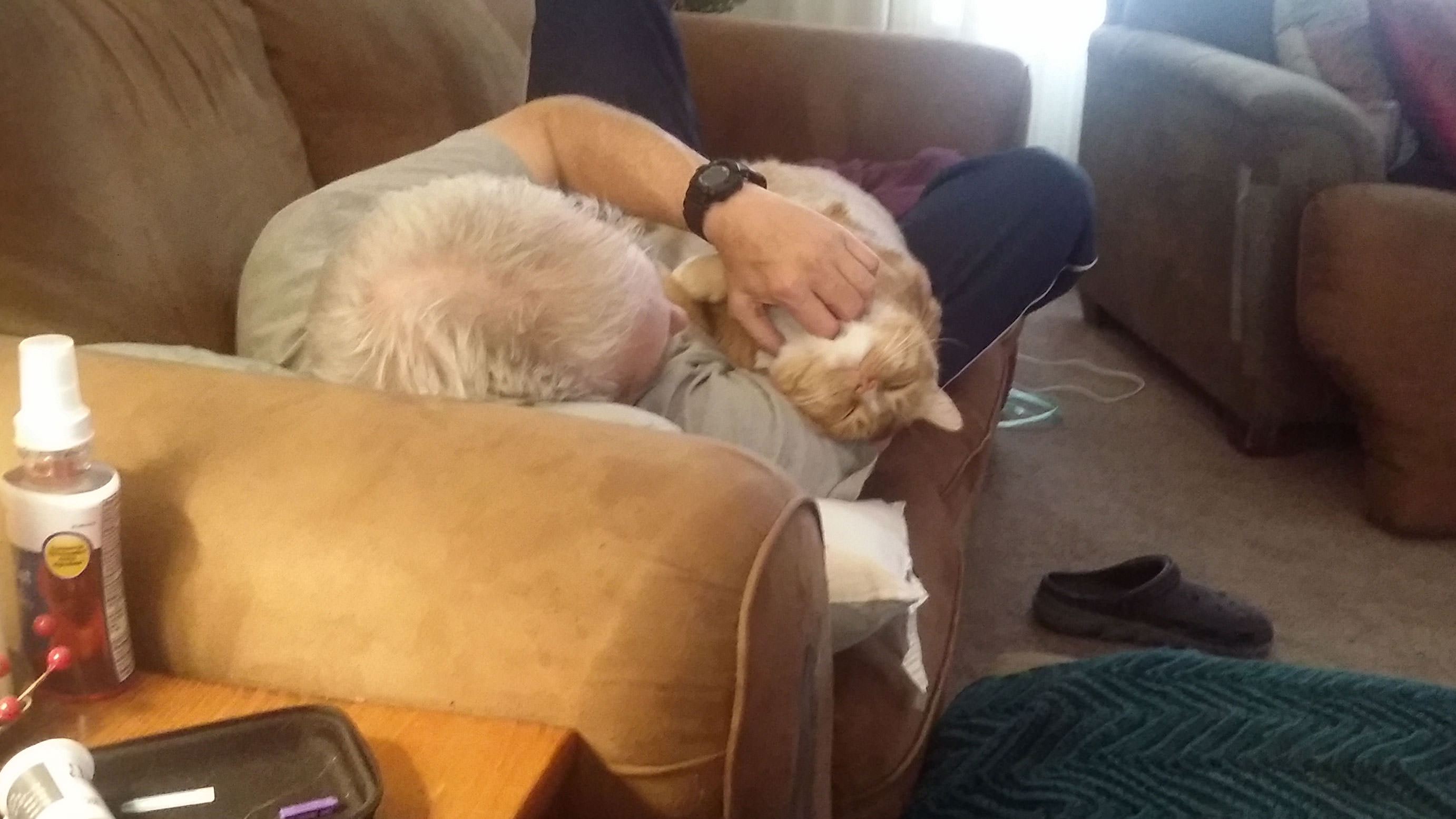
? It's a breakthrough!!!! Wilbur is letting me test!

Status
Not open for further replies.

johnt

Member Since 2016
I've been on this forum several times asking for help, telling people he refused to let me test him...

I suspected he had too much insulin one day and I thought 'heck with it' i'm doing it again for the umpteenth time.

I was able to position him right (it's easiest to wake him when he's napping. i don't do it when he's hard asleep). for the FIRST TIME he allowed me to prick his ear. I'll admit it took a couple pokes to get it but I got it! And now I'm to the point i usually get it the first try.

Since then i've got him to finally let me test. he still struggles sometimes but it's very minimal, and after i get the sample i put the tester down while it counts down and give hi m tons of attention, and I can tell he really likes it.

I also don't just run in to test. I position the strip almost all the way in, but just enough out to not activate. When it's time I push it in and while it's going through the motions i start petting. after a few seconds now he lets me. sometimes he still fights me, but in the last four days I've gotten a successful test. not one failure.

ANyway, i've been averaging about 5 tests per day, but i want to slow that down some. I need to get a feel for his levels.

I was definitely correct. When i started testing him I immediately cut him back 50%. Now I've got things under control i was looking for a blank spreadsheet you guys use. I used excel with a generic list.

I'd like to post my results but first I'd like to find the template again on Google Docs so i can fill mine out.

Can someone point me to that empty one?

Thank you! and I'm SOOOOO much happier now. no more stressing if he doesn't eat on my schedule for injections. no more wondering how he is.

No more runs to the vet to check him. no more glucose curves or fructosamines.

I feel like I've been liberated!
 
Wow! This is fantastic news! It's so great knowing you can keep an eye on his BG levels and do what it takes to keep him safe - and save some money because you don't have to take him to the vet. :D

Here's the link to the Google spreadsheet we use here:
http://www.felinediabetes.com/FDMB/threads/fdmb-spreadsheet-instructions.130337/
Perfect. Thank you.

I'm surprised at the spread of the results I'm getting but at least now I can a handle on his trends.

Thanks again!
 
Such great news!!!
I know it's a bit silly to be thrilled about this, but it's the first time in 6 years of testing that I can track it (i think it's 6 years).

I'm a bit surprised at my results.

I'm giving him VetSulin. Should I bet posting in that forum to go over his testing cycles? or is there a generic forum i should use?
 
I know it's a bit silly to be thrilled about this, but it's the first time in 6 years of testing that I can track it (i think it's 6 years).

I'm a bit surprised at my results.

I'm giving him VetSulin. Should I bet posting in that forum to go over his testing cycles? or is there a generic forum i should use?
You can write here in the main health forum or in the vetsulin forum.
 
I've got a question about the spreadsheet.

i finally got enough energy to do this (long story, had serious sleep problems).

I'm looking at the google spreadsheet and my own, wow, much different.

I don't know what the "AMPS" column is for and I assume "U" is for units dosed of insulin?

Wait, I see AMPS and PMPS, what does the "PS" stand for? i assume it's am/pm

The other issue is dosage. Wilbur has gone up substantially in frequency now. I'm worried. It seems his VetSulin is only lasting for about 8 hours and he's going way too high. So i need to figure that out. but it's causing my dosage times to not fit correctly in the spreadsheet. is that OK?
 
Last edited:
This will help:
http://www.felinediabetes.com/FDMB/threads/understanding-the-spreadsheet-grid.156606/

This is a whole new world now that you're testing his BG at home and will be logging the data on the spreadsheet. How did you determine the lack of duration of the Vetsulin without testing? Are you relying only on how he looks or behaves? Vet testing?

I strongly recommend you go with 12 /12 dosing for at least a week while you get used to this new way of doing things. Log all your BG test results on the spreadsheet and ask for help here to interpret them and decide on how to dose going forward. Here's the basic testing routine we recommend:

Here's how to approach finding the good dose range:
  1. test every day AM and PM before feeding and injecting (no food at least 2 hours before) to see if the planned dose is safe
  2. test at least once near mid cycle or at bedtime daily to see how low the BG goes
  3. do extra tests on days off to fill in the response picture
  4. if indicated by consistently high numbers on your SS, increase the dose by no more than 0.25 u at a time so you don't accidentally go right past a good dose
  5. post here for advice whenever you're confused or unsure of what to do.
As you can see it's very methodical in order to gather the most meaningful data and make safe dosing decisions.

I just had a look at the data you posted and you're right - the numbers are erratic,. The goal right now is to see if you can't settle him down by sticking with one dose AM and PM for several days, follow the testing routine I described above and log the data on the spreadsheet we use. It looks to me that some days you've given insulin only once and other days three times. Is this correct? If so that can be causing some of the crazy ups and downs you're seeing. I strongly recommend that you read this information about Vetsulin. It was put together by members here who are very knowledgeable about this insulin:
http://www.felinediabetes.com/FDMB/threads/beginners-guide-to-caninsulin-vetsulin.186099/

Re what dose to give: why not start again with 4 units twice a day as close to 12 hours apart as you can manage. You've jumped from 3 u to over 6 u and have dosed as little as once a day and up to 3 times a day. You need to simplify everything ASAP and gather the necessary data that allows good dosing decisions.

I also see that he gets some dry food too. If you can wean him onto low carb wet food only you might see better progress with his BG.
 
OK i read through this, I'm just unsure how I can only dose him once every 12 hours if it's starting to rise over 300 after only 8 hours. That's really the only question i have left.

FYI i am reading that document several times and understand the 8-12 hours.
 
Last edited:
OK, let's start with this:
upload_2018-2-5_16-36-0.png


This is a typical BG curve for Vetsulin given to cats. It's taken from the Vetsulin web page. Notice the dosing - twice a day at 12 hour intervals. Notice how the BG starts high, drops to its lowest value (the nadir) about half way between doses and then rises to a level similar to where it started. The nadir is about 50% of the beginning and end of cycle levels. This is an ideal curve. Most of the time a cat's actual curve will deviate from this for a variety of reasons.


Here's a curve showing insulin resistance, ie., the cat's BG stays high because he's not responding to the insulin properly. One common reason for that is the high BG has impaired the ability of the cells to respond to insulin. The high BG can happen if a dose is too low but also if it's too high (causing "bouncing") - more on that later:
upload_2018-2-5_16-43-23.png


Here's a curve showing lack of duration of the insulin. At this point you can't be sure that's what's going on with your kitty:

upload_2018-2-5_16-45-0.png


Here's a curve that shows the rebound effect that can happen if the BG drops too low or too fast. It doesn't even have to be too low, just lower than usual:

upload_2018-2-5_16-46-29.png


There's a lot of great info on the Vetsulin website:
http://www.vetsulin.com/vet/Cats_Monitoring_About.aspx

1st, my vet said never to give him insulin unless his blood was over 250.
I agree with this if you're using an pet meter. If a human meter, we'd say 200. Vetsulin has the ability to drop BG hard and fast and you need enough "room" at the start for the nadir to not be too low. Ideally a nadir in the range of 90 to 110 is what you want.

I also thought anything over 300 was too high. If you notice, my dosing was done when it was really high.
There's much greater immediate danger in BG falling too low than there is in it being high as long as the highs aren't a constant day in and day out. Highs within a cycle that also has a good low aren't a problem.

I've been afraid to wait to 12 hours because it's getting so high. I am paranoid for this little guy. he started having seizures when I was in arkansas and at a really bad vet (didn't know this at the time). They had me dosing him every 12 hours and 10u each time.
Giving insulin every 12 hours is the easiest routine to follow in the long term. You can't chase the BG and dose when it rises above 300 because your dose schedule will be erratic and the danger of overdosing is higher. The single most common cause of seizures in a diabetic cat is hypoglycemia NOT high BG. I have no idea how that 10 u dose was arrived at but I can say it's dangerously high. There are a few medical conditions that can cause a cat to need a high dose of insulin but most who don't have these conditions will need on average 1 to 3 units twice a day. There are a few that will creep up to about 4 or 5 units twice a day.

Back to the topic (i'm bad about that). I started marking his seizures in my outlook calendar. he had two in one day on 5/8/2015 and another on 5/28/2018

That's when that vet told me to put him up to 10u 10u after doing a glucose curve. Previously they had me on 4u am and 2u pm. But those seizures kept up. (I would say he's had 10 overall).

When i raised him he hasn't had a seizure for 2.5 years now. I'm terrified of him having more. they're so hard on him. he's knocked both his upper canines out in different seizures and i can only catch him about 20% of the time. when I do i put him on a tiled floor and hold his body to the floor so he doesn't flail around. but if i'm not in the room i don't see it.

On the face of it seems your cat has likely been overdosed and that's probably the reason for the seizures. We can't possibly know what those huge doses were doing without seeing a spreadsheet of data but my best guess is repeated episodes of hypoglycemia.

If I dose him at say 8am and I check his sugar at 4pm and it's 350 isn't it going to skyrocket if I wait another 4 hours?
Maybe, maybe not. If the Vetsulin isn't lasting long enough that might be true. It's also possible that he dropped fast or low or lower than usual in the hours before that late afternoon test and he's "bouncing" as we call it - rebound hyperglycemia like that graph above.

but if it was 250 or higher the vet told me to give him 4.5 and adjust if it went higher.
Correct me if I'm wrong but this sounds as though you'd dose before the 12 hours were up if the BG had already risen to 250 within a cycle. We wouldn't recommend doing that. Rather, stick to 12/12 dosing, test as per the outline I gave you in my previous post, log the data on the spreadsheet we use here, collect data for several cycles at a dose then evaluate to decide if the dose needs to change. The only exception is if you test and get a BG under 50 if you're using a human meter to test (under 68 on a pet meter). That's an immediate dose reduction. If several days' data shows nadire lower than 90 but higher than 50 a reduction might also be needed to give you that cushion of safety that kitties on Vetsulin need.

So some guidance on that, i'd much rather dose him 12/12 but feared those high num bers
Again, you seem to be under the impression that the high numbers are the ones to worry about. In the longer term, yes, but in the short term no. It's the very high insulin dose that likely has caused symptomatic hypoglycemia (seizures) that is the immediate danger.

Here's an explanation of bouncing (AKA rebound hyerglycemia):
  1. BG goes low OR lower than usual OR drops too quickly.
  2. Kitty's body panics and thinks there's danger (OMG! My BG is too low!).
  3. Complex physiologic processes take glycogen stored in the liver (I think of it as "bounce fuel"), convert it to glucose and dump it into the bloodstream to counteract the perceived dangerously low BG.
  4. These processes go into overdrive in kitties who are bounce prone and keep the BG propped up varying lengths of time (AKA bouncing).
  5. Bounce prone kitty repeats this until his body learns that healthy low numbers are safe. Some kitties are slow learners.
  6. Too high a dose of insulin can keep them bouncing over and over until the " bounce fuel" runs out and they crash - ie., have a hypo episode. That's why we worry so much about kitties that have had too high a starting dose prescribed by the vet and the owner isn't home testing.
  7. Many vets have little/no understanding of the bouncing phenomenon.
So, in summary, here's what we would recommend that you do now that you're testing:
  1. Do your testing strategically according to that schedule I gave you above. Try to show when those extra doses were given on a day where you did that.
  2. Set up the spreadsheet we use here and enter any/all data you have since you've begun testing.
  3. Go back to 12/12 dosing right way
  4. Drop the dose to 4 u right way. If it's too low we can advise on how to raise it quickly but safely.
  5. If the 4 u dose isn't dropping him too low at nadir, keep it for at least 3 or 4 days to get a set of baseline data as a reference.
Does this seem workable to you? Questions? We're here to help.
 
Last edited:
I had a long response all written out but Wilbur stepped on my keyboard when i had it all selected and it deleted it all :) He's good for that.

Anyway, I'm holding. it's not easy since right now i'm +11 and it's 389 but i'll wait.

Since I'm posting about him here's him a couple hours ago being spoiled

Svvt0qB.jpg
 
Here's a question.

Since my testing was erratic as i started on the 30th, the times don't fit in the chart well because they're based on just am/pm dosing.

Should I just start charting where I am now since i started doing 12 hour intervals yesterday?
 
Here's a question.

Since my testing was erratic as i started on the 30th, the times don't fit in the chart well because they're based on just am/pm dosing.

Should I just start charting where I am now since i started doing 12 hour intervals yesterday?

By all means start there if that's easier for you. I'm glad you'll be using the spreadsheet because it'll make it easier for us to give our input if you have a question. :)

I see your spreadsheet with a few BGs on it. I think you might have accidentally entered that blue 182 at +4 in the wrong box. Also check the dates - tomorrow is o2/07/2018. That blue number is pretty good. Stick with 4.5 u for a couple of days.

Another useful bit of info to include: if you could add what meter you're using to your "signature" (the light grey text under your posts) that would help us to assess your spreadsheet better. It's especially important that we know whether you're using a human or a pet meter.
 
OK I'll do that. Not sure what you meant about wrong entry though. Did I do this wrong?

I stabilized him at 9am/9pm I gave him a test last night at 10PM but I had already given him a shot, then went to bed. i've been sick so i way overslept Then a dose of 4.5 and 9am this morning with the reading at that time. and i tested him just a bit ago, so i rounded up and put it at +4

If I'm doing that wrong let me know. the dates should be accurate, no?

I'm using a old tester because the strips are expensive for me. TRUEtrack human meter. I use it, know it's old, but strips are $16.00 for 100 so it's reasonable. It uses the old coded tabs and takes 10 seconds to read, but I don't really care about that. is that OK?

EDIT:
Wait I think i see. I started charting when I gave him the shot last night. So he's only had one test since then. I figured i might as well just start there

EDIT 2.
nevermind i see it. i'll fix it when i get home
 
Last edited:
I was able to position him right (it's easiest to wake him when he's napping. i don't do it when he's hard asleep). for the FIRST TIME he allowed me to prick his ear. I'll admit it took a couple pokes to get it but I got it! And now I'm to the point i usually get it the first try.


I feel like I've been liberated!

and you have been :D Well done you. It's not easy is it but you have got there. :cat:
 
and you have been :D Well done you. It's not easy is it but you have got there. :cat:
well thank you!

Here's my stress though.

I'm told to wait to 12 hours. how do i do that now? 9.5 hours post and he's at 456. I shouldn't worry that he could go into a seizure? This is normally where I'd give him some.

look at sheet for today. it's scary!~ it's been driving me nuts.

I wouldn't worry so much but he's had several seizures in the past (over 2.5 years ago)

EDIT: see this is why I say he's showing that top bad curve.

take a look at his chart. I don't even see how it's possible to drop 300 points in one hour.

this just doesn't look right to me and leaves me stumped

this makes me think this is what's happening. Doesn't this mean I'm giving him too much? shouldn't I see it much lower in the early hours?

upload_2018-2-5_16-46-29-png.34055
 
Last edited:
and you have been :D Well done you. It's not easy is it but you have got there. :cat:
Since I'm new to this I need some help (if you don't mind)

Looking at your chart, I don't understand what this mean?

chart.png


I'm trying to understand how to correctly fill this out.
 
9.5 hours post and he's at 456. I shouldn't worry that he could go into a seizure?
No, a high number won't cause a seizure. A very low number ( well below 50 on a human meter) could cause one. I looked at your numbers and they are strange. The pink and reds seem out of place. Did he eat some high carb food around +6 or +7? Other high carb contraband? Are you sure your meter is working correctly and the test strips are well before their expiry date? You could try to test your own blood sugar to see if it falls in the normal range, assuming you're not diabetic yourself.
this makes me think this is what's happening. Doesn't this mean I'm giving him too much? shouldn't I see it much lower in the early hours?
You don't have enough data yet to know what's really going on. We'd like to see at least three or four days of data while you're following a structured testing routine and keeping the same dose on a 12/12 schedule before making any assessment of what needs to happen next. If his BG at the 12 hour mark (just before his next dose) is still low-ish (mid to high 100s) post here for advice.

Re the spreadsheet entries above that you don't understand: if BG tests are done close together (eg. 15 minutes apart) both results can be entered in the same cell on the spreadsheet. An example of what the notation means is "at +4.5 hours after the shot the BG was 90".

Please take some deep breaths and try not to panic. I know you had some frightening experiences when your vet recommended a scary high dose and you weren't testing at home. Everything we recommend here from testing on a schedule, being methodical, keeping a spreadsheet, etc. is aimed at preventing these situations from happening.
 
Last edited:
boy this is just so bizarre. my last vet told me the seizures were due to the glucose going very high. They said it was 550 when i took him in right after the last one. They were always happening around +9 but like I was saying, this was back when I was only giving him 4u am 2u PM

that's the only reason I was worried about it. The seizures stopped completely when I moved to 10/10 @12.

I have two of these meters, and test them on myself and even others. the numbers all look right. that's what seems so strange. I even have a new 'one touch' meter and the numbers vary sometimes 15 digits but are close enough to understand trends.

Also, the strips are good until 7-13-2019 according to the tube

I'm going to get a different kind of tester. But can you tell me how often I should be testing? right now i'm worried I'm testing him too often and he'll get irritated, but i want to get as much data as you need.

Sorry for my exasperation, my old vet had me so scared to let it get that high.
 
Last edited:
boy this is just so bizarre. my last vet told me the seizures were due to the glucose going very high. They said it was 550 when i took him in right after the last one. They were always happening around +9
There are many unregulated cats here who have occasional numbers so high the meter won't give a numerical result, just a "HI" reading. What can happen if the cat is in high numbers day in and day out is that they can develop ketones in their blood and if that's left untreated it can develop into a serious complication called diabetic ketoacidosis. The symptoms for that aren't seizures but lethargy, lack of appetite, etc. It's possible that your cat's BG dropped extremely low on one of those occasions, triggered an episode of hypoglycemic seizuring and by the time you got him to the vet his BG had rebounded very high. Only speculation on my part ...

Your meters are likely OK. I'll ask again: did he eat some high carb wet food or kibble in the +6 or +7 time frame? Those numbers look like a carb spike.
 
Oh i'm sorry. He didn't eat anything out of the ordinary. He does eat dry food. Hills Prescription Diet W/D but i know dry is bad. He just grazes.

Problem is i have 3 cats and it is so difficult to manage feeding them separately. so i just put all the cats on that for their dry.

Wilbur also gets some of the meow mix simple servings tuna with salmon or tuna with shrimp twice per day. He would eat tuna in water any time if I fed him that.

But I see no difference in his eating during that last time.

Finally, his dose is due in about 20 minutes. I'll test him then and see if I can hold off a few to dose him again.

This makes me so angry at that last vet. they told me so many incorrect things.

also, again let me know how often i should test him tomorrow so i can get enough, but not do too much
 
Here's the testing routine I described above in an earlier post:
  1. test every day AM and PM before feeding and injecting (no food at least 2 hours before) to see if the planned dose is safe
  2. test at least once near mid cycle or at bedtime daily to see how low the BG goes
  3. do extra tests on days off to fill in the response picture
  4. if indicated by consistently high numbers on your SS, increase the dose by no more than 0.25 u at a time so you don't accidentally go right past a good dose
  5. post here for advice whenever you're confused or unsure of what to do.
It's important to withhold food at least 2 hours before your AM and PM pre shot tests. You need to know what the BG is without the influence of food that can raise it. This is needed so you can judge whether it's safe to give insulin. Until you have more data collected on your spreadsheet, you shouldn't give insulin if he's below 200 on a human meter. If it's right on the margin post here for advice. As you get to know Wilbur's responses to Vetsulin better (by testing and keeping your spreadsheet up to date) you might be able to lower the "no shot" number a little.

Re feeding three cats: have you given any thought to switching all three to low carb wet food? feeding them in separate rooms on a set schedule?
 
If you're at home during the day and while you're working on building a clearer picture of Wilbur's BG levels try this:
  • pre shot test AM and PM - essential! (no food 2 hours before each)
  • two tests somewhere in the middle part of the cycle but vary them day to day - eg. +3 and +6 one day, +4 and +7 another day, +5 and +8 on yet another day
  • one before bed test every day.
The goal is to get a scattering of BG tests that build up a profile over time. You're looking for overall patterns and have to ignore odd-looking numbers unless they're dangerously low. Don't panic at any high numbers you get!
 
OH i'm sorry, i thought you meant a different testing than those for the first time span. I apologize.

I just tested him now and he's at 343 that's what doesn't make sense. but i'll give him his typical 4.5 right now and tomorrow I'll test him only once mid cycle each time but before both dosage times.

Sorry

EDIT: you replied while I was typing. Ok i'll do that. i'll give him his 4.5 now.

i don't know how well he'll enjoy withholding food 2 hours prior but I'll figure it out

And yes i'm home during the day. I work from home
 
Last edited:
OH i'm sorry, i thought you meant a different testing than those for the first time span. I apologize.

I just tested him now and he's at 343 that's what doesn't make sense. but i'll give him his typical 4.5 right now and tomorrow I'll test him only once mid cycle each time but before both dosage times.

Sorry
OK. That 343 is certainly high enough to give him the same dose. Numbers will only make sense once you've built up enough of a data base on your spreadsheet. I know Wilbur was diagnosed a while ago but you're only now beginning a structured monitoring program so it's almost like his diagnosis was a week ago.

Keep this dose for now because there's nothing in the data you have so far to indicate it's too high.

Check your dates column on your spreadsheet: you have two dates of 02/06/2018. Might be confusing later on.
 
OK. That 343 is certainly high enough to give him the same dose. Numbers will only make sense once you've built up enough of a data base on your spreadsheet. I know Wilbur was diagnosed a while ago but you're only now beginning a structured monitoring program so it's almost like his diagnosis was a week ago.

Keep this dose for now because there's nothing in the data you have so far to indicate it's too high.

Check your dates column on your spreadsheet: you have two dates of 02/06/2018. Might be confusing later on.
I can't believe this. I completely misunderstood that chart and how to fill it out.

I will correct it and get it squared up before I go to bed. it'll be corrected in the morning.
 
If you feel like poking him once more tonight, get a +2 test. Those can often give a hint of what the rest of the cycle will be like. If the +2 is the same or higher that the pre shot test there won't be much happening in the cycle - ie., business as usual. If the +2 is quite a bit lower, say 50+ points, it can be a sign that the nadir might be lower than previous cycles.

Important: did he have food shortly before the pre shot test of 343?
 
If you feel like poking him once more tonight, get a +2 test. Those can often give a hint of what the rest of the cycle will be like. If the +2 is the same or higher that the pre shot test there won't be much happening in the cycle - ie., business as usual. If the +2 is quite a bit lower, say 50+ points, it can be a sign that the nadir might be lower than previous cycles.

Important: did he have food shortly before the pre shot test of 343?
i can test him +2
yes I did fee him. I never dose without him eating. ever

I expect the +2 to be close to the 343 but we'll see.

as to the other question, i was just looking at the chart wrong, i thought I start over now, i just need to go to the right. same row, for the PM side. I get it.

dates should be right
 
i can test him +2
yes I did fee him. I never dose without him eating. ever

I expect the +2 to be close to the 343 but we'll see.

as to the other question, i was just looking at the chart wrong, i thought I start over now, i just need to go to the right. same row, for the PM side. I get it.

dates should be right
To clarify, the sequence is:
  1. take all food away for 2 hours before the pre insulin BG test
  2. test BG
  3. feed
  4. wait 20-30 minutes for food to hit bloodstream (because Vetsulin goes to work quickly)
  5. give insulin shot.
 
Kris, you're on your A game! Just stopping by to lend some support. My cat is one of those unregulated cats that have spent months above 400 or 500! He has never had a seizure. Kris has given you excellent guidance. Congrats on home testing! I'm shocked at the 10 unit dose he was on! My cat is a high dose cat but he started at 1 unit and increased very slowly in dose. His old vet prescribed 7 units and it would have killed him if we didn't find FDMB.
Chuck had a similar issue with the dose not working long enough and getting back up onto the 400/500 range for every shot. Once his body has a chance to settle down you might see him level out a little. I think you're in good hands here!
 
To clarify, the sequence is:
  1. take all food away for 2 hours before the pre insulin BG test
  2. test BG
  3. feed
  4. wait 20-30 minutes for food to hit bloodstream (because Vetsulin goes to work quickly)
  5. give insulin shot.
Correct. that's the sequence I did.

+2 after the shot was as expected. 353.

I think part of my issue might be misunderstanding and something I did not mention.

when i had him on with the other vet they were prescription ProZinc. in Oct 2016 I moved, and selected a new Vet which told me he owned a diabetic cat and he preferred Vetsulin. I didn't care, but I did remember that ProZinc took awhile to take affect (at least that's what they told me). I wasn't told that Vetsulin is different than that so i didn't know it was fast acting.

Anyway, he's about the same at +2 as he was pre shot. I have to go to bed now so i'll test him again when I get back up.


Kris, you're on your A game! Just stopping by to lend some support. My cat is one of those unregulated cats that have spent months above 400 or 500! He has never had a seizure. Kris has given you excellent guidance. Congrats on home testing! I'm shocked at the 10 unit dose he was on! My cat is a high dose cat but he started at 1 unit and increased very slowly in dose. His old vet prescribed 7 units and it would have killed him if we didn't find FDMB.
Chuck had a similar issue with the dose not working long enough and getting back up onto the 400/500 range for every shot. Once his body has a chance to settle down you might see him level out a little. I think you're in good hands here!
See there is so much I keep hearing from my previous vets, new vet, then forums. I was explicitly told that the 12 seizures Wilbur had were due to high glucose levels. For 6 years I thought that's what the problem was, so once it started getting over 450 I began to panic. it was so hard on him.

Once I get here i learn the truth, it was the opposite. LOW sugar that likely caused it.

that's all. I've been frantic and he still doesn't like all this testing stuff. But now i have a process and i'll stick to it and get this sorted. it just floors me how his insulin can go from 438, in one hour read 130 and in the next hour go to 450. So it's very confusing for me.

Had I realized it was LOW sugar that was causing his seizures, not HIGH, none of this panic i've had for years would have been there.
 
Re the spreadsheet entries above that you don't understand: if BG tests are done close together (eg. 15 minutes apart) both results can be entered in the same cell on the spreadsheet. An example of what the notation means is "at +4.5 hours after the shot the BG was 90".

Thank you @Kris & Teasel .

Sorry @johnt . I didn't see your post before I left home. I had to go and collect Tyler from the vet clinic.

My cat Tyler is on Lanctus , not Vetsulin .

You've been given excellent guidance by Kris & Teasel. It is very hard but you are in safe hands here and together with this you can work with your vet to help your cat.
 
Had I realized it was LOW sugar that was causing his seizures, not HIGH, none of this panic i've had for years would have been there.

I hate to throw a screw in the works and make you any more confused or worried than you already are, but both high and low blood glucose can cause seizures.

They are more common due to low BG, but very high numbers can cause seizures too

http://catguide.com/seizures-in-cats/
 
it just floors me how his insulin can go from 438, in one hour read 130 and in the next hour go to 450. So it's very confusing for me.
I had a hard time wrapping my head around this in the beginning. Sometimes even now!!
 
I hate to throw a screw in the works and make you any more confused or worried than you already are, but both high and low blood glucose can cause seizures.

They are more common due to low BG, but very high numbers can cause seizures too

http://catguide.com/seizures-in-cats/
I hate to throw a screw in the works and make you any more confused or worried than you already are, but both high and low blood glucose can cause seizures.

They are more common due to low BG, but very high numbers can cause seizures too

http://catguide.com/seizures-in-cats/
I wonder what the actual incidence of this is. Very low BG is a far more likely culprit for seizures than high BG - based on all the evidence from members here who have logged very high BGs (blacks on a SS) with no reports of this.
 
Here's a good summary:
http://veterinaryteam.dvm360.com/managing-complications-diabetic-cats?id=&sk=&date=& &pageID=3
One factor you can control that can help reduce complications - along with giving the proper amount of insulin of course - is to make sure Wilbur is well hydrated. Drinking water helps but many cats don't drink enough on their own. That's where feeding canned wet food is best and you can add more water to every wet food meal to make a sort of stew. Dehydration is always a problem with diabetic cats because they're always losing water because of excess urination. Any sort of dry food in the diet makes the problem worse.
 
Last edited:
Did the vet use the label "hyperglycemic hyperosmolar syndrome" (HHS) for the seizure episodes when Wilbur had them? Was he hospitalized for intensive care treatment with these episodes? I ask because this can be a rare complication of diabetes. Like most of the complications of diabetes good control of BG, good hydration, etc. are really important.
 
Hi John and Wilbur! I see Kris has given you excellent info already, but I thought I'd pop in too. :) Prozinc is a gentler insulin that Vetsulin usually, but that doesn't mean Vetsulin is bad. We haven't seen as good results from it here, but there have been kitties who've done great on it and even gone into remission. We have a saying: the best insulin is the one that works for your cat. I do think your absolute best bet is to stick with the consistent dosing for several days and let's see what happens...and if you do get a strange number for a test, you can do an immediate retest just to be sure. Those wonky tests can come from bad strips, not enough blood, too much blood, etc.

I don't think I've ever seen a high number be the cause of a seizure. Not saying it can NEVER happen, but I wouldn't worry about it really since it seems like SUCH an unlikely occurrence.

BTW, CONGRATS on the home testing! Just to be sure, do you give a special treat after a test? Gypsy would come running for her tests and when I poked she'd often make an irritated meow at me, but she'd sit still and let me because she knew something yummy was forthcoming. :)
 
"See there is so much I keep hearing from my previous vets, new vet, then forums. I was explicitly told that the 12 seizures Wilbur had were due to high glucose levels. For 6 years I thought that's what the problem was, so once it started getting over 450 I began to panic. it was so hard on him."

Can you explain exactly what was said/diagnosed at the time of these episodes? The advice we give here is based on what we see with the vast number of members’ cats. If your cat was diagnosed with something like episodes of hyperglycemic hyperosmolar syndrome or another rare condition we need to know that. In a case like that we, as non veterinary experts, wouldn’t be able to give the usual guidance. Has Wilbur been seen by a veterinary specialist like one in internal medicine or endocrinology?

We want to help but we need clear information about what has happened in the past. You also mentioned in a recent post that he’s been on ProZinc before Vetsulin. It would be helpful to know why the insulin was changed.
 
Last edited:
I hate to throw a screw in the works and make you any more confused or worried than you already are, but both high and low blood glucose can cause seizures.

They are more common due to low BG, but very high numbers can cause seizures too http://catguide.com/seizures-in-cats/

Thanks for this @Chris & China. This highlights the strengths of a peer reviewed forum. :) That got me researching what might cause seizures from hyperglycemia. What came up was a rare complication of diabetes called hyperglycemic hyperosmolar syndrome. It's a "cousin" to DKA but less common and seizures are *sometimes* part of how it shows.
 
I'm sorry that you'll have an onslaught of posts to wade through this AM but I'm trying hard to get a clear picture of Wilbur's issues. We do our very best to give good advice here but it can only be as good as the information we've been given and it's limited by what we see in the vast majority of cats whose owners post here. We aren't vets, just people who live FD day in and day out. If we never see an uncommon condition/complication it won't be part of the advice we give. That's why we rely so heavily on the owner to convey important information to us.

If you could answer these questions it would help:
  1. Did Wilbur start off as a high dose cat or did the dose creep up over time according to vet's instructions?
  2. Did he start on ProZinc originally or another insulin?
  3. Has he had problems with seizures right from the start after his diagnosis?
  4. Did any of your vets give a name to the cause of the seizures?
  5. If the goal of treatment was to get his BG down into safe levels was one of the longer acting insulins like Lantus or Levemir ever suggested? These often work better at keeping numbers low and flat.
  6. Does Wilbur have any other health issues or medications?
  7. Do you have any older vet reports from the seizure visits that might give details about what the vet thought was the cause? Just saying hyperglycemia isn't really enough. In your position I'd call my vet and ask specifically what the diagnosis was.
I realize that all this will take away that feeling of relief you had when I focused on low numbers potentially causing seizures. At this point I have no idea if I'm barking up the wrong tree with this hyperosmolar syndrome thing but it warrants attention.
 
I've gone back and read all your previous threads here on FDMB to try to piece together a better picture. In a very early thread you said that Wilbur had a diagnosis of epilepsy two years before his diabetes diagnosis. Can you clarify this for us? Also early on you described a visit to the vet where you were trying to convince her his seizures were epilepsy and not due to high BG. Later on, that idea appears to have changed to high BG being the cause. Again, could you explain this a little more?

Re Wilbur's weight: you've said in other posts that you know he needs to lose weight. I can tell you from personal experience that the single best way to accomplish that is to feed only wet low carb food. My diabetic cat's brother was a little over weight so I switched him to the same low carb wet as Teasel gets and he lost over 2 lbs in a year.
 
Ugh, the forum doesn't send notices if you are sent a notice, and there are more replies before you visit the first notice. This is not bad, I love Xenforo and as someone that's a security/programming/web development person this is by far the best option, however it also keeps me from noticing.

this will be long, REALLY long. But i'll start at the beginning. keep in mind, i have Huntington's disease which affects my memory greatly so i might miss timelines. but i documented as much as i could.
"See there is so much I keep hearing from my previous vets, new vet, then forums. I was explicitly told that the 12 seizures Wilbur had were due to high glucose levels. For 6 years I thought that's what the problem was, so once it started getting over 450 I began to panic. it was so hard on him."

Can you explain exactly what was said/diagnosed at the time of these episodes? The advice we give here is based on what we see with the vast number of members’ cats. If your cat was diagnosed with something like episodes of hyperglycemic hyperosmolar syndrome or another rare condition we need to know that. In a case like that we, as non veterinary experts, wouldn’t be able to give the usual guidance. Has Wilbur been seen by a veterinary specialist like one in internal medicine or endocrinology?

We want to help but we need clear information about what has happened in the past. You also mentioned in a recent post that he’s been on ProZinc before Vetsulin. It would be helpful to know why the insulin was changed.

I'm writing this up now. it will take awhile to fit everything in. i'll go from beginning of the problems up to now.
 
Hi John and Wilbur! I see Kris has given you excellent info already, but I thought I'd pop in too. :) Prozinc is a gentler insulin that Vetsulin usually, but that doesn't mean Vetsulin is bad. We haven't seen as good results from it here, but there have been kitties who've done great on it and even gone into remission. We have a saying: the best insulin is the one that works for your cat. I do think your absolute best bet is to stick with the consistent dosing for several days and let's see what happens...and if you do get a strange number for a test, you can do an immediate retest just to be sure. Those wonky tests can come from bad strips, not enough blood, too much blood, etc.

I don't think I've ever seen a high number be the cause of a seizure. Not saying it can NEVER happen, but I wouldn't worry about it really since it seems like SUCH an unlikely occurrence.

BTW, CONGRATS on the home testing! Just to be sure, do you give a special treat after a test? Gypsy would come running for her tests and when I poked she'd often make an irritated meow at me, but she'd sit still and let me because she knew something yummy was forthcoming. :)
Thank you. The vet was who told me she thought his seizures were from high glucose. the told me they were from the diabetes at first.

Mind you, I'm rather confident they had little experience with it, and now after finding a helpful vet it makes me realize just how little concern they had for Wilbur, or me. it's ok now though
 
Status
Not open for further replies.
Back
Top