? 08/01 Glen AMPS 99, +8 106 - advice please

Status
Not open for further replies.

Islandmomma

Member Since 2016
http://www.felinediabetes.com/FDMB/...-169-3-139-9-151-pmps-99.170936/#post-1864863

AMPS 99 - no insulin

Glen is his usual self. Ate a good size breakfast of LC food. The other 2 were less than impressed that they don't have their HC Friskies. I am trying super hard to take away their carbs. But they pout like teenagers that have had their cell phones taken away! I will be strong and persevere!

We are taking a pokie break for today and will thoroughly enjoy!

What should I plan with Glen now? He has been consistently low for a few days on zero/0.25u...
 
Last edited:
No shot again. Yea! Let's see what happens at PMPS.
Will definitely test and post!
I am happy for Glen! It seems the Cartrophen is doing wonders for his arthritis! He is able to clean his butt again and the rest of himself for that matter. He is sleeping all curled up in a ball again and not just stretched out straight.

And because his sugars are under control he isn't in the litter box all the time or at the water dish :)
 
He is able to clean his butt again and the rest of himself for that matter. He is sleeping all curled up in a ball again and not just stretched out straight.

And because his sugars are under control he isn't in the litter box all the time or at the water dish :)
That is the best news! It's so wonderful when you can see that they are feeling better.

Glen, don't spend too long on the beach. The lagoon is much more comfortable!
 
That is the best news! It's so wonderful when you can see that they are feeling better.

Glen, don't spend too long on the beach. The lagoon is much more comfortable!
So what number should I be aiming for him? Everything I am reading says between 100-200?

I am so afraid to give him more insulin!
 
Actually, normal for a cat is between 50 and 80, according to the TR stickie. But we tell people they want to aim for below 120.

Most importantly, you want to keep him below renal threshold, which is the point at which glucose spills into the urine. In my cats, it was around 250, but it varies per cat. Some are much lower, and some higher than that.
 
Actually, normal for a cat is between 50 and 80, according to the TR stickie. But we tell people they want to aim for below 120.

Most importantly, you want to keep him below renal threshold, which is the point at which glucose spills into the urine. In my cats, it was around 250, but it varies per cat. Some are much lower, and some higher than that.
Doh :facepalm:
 
So if Glen's PMPS is <150 should I plan on shooting?

I can get a +2 but I work tomorrow so can't monitor much past that.
 
Yes, if it's above 150, I would shoot. Do you have an auto feeder so you can set it to give him small meals every 1-2 hours during the first part of the cycle? This will help to keep him safe while you're out.
 
I took Glen to the vet earlier. He was doing this weird twitching thing. His muscles were twitching and so was his face. He wasn't concerned. Said if it got worse to bring him back.

I checked his sugar before I left and it was 139. We just got home and I know his blood sugar will be skewed. What do you do in these instances? I don't even want to check him as he is stressed enough and wants to eat!
 
That's your call. At least you won't have to worry about his dropping tonight.
What do I do next?

I'm trying to follow SLSG but that hasn't worked out as planned! I have followed everyone's advice and this is where we are! Do I start back up even though his AMPS/PMPS is below 150? He's mainly less than 150 throughout the day.
Just not sure how to proceed. Thanks for your help!
 
Well, Glen earned a reduction when he was on .25 by going below 90. According to SLGS you would have reduced to .1, but you stopped shooting for the most part. If you are able to monitor, you should be able to shoot anything above a 90. You test enough for TR. Please refresh my memory - why are you doing SLGS?
 
Last edited:
Well, Glen earned a reduction when he was on .25 by going below 90. According to SLGS you would have reduced to .1, but you stopped shooting for the most part. If you are able to monitor, you should be able to shoot anything above a 90. You test enough for TR. Please refresh my memory - why are you doing SLGS?

I am doing SLGS because I didn't want to monitor as tightly as I am. I love Glen with all of my heart but I am a cancer survivor recovering from chemo and radiation. I have to take care of myself. Fatigue is a big side effect of my treatment, therefor my sleep is necessary for me.

I can't keep doing the monitoring into the wee hours of the morning. It's really affecting me. I've missed work because of it as well.

I thought a 0.25 reduction on a 0.25 dose would be zero?
I thought the guideline said not to shoot below 150? Glen drops pretty fast so I thought that was a safe number. I am only home all day on weekends. I can't monitor him during the day on weekdays or late at night.
 
The guidelines say to not shoot below 150 until you are comfortable with knowing how the insulin affects your cat. The next reduction after .25 is to .1. It has been found that cats get a stronger remission if they can stay on insulin a little longer after the pancreas starts to heal, to give it that extra support. You'd be surprised at the difference .1 can make.

am doing SLGS because I didn't want to monitor as tightly as I am. I love Glen with all of my heart but I am a cancer survivor recovering from chemo and radiation. I have to take care of myself. Fatigue is a big side effect of my treatment, therefor my sleep is necessary for me.
Sorry, I should have remembered that.

I am just concerned about the inconsistency of giving insulin, then skipping, then giving insulin, etc. It can really make the numbers wonky. Perhaps if you tried shooting .1 next time you get a number over 90, you might find Glen's numbers flattening out a little more and then you could safely shoot consistently. Would you be comfortable trying that?

We need to find a way to help Glen without compromising your health. I really think we can get him into remission, but we want to be sure he stays there!


The guidelines say to not shoot below 150 until you are comfortable with knowing how the insulin affects your cat. The next reduction after .25 is to .1. It has been found that cats get a stronger remission if they can stay on insulin a little longer after the pancreas starts to heal, to give it that extra support. You'd be surprised at the difference .1 can make.


Sorry, I should have remembered that.

I am just concerned about the inconsistency of giving insulin, then skipping, then giving insulin, etc. It can really make the numbers wonky. Perhaps if you tried shooting .1 next time you get a number over 90, you might find Glen's numbers flattening out a little more and then you could safely shoot consistently. Would you be comfortable trying that?

We need to find a way to help Glen without compromising your health. I really think we can get him into remission, but we want to be sure he stays there!


Ok I can do that!
I am anticipating he will be above 90. But I will be shooting and then going to work. So no monitoring will happen after his shot.
 
If you'd rather wait to try it until tomorrow night when you can get one or two tests before bed, that's fine. But if he's up near 150 or higher, I'd do it in the morning anyway and just leave plenty of food available. Do you have an autofeeder?

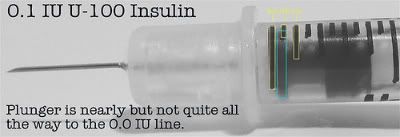
Here is some info to help you with .1:

Fine dose gradations:
  • 0.5U = exactly half a unit
  • 0.4U = skinny 0.5 touching the line
  • 0.3U = skinny 0.5 with daylight under the line
  • 0.2U = fat zero with daylight over the line
  • 0.1U = fat zero barely touching the line

Pictorial guide using a U-100 syringe marked with half units:

01unit-1.jpg


Remember, consistency is more important than accuracy, so once you decide where the .1 is on your syringes, you want to use that same spot each time.
 
If you'd rather wait to try it until tomorrow night when you can get one or two tests before bed, that's fine. But if he's up near 150 or higher, I'd do it in the morning anyway and just leave plenty of food available. Do you have an autofeeder?

Here is some info to help you with .1:

Fine dose gradations:


    • 0.5U = exactly half a unit
    • 0.4U = skinny 0.5 touching the line
    • 0.3U = skinny 0.5 with daylight under the line
    • 0.2U = fat zero with daylight over the line
    • 0.1U = fat zero barely touching the line
Pictorial guide using a U-100 syringe marked with half units:

01unit-1.jpg


Remember, consistency is more important than accuracy, so once you decide where the .1 is on your syringes, you want to use that same spot each time.
I'm feeling comfortable with 0.1u. I don't underestimate insulin at all but it is less then what he has had so far so hoping it's perfect and exactly what he needs!

I will practice tonight on the syringe for sure! That sure is a teenie tiny dose! My son will be home from school @ +6. Although he is too young to test he can at least keep an eye out.

I do have an auto feeder but Glen hasn't quite figured it out yet :) I will put snacks in it to open up a couple times while I am at work.

If he's around 150 I'll do it for sure!
 
I'm sure you are about to go to bed now, but if he doesn't get the hang of the feeder tomorrow, tomorrow night you can try working with it and him - put his dinner in it a little ahead of time and program it to open at his usual feeding time. Place it where he usually eats. Put any other meals you usually give him in it, and soon he'll associate the sound of it turning with food.

If you can get him to use it, it will be a valuable tool to help you get sleep and to keep him safe while you're at work.

Although he is too young to test he can at least keep an eye out.
That's good. If he sees anything unusual about him, have him offer food.

 
I'm sure you are about to go to bed now, but if he doesn't get the hang of the feeder tomorrow, tomorrow night you can try working with it and him - put his dinner in it a little ahead of time and program it to open at his usual feeding time. Place it where he usually eats. Put any other meals you usually give him in it, and soon he'll associate the sound of it turning with food.

If you can get him to use it, it will be a valuable tool to help you get sleep and to keep him safe while you're at work.


That's good. If he sees anything unusual about him, have him offer food.
I am going to bed. Thank you for everything!
 
Status
Not open for further replies.
Back
Top