I have a 13 year old diabetic cat, Matty. She was diagnosted around september of last year. I've had alot of stress over all of this, constant peeing outside the box, putting down ALOT of money on insulin, syringes, vet bills etc... I am severely depressed on top of all of this, and this is only making things worse. I am growing more and more incapable of taking care of her and I don't know what to do at this point. She's not in pain, I don't have the heart to put her to sleep, i've had her since she was a small kitten. It breaks my heart to peices not knowing what to do at this point. I have 2 other cats in the household, both are kittens and I free feed my cats. Due to the layout of my house, as well as stress in keeping Matty in my room to make sure she's fed. The other 2 will constantly meow at the door, and that tends to stress Matty out. She's definatly stressed out and everytime my girlfriend comes over she hisses and growls alot. My 2 kittens like to stay near me most of the day and there isn't really a place for Matty to safely sit without being bombarded at times by the 2 kittens. Not sure what to do at this point, I just don't know...

You are using an out of date browser. It may not display this or other websites correctly.
You should upgrade or use an alternative browser.
You should upgrade or use an alternative browser.
New to the forums from thecatsite.com
- Thread starter xeoneex
- Start date
- Status
- Not open for further replies.

Elizabeth and Bertie
Member Since 2010
Hello, and welcome to you and to Matty. 
It sounds like you're having a really tough time of things at the moment. But I do wonder if there are ways of making things a bit easier for you, and for Matty... A few questions for you:
1. Would it be easier if all the cats could eat the same food..?
2. Is it possible to set up toys in a room of the house and have the kittens shut in there for a time to give Matty a break? (I also have a boisterous youngster and have a room designated as a 'playroom' for her at the moment).
3. Do you know why Matty has a problem with your girlfriend?
4. Are you testing Matty's blood glucose levels at home, and if not, are you willing to learn? It's not that difficult. It won't hurt Matty. It will help you manage her diabetes. And it could save you quite a bit of money in vet's bills (because blood glucose tests could be done at home and wouldn't need to be done by the vet.)
5. What insulin is Matty on, and what dose?
Peeing outside of the box can be a sign of high blood glucose levels, or of a UTI (urinary tract infection).
Welcome to FDMB. We are here to help if we can.
Reassuring hugs to you
Eliz
It sounds like you're having a really tough time of things at the moment. But I do wonder if there are ways of making things a bit easier for you, and for Matty... A few questions for you:
1. Would it be easier if all the cats could eat the same food..?
2. Is it possible to set up toys in a room of the house and have the kittens shut in there for a time to give Matty a break? (I also have a boisterous youngster and have a room designated as a 'playroom' for her at the moment).
3. Do you know why Matty has a problem with your girlfriend?
4. Are you testing Matty's blood glucose levels at home, and if not, are you willing to learn? It's not that difficult. It won't hurt Matty. It will help you manage her diabetes. And it could save you quite a bit of money in vet's bills (because blood glucose tests could be done at home and wouldn't need to be done by the vet.)
5. What insulin is Matty on, and what dose?
Peeing outside of the box can be a sign of high blood glucose levels, or of a UTI (urinary tract infection).
Welcome to FDMB. We are here to help if we can.
Reassuring hugs to you
Eliz
1. It all depends if 2 kittens can eat the same food and still get the nutrition they need.
2. Unfortunatly I don't have a room to do this, we have one spare room but it's filled with stuff and I want to keep them out of there I have valuable stuff that I don't want torn up.
3. I'm not really sure other than she doesn't like anyone outside of me my brother or mother. Jealousy probably I don't know.
4. I do not have a tester, from what I understood from the vet it would cost me a considerable amount of money on test strips. I forget the amount she quoted, but it was pretty pricey I remember that much. I'm willing to learn if I can keep it cheap.
5. Vetsulin 2 units twice daily.
I think the peeing is due to stress. I've seen her use the litterboxes just fine, in fact prior to a few weeks ago when I started having my girlfriend come over she hadn't peed outside the box in a while. Only after the stress of having my girlfriend over seems to have caused her to start peeing next to the box. Another note I forgot to mention, under her belly she has chewed her fur off and it never grew back leading me to believe she keeps chewing it. I told the vet and they said there was nothing wrong, they checked for UTI, or so they told me, and that came back negative.
2. Unfortunatly I don't have a room to do this, we have one spare room but it's filled with stuff and I want to keep them out of there I have valuable stuff that I don't want torn up.
3. I'm not really sure other than she doesn't like anyone outside of me my brother or mother. Jealousy probably I don't know.
4. I do not have a tester, from what I understood from the vet it would cost me a considerable amount of money on test strips. I forget the amount she quoted, but it was pretty pricey I remember that much. I'm willing to learn if I can keep it cheap.
5. Vetsulin 2 units twice daily.
I think the peeing is due to stress. I've seen her use the litterboxes just fine, in fact prior to a few weeks ago when I started having my girlfriend come over she hadn't peed outside the box in a while. Only after the stress of having my girlfriend over seems to have caused her to start peeing next to the box. Another note I forgot to mention, under her belly she has chewed her fur off and it never grew back leading me to believe she keeps chewing it. I told the vet and they said there was nothing wrong, they checked for UTI, or so they told me, and that came back negative.

Critter Mom
Member Since 2014
One thing you could look at is whether her current food contains any common allergens. It's one possible reason why Matty might be overgrooming her tum.Another note I forgot to mention, under her belly she has chewed her fur off and it never grew back leading me to believe she keeps chewing it.
If you had space for a cat 'playpen' it could facilitate having all the kitties in the one room but stop the kittens from getting so up close and personal with Matty. I got one for Saoirse recently (see below) so that I could keep her safe while she was recovering from an operation but have her in a space that didn't feel like a hen coop. It has some sense of space compared to conventional resting cages. There is room in it for a bed, food station, litter box, and sisal scratching mat and some moving around space. It's really quick to set up and take down. It collapses down into a very small package and comes with a storage bag so it's easy to use on an ad hoc basis. It's the best thing I can think of to suggest to you as a possible solution (if only to inspire you to find something else that works for you). Other members may have better ideas.there isn't really a place for Matty to safely sit without being bombarded at times by the 2 kittens.

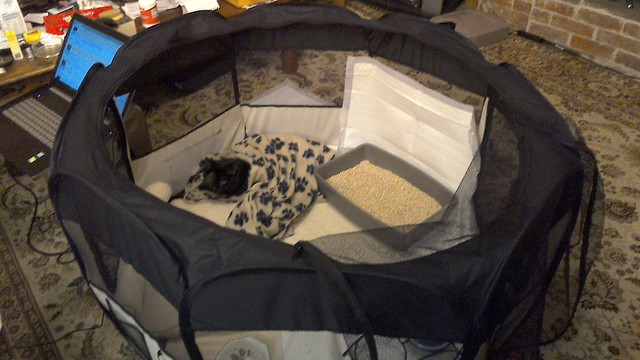
Here's an Amazon UK link to the product details for Saoirse's 'kitty hotel'; I'm sure there are similar products available in the US:
http://www.amazon.co.uk/gp/product/B00BXJDMSO?tag=felinediabetesfdmb-20
I truly feel for you.I am severely depressed on top of all of this, and this is only making things worse. I am growing more and more incapable of taking care of her and I don't know what to do at this point.
(I've got severe anxiety and depression problems, too.)Mogs
.
Critter Mom
Member Since 2014
Pet meter strips are indeed pricey. Most people here use human meters with much more affordable strips (along with a cat-specific measurement reference range). Assuming you're in the US, Walmart do Relion Micro, Confirm, and Prime models. The first two have slightly dearer strips than the Prime but they have the advantage of only needing a very tiny blood sample. If you're not in the US, let us know which country you're in and we can suggest other meters.4. I do not have a tester, from what I understood from the vet it would cost me a considerable amount of money on test strips. I forget the amount she quoted, but it was pretty pricey I remember that much. I'm willing to learn if I can keep it cheap.
Vetsulin frequently doesn't keep a cat in regulated numbers for the full day. If you learn to home test you'll be better able to see how Matty is actually responding to the Vetsulin day to day. You may then be able to better regulate her blood sugar levels. This could lead to improvements in both mood and toileting behaviour for Matty and much less stress for you.Vetsulin 2 units twice daily.
Hope some of the above helps a bit - or at least gives you some ideas.
Mogs
.
I'm in the US. Sadly I can't buy the TecTake Pet Play Pen Dog Cat Puppy Fabric Soft Foldable Playpen, due to me being outside the UK. I'm looking at other avenues to find one and try that by keeping her in my room at night and locking the other 2 out, though she whines when she can't go out of the room and I don't know how wel she'll take to the pen but its worth a try at this point.
I'm on a fixed income, with some hefty financial responsibilities and have to make sure I don't go over budget for everyday living. Thats the key problem for being able to afford strips and whatnot. I haven't worked in ages though I am in the search for a job, I haven't found one yet due to my lack of experience and years of not working due to my mental problems. As far as the strips go, do I need a specific testing machine or will any do? And how do I get the blood needed for the testing?
I'm on a fixed income, with some hefty financial responsibilities and have to make sure I don't go over budget for everyday living. Thats the key problem for being able to afford strips and whatnot. I haven't worked in ages though I am in the search for a job, I haven't found one yet due to my lack of experience and years of not working due to my mental problems. As far as the strips go, do I need a specific testing machine or will any do? And how do I get the blood needed for the testing?
Critter Mom
Member Since 2014
I haven't been able to work for years either, so I fully appreciate the financial strictures. 
BTW, just had a quick gander on Amazon US and they have playpens too (should you decide to go for one at some stage). Here's an example (and cheaper than the one I got in the UK - don't know how much the shipping would be):
http://www.amazon.com/Parkland-Pet-...able/dp/B01B37WUXI/?tag=felinediabetesfdmb-20
FWIW, Saoirse was really comfortable and settled in her playpen. By comparison she used to get a bit fretty and frustrated any time she needed to be in her smaller resting cage.
Re the testing, whichever meter you choose you will need to get the strips which match that particular meter. You can get blood samples from the edge of the ear or from one of the paw pads. Most people test on the ear. Here are links to teaching materials to help you learn how to home test. It can be a bit tricky at first but as you continue to test more capillaries develop at the test sites and it gets progressively easier and quicker to get a blood sample. If you need help with testing, post on the Feline Health board for assistance and we'll do our best to help you solve any problems.
Home testing links and tips (has tutorial videos)
Testing and injecting tips (has very helpful diagram of the best place to test on the ear)
I'm really glad that you've found FDMB - for both your sakes. The members here are so kind, friendly, knowledgeable, helpful, and very supportive. They have helped me and my Saoirse so much. I'm sure they'll be able to help you and Matty, too. It makes a huge difference emotionally as well as practically not to feel all alone and overwhelmed with things. I'd have been in a home for the bewildered long ago were it not for FDMB.
Mogs
.
BTW, just had a quick gander on Amazon US and they have playpens too (should you decide to go for one at some stage). Here's an example (and cheaper than the one I got in the UK - don't know how much the shipping would be):
http://www.amazon.com/Parkland-Pet-...able/dp/B01B37WUXI/?tag=felinediabetesfdmb-20
FWIW, Saoirse was really comfortable and settled in her playpen. By comparison she used to get a bit fretty and frustrated any time she needed to be in her smaller resting cage.
Re the testing, whichever meter you choose you will need to get the strips which match that particular meter. You can get blood samples from the edge of the ear or from one of the paw pads. Most people test on the ear. Here are links to teaching materials to help you learn how to home test. It can be a bit tricky at first but as you continue to test more capillaries develop at the test sites and it gets progressively easier and quicker to get a blood sample. If you need help with testing, post on the Feline Health board for assistance and we'll do our best to help you solve any problems.
Home testing links and tips (has tutorial videos)
Testing and injecting tips (has very helpful diagram of the best place to test on the ear)
I'm really glad that you've found FDMB - for both your sakes. The members here are so kind, friendly, knowledgeable, helpful, and very supportive. They have helped me and my Saoirse so much. I'm sure they'll be able to help you and Matty, too. It makes a huge difference emotionally as well as practically not to feel all alone and overwhelmed with things. I'd have been in a home for the bewildered long ago were it not for FDMB.
Mogs
.
Critter Mom
Member Since 2014
The Relion range are, I think, far and away the most popular meters used by members here. If price is the absolute arbiter of choice then the Relion Prime has the cheapest strips (but needs a bigger blood drop). In the early stages of testing the Relion Confirm or Micro models need a tinier blood sample and that can make the early days of testing successful faster but the strips are a little dearer.
I hope the playpen will be really helpful to you and Matty. Tip: line the base of the pen with abs0rbent puppy training pads. It's a practical and fairly stress-free way to contain any accidents AND clean-up is a breeze. Our vets were so impressed with Saoirse's Kitty Hotel they asked me for a link to the product because they think it might help a lot of their patients. Keeping fingers and paws crossed in the Shire for it to be a big hit with Matty.
Would love to hear how you all get on.
Mogs
.
I hope the playpen will be really helpful to you and Matty. Tip: line the base of the pen with abs0rbent puppy training pads. It's a practical and fairly stress-free way to contain any accidents AND clean-up is a breeze. Our vets were so impressed with Saoirse's Kitty Hotel they asked me for a link to the product because they think it might help a lot of their patients. Keeping fingers and paws crossed in the Shire for it to be a big hit with Matty.
Would love to hear how you all get on.
Mogs
.
Those both seem relatively cheap. Walmart has them for $9.99 for the micro, and $14.99 for the confirm. Is there a good enough difference to get the confirm or would the micro be fine? Is it just the size of blood I need that is the determining factor here? Also when do I check her blood, before she eats or before I give her insulin?
Critter Mom
Member Since 2014
I'm sure the Micro would be fine. Both meters are popular with US members here. (I'm in the UK.)
When beginning to test, having a meter that works with a small blood sample is very helpful because you might only get tiny droplets of blood when you first start testing. (Tip: get some Vaseline or Neosporin ointment and smear a very thin film over the edge of the ear before doing the poke with the lancet. It will help the droplet to bead up instead of wicking into the fur, making it easier to get blood onto the test strip. Also, coarser lancets (e.g. 28 gauge) tend to be better when starting out, too.)
Testing Schedule:
1. Make sure Matty doesn't have any access to food from 2 hours before her next injection is due (unless she's running low, in which case you'd need to feed her to get her numbers up) to make sure that her preshot blood glucose level isn't influenced by food. It is necessary to know the fasting blood glucose level in order to make sure it's safe to give the next dose of insulin. I recognise that this can be a little trickier in a multi-cat household - kittens might be a little miffed at first - but it's important for safety. The two-hour fast may also help Matty's BG levels in the last part of the cycle because that's typically when the Vetsulin dose has more or less petered out.
2. 30 minutes before the dose is due, do a preshot blood test. (AMPS = morning preshot test, PMPS = evening preshot test).
(NB: While you have very little data, the general rule is not to give insulin if the preshot blood test is less than 200 on a human meter. However, for cats with a history of producing ketones or of diabetic ketoacidosis (DKA) more caution is needed since missing an insulin dose is a bigger deal for these kitties. If Matty has a history of ketones/DKA I recommend you post for help here and also speak to your vet if she has a preshot BG of 200 or less.)
3. Make sure that Matty has a good feed before giving her injection to make sure that she has enough food on board for the Vetsulin to 'work on' as soon as it kicks in.
4. Provided it is safe to do so, 20 or so minutes after the meal give the insulin dose.
5. Typically Vetsulin starts exerting its strongest BG-lowering effects any time from +2 hours after the insulin dose was administered. When Saoirse was on Caninsulin (same as Vetsulin) I'd watch to see when she started looking for food in the hours after her injection to get a handle on when the insulin dose was kicking in. In general I'd test at +3 hours after injection time, morning and evening to make sure the dose wasn't likely to take her too low. In the early days of building up your data picture for how the Vetsulin is/isn't working for her it would be great if you could get another test in at +6 or +7 hours after injection time. This will give you an idea of how long in each 12-hour cycle the Vetsulin is lowering her blood glucose (the duration). Most people do the later test during the daytime cycle. (Important Note: Per the hypo guide, if a cat is running in low numbers (close to or below 50 on a human meter) you then test much more frequently until you know that the cat is back in safe numbers and is going to stay there - but that's the exception, not the norm.)
6. For the time being, during the cycle keep to Matty's current feeding schedule as it is (apart from lifting the food 2 hours before each injection) because you know that thus far she has been safe with that routine. When you get more data on her blood glucose levels you may be able to refine her feeding schedule to work better with the insulin (again - might be trickier in a multi-cat household but we can cross that bridge when we come to it).
We have a spreadsheet template that you can use to record Matty's test results. It looks a bit busy at first glance, but essentially it's just a grid in which you fill in her numbers. It's an incredibly helpful tool because it helps you to visualise what's happening - much less 'thinky' than trying to work things out in an already frelled head (I speak from experience! ). Also you can put a shared link into your forum signature so that other members will be able to see how she's running and they'll be better able to help you with suggestions about how to improve Matty's regulation. I'm including a link to the instructions on how to set up a spreadsheet. If the prospect of this is overwhelming to you just give a shout and one of our members will be more than happy to do the initial set-up for you then all you'll have to do is fill in Matty's BG readings as you go along.
FDMB Spreadsheet Instructions
Hope the above helps you. Be sure to ask about anything that's unclear or confusing (I'm very, very tired at the moment). I also hope that, now you've found FDMB, you won't feel quite so isolated or overwhelmed about things feline diabetes. We'll do all we can to help you improve things for both yourself and Matty.
Mogs
.
When beginning to test, having a meter that works with a small blood sample is very helpful because you might only get tiny droplets of blood when you first start testing. (Tip: get some Vaseline or Neosporin ointment and smear a very thin film over the edge of the ear before doing the poke with the lancet. It will help the droplet to bead up instead of wicking into the fur, making it easier to get blood onto the test strip. Also, coarser lancets (e.g. 28 gauge) tend to be better when starting out, too.)
Testing Schedule:
1. Make sure Matty doesn't have any access to food from 2 hours before her next injection is due (unless she's running low, in which case you'd need to feed her to get her numbers up) to make sure that her preshot blood glucose level isn't influenced by food. It is necessary to know the fasting blood glucose level in order to make sure it's safe to give the next dose of insulin. I recognise that this can be a little trickier in a multi-cat household - kittens might be a little miffed at first - but it's important for safety. The two-hour fast may also help Matty's BG levels in the last part of the cycle because that's typically when the Vetsulin dose has more or less petered out.
2. 30 minutes before the dose is due, do a preshot blood test. (AMPS = morning preshot test, PMPS = evening preshot test).
(NB: While you have very little data, the general rule is not to give insulin if the preshot blood test is less than 200 on a human meter. However, for cats with a history of producing ketones or of diabetic ketoacidosis (DKA) more caution is needed since missing an insulin dose is a bigger deal for these kitties. If Matty has a history of ketones/DKA I recommend you post for help here and also speak to your vet if she has a preshot BG of 200 or less.)
3. Make sure that Matty has a good feed before giving her injection to make sure that she has enough food on board for the Vetsulin to 'work on' as soon as it kicks in.
4. Provided it is safe to do so, 20 or so minutes after the meal give the insulin dose.
5. Typically Vetsulin starts exerting its strongest BG-lowering effects any time from +2 hours after the insulin dose was administered. When Saoirse was on Caninsulin (same as Vetsulin) I'd watch to see when she started looking for food in the hours after her injection to get a handle on when the insulin dose was kicking in. In general I'd test at +3 hours after injection time, morning and evening to make sure the dose wasn't likely to take her too low. In the early days of building up your data picture for how the Vetsulin is/isn't working for her it would be great if you could get another test in at +6 or +7 hours after injection time. This will give you an idea of how long in each 12-hour cycle the Vetsulin is lowering her blood glucose (the duration). Most people do the later test during the daytime cycle. (Important Note: Per the hypo guide, if a cat is running in low numbers (close to or below 50 on a human meter) you then test much more frequently until you know that the cat is back in safe numbers and is going to stay there - but that's the exception, not the norm.)
6. For the time being, during the cycle keep to Matty's current feeding schedule as it is (apart from lifting the food 2 hours before each injection) because you know that thus far she has been safe with that routine. When you get more data on her blood glucose levels you may be able to refine her feeding schedule to work better with the insulin (again - might be trickier in a multi-cat household but we can cross that bridge when we come to it).
We have a spreadsheet template that you can use to record Matty's test results. It looks a bit busy at first glance, but essentially it's just a grid in which you fill in her numbers. It's an incredibly helpful tool because it helps you to visualise what's happening - much less 'thinky' than trying to work things out in an already frelled head (I speak from experience!
). Also you can put a shared link into your forum signature so that other members will be able to see how she's running and they'll be better able to help you with suggestions about how to improve Matty's regulation. I'm including a link to the instructions on how to set up a spreadsheet. If the prospect of this is overwhelming to you just give a shout and one of our members will be more than happy to do the initial set-up for you then all you'll have to do is fill in Matty's BG readings as you go along. FDMB Spreadsheet Instructions
Hope the above helps you. Be sure to ask about anything that's unclear or confusing (I'm very, very tired at the moment). I also hope that, now you've found FDMB, you won't feel quite so isolated or overwhelmed about things feline diabetes. We'll do all we can to help you improve things for both yourself and Matty.
Mogs
.
My aunt who had a diabetic cat is trying to encourage me to put her to sleep. My family is saying the same thing. I just don't know what to do. All this about taking her blood and all this it's just overwhelming me and I have so severe depression, and this is only making things worse, that I don't have much drive to do much of anything. Part of me wants her to have peace, part of me doesn't have the heart. My aunt said she knows a doctor who had a diabetic cat and it was too costly. And I don't have the finances to carry this on for awhile. I just don't know what to do...
Elizabeth and Bertie
Member Since 2010
Please know that diabetes is eminently treatable in most cases. And with good care a diabetic cat can live as long and as healthily as a non-diabetic cat. (My own diabetic cat has been diabetic for 9 years.)I just don't know what to do...
Regarding cost, yes treating diabetes does cost money. But there are quite a few people here managing on very restricted incomes: Some people are retired. Some are unemployed. Some are students. Some are disabled and unable to work. Some are caring for sick or disabled relatives.
I'm not saying that it's 'easy'. But there certainly are ways to cut the cost of caring for a diabetic cat.
Many supplies can be bought more cheaply online. 'Hometesting' need not be costly and may actually save you money. You don't need to buy expensive food. Ordinary food will be fine. And, you never know, Matty may turn out to be one of the lucky ones who goes into remission (ie. recovers sufficiently to have her diabetes controlled by diet alone.)
If you absolutely decide that you cannot continue to care for Matty then you might consider trying to get her rehomed to someone who is willing to try to treat her diabetes. Finding homes for diabetic cats isn't easy, but if you are unwilling to continue treating her, but are willing to try to find her an alternative home, that would at least give her a chance at life.
Alternatively, you might try to rehome the kittens, as these may more easily find a new home.
Matty is in your care, and is your responsibility. So, it is absolutely your choice how to proceed.
Best wishes,
Eliz
- Status
- Not open for further replies.