Long Story about my Diabetic Savannah Cat - Would love advice

Status
Not open for further replies.

ryashani

Member Since 2015
I have a F1 Savannah cat that was born in 2006 (he is 50% African Serval). He was perfectly healthy until May 2014, when he started to get a runny nose (one side only). In a very short time it went from clear discharge to really gross gloppy crap. Numerous vet visits (including specialists) showed that this was a psuedomonis infection. We had to have several nasal flushes, had biopsies, had a CT scan. Tried Baytril, which did not help, then Merepenem shots in October of 2014 that seemed to cure him. We had a couple of great months and then the infection came back. Another flush and the a prescription for Veraflox.

I think I should mention that at this time he weighed 23lbs, is exceptionally strong and exceedingly smart. (When he tried to run from us once when we were going to crate him to go to the vet, he ran in the bathroom, opened the cabinet, ran inside and then reached a paw out and PULLED THE DOOR SHUT BEHIND HIM.) He is impossible to pill or to shoot liquid down his throat. For several weeks we did get Veraflox in him by adding it to his food and then he went on a hunger strike and refused to eat any food with ANY trace of meds.

Immediately after that hunger strike (which only lasted 24 hours), he started drinking more, peeing more, and went from slightly "fluffy" to very thin in a matter of 2 weeks. He was also revenous, and was trying to lick cat food cans that were in the trash even. At his next vet visit he was diagnosed with diabetes. We started him the next day on 2 units of Prozinc.

For about 5 days he was AWESOME. Had more energy since the sinus infection started, playing all the time, happy and social. Further, the sinus infection disappeared.

Before diabetes he ate Purina Pro Plan food (many flavors) with occasional raw meat treats. After the diabetes, we switched to only one flavor of that brand - the Chunky Chicken - as it has the lowest carbs.

Then he crashed. His blood sugar went through the roof and he got sick, we rushed him to the ER and he spent three days there on IV insulin. They wanted to keep him one more night, but once he started to feel better he took off the cone of shame, removed his IV and demanded to go home. The ultrasound done while there showed nothing unusual, and the blood work showed slight pancreatitis.

We have an Alphatrak, but we can NOT get readings at home. We honestly have tried. We can only get one if he gets sick and crashes. If he even sees me pick it up he goes and hides or gets hissy with me. Given that I NEED to give him shots (which he is mostly good about), we decided with our vet (internist from the ER that we now have dealing with the diabetes) that if he was always worried about me and the glucometer that he would stop allowing the shots, so we had to choose just administering shots and reserving the glucometer for emergencies.

Brought him home and he was doing ok, and insulin was up to a dose of 4 units (if I recall correctly). Again, everything was fine for about a week, and then he crashed again. NO ER this time, as the crash happened right before his shot time, so I gave him his shot and we called the vet who told us to monitor him. 2 hours later he was walking around again, and an hour or so after that he ate. The next morning he was completely normal. After this, the decision was made to go to 6 units.

At 6 units he was fine for a week, but then went through another phase where he got really nippy and ravenous and was aggressively asking for food. Irritable, pacing. We backed off to 5 units and the behavior went away in a day or two. But then in a week he crashed again.

After this crash the decision was made to switch to Lantus on May 22 (the ER vet prefers that over the ProZinc and I had also talked to an exotics specialist that handles Servals and Savannahs and he said absolutely to use the Lantus as the ProZinc does not have the staying power for these cats). 4 units for a week and he was great. Crash. Up to 6 but at this dose he was roadkill cat... sleeping HARD after insulin, and very unactive at others times.

We had him in the vets for a curve, but they only were able to get three readings. All of which were 390-410 (but he is also one that that has sugar that would go high at the vets even before the diabetes).

Another crash sent us up to 7... went from floppy cat to aggression again concerning food. Irritability. Pacing. No crashes for most of June, but the behavior was horrid.

(This whole time we were having frutosamine tests done every 2 weeks, and they are always high. Every 2 weeks the vets get blood and urine, and always high 380+.)

We started using a special sand litter and could test for glucose in the urine and ketones this way. Sugar was always there, but was less just BEFORE a shot, while being all the way high on the stick at other times. Worried about symogi effect and him getting too much insulin causing the behavior issues we backed off to 3 units and had the BEST two weeks ever. He played, ate like normal instead of a crazy beast (pre-diabetes he was doing 5-7 cans of food... at the worst of this we were up to 11 cans a day). Loving and social. And then I had an "oops" shot... where he moved and I was not 100% sure that the shot went in, but could not re-give it. That night the same thing happened (when he is less focused on the food, he is WAY more fidgety), only I was 90% sure that one missed. The next day he had ketones in his urine, and the following day they were worse. We had to go back up to 5 units, and the ketones cleared up.

But at 5 he is roadkill. Sleeps for 3-4 hours after the shot without moving or waking up when you call him (you have to prod him to move). And most of the rest of the time he was floppy and just laying around. (If you know Savannah cats, you know they just are not like that.)

Down to four and had a week of good behavior, still a little floppy. No ketones. Sugar always at highest mark in urine unless it is right before the shot, when it comes down a little. Then the aggression and hunger-crazies started again. Went back down to three last night and he was still batty, but seems to be a bit more normal today. We will see...

I know this is long and rambling, but I was just putting this out there to see if anyone else has ideas or has experienced something similar. I KNOW that the best way to handle this is to get blood glucose readings, but it is just not working. We had a blood test to check for a pituitary tumor, and are waiting on results of that just in case that could be causing all of this. No further signs of the initial pancreatitis either, but that has not been ruled entirely out as well.

I really just want my special, loving kitty well. He is the most social cat I have met and has SO much personality and I miss it when he is not himself. :-(
 
Because we cannot do the blood tests, we monitor EVERYthing else. He is weighed twice a day, every day. We keep an eye on how much water he drinks and how often he pees. We have detailed notes on his behavior changes, and the sinus infection (which comes back at lower doses of insulin). We monitor pretty much every aspect of his life that we can, and share all of the data with our vet so any changes in dosage are made with what information we DO have at least. We compile charts on all of this (nothing like having a snot output chart.... lol).
 
Hi and welcome to the group.

Nimar is gorgeous and sounds like quite the scamp when he doesn't like what's going on! What an ordeal you are having trying to get him regulated!

I'm having a bit of a go at regulating my girl too but she is a co-operative patient and allows me to test her so that alone makes my life much simpler and much easier to rule out underdosing or overdosing.

I've only been at this for a few months so I am no expert by any means but a couple of things come to mind as items to consider. I noticed that you are increasing or decreasing his dose by a full unit when these "crashes" occur. Despite the fact that your kitty is a large breed the dose of insulin seems high to me unless there is something other than diabetes involved.

When did you start treatment with the insulin?
When you say "crash" what exactly do you mean?
What are the symptoms you observe when this happens?

I notice my girl is very sleepy after her shots too and sometimes needs a shake to arouse. While she gets ravenous at times, it's nothing close to food aggression. These symptoms could signify either a low or high blood sugar.

You indicated the ER hospital had him on an IV of insulin which would suggest that your cat had full blown ketoacidosis so checking his urine for ketones and finding that positive at times is a concern.

We usually only increase and decrease by no more than half units at a time. If you are using Lantus with the pen right now, you'd have to switch to syringes to do half unit dosing.

That said, it would be so much easier if you could test at home.
Are you continuing to try to do testing at all?
Since Nimar runs at the sight of the glucometer, can you get near him with a lancet and get a bead of blood on your finger nail to test in another room?
If getting a blood bead is an issue, rubbing a little vaseline on the ear helps.
If he's sensitive about his ears, can you use his paw?

The difficulty here is that with a history of vet elevated sugar levels, you can be sure that part of those high readings you're seeing now is stress related. The stress alone can raise the sugar by 100 - 200mg. which means your cat may be getting too much insulin and what you are witnessing are the cat's own body defences against too low rather than too high blood sugar. When a cat's body detects it's glucose level going too low, their liver will pump out glycagon to raise their glucose levels sometimes through the roof making it look like they need more insulin when in fact they need less. Your suggestion of Somogyi is what I am thinking is happening.

I completely understand the difficulty you are having getting home tests. I have one cat who has a CAUTION on his file at the vets and I have no idea how I would ever be able to test him without a lot of blood letting and it wouldn't be his! My sense though is that home tests are the key to figuring out how to best help Nimar and that means outsmarting your smarty pants kitty! I know easier said than done!
I know some people cocoon their cat in a towel or blanket but I find that just escalates any existing catitude.:cat:

Hopefully some more experienced folks will chime in and offer some more suggestions.
 
It would be great to be able to condition him to accept the home tests. Some cats respond better to paw pad tests than ear tests and vice versa. Using treats or other motivators and establishing a very regular routine surrounding tests helps to condition the cat to enjoy test time (my cat hops on my lap and purs, he -likes- getting tested now). Unfortunately, with an F1 savannah, this might not be so simple with a big cat who has a mind of it's own.

So I want to throw this out there, it's not usually a suggestion I would make: When I was researching diabetes in cats when Max was first diagnosed, I did read that there are people out there who are having success with insulin pumps in cats. How these work, is there are 2 catheters placed with a small adhesive disk onto the skin which are connected to the pump. One catheter monitors sugar, the other delivers the regular insulin. You would then only have to change these once a week or whatever the schedule is per manufacturer. The pump can be set for basal (constant rate) and bolus if the sugar is high.
 
Meya, there is no way he would stand for the pump. He took out his own IV at the ER and undoes the bandage they put on his leg every two weeks after bloodwork. He won't wear a collar and he was impossible to harness/leash train. He is quite determined ;-)

As far as testing… a small part of it is likely a result of my own stress. I have tried to to the ear prick with the intent of catching it on my thumbnail and then testing. The problem is that I stress even thinking of it and if I am stressed he gets stressed even if I act no differently. He is quite perceptive. So normally I can lay down with him an d play with his paws or ears, but if I have an ulterior motive, he "knows" and it does not end well. lol
 
Mr Worfmen's Mom. Thank you for your reply! After reading this forum some, I see that most people do not adjust more than a half unit at a time. We were going on what our discussions with the vet lead us too, but we have already decided that any other adjustments will be more gradual.

As far as a crash… his sugar gets so high he gets sick, throws up (once was food, but most of the time it is just clear saliva/mucus), he curls up and just looks sick and won't move from that spot. What happens exactly is that he goes from acting mostly ok (maybe a little slower than usual), to having no appetite at all, to the vomiting and "crashing". It has not happened in some time, but it has always happened in that hour before his next shot was due so we gave him his normal dose (whatever it was at the time) and he would spring back in 3-4 hours and start eating again. It it happens identically each time, and the recovery time is identical (like clockwork actually). The first time was the time that sent him to the ER with very high sugar. The we did get a reading on blood two of the other times and it was in excess of 400.

As for the ER trip, he had high ketones in his system then, but if I recall correctly he had NOT gone into ketoacidosis.

As for sugar levels at the vet, even the vet only gives so much credence to what we get there ever two weeks, for that very reason. (I was told by the exotics doc I talked to that Servals can have an even more extreme reaction than a domestic), so while we monitor numbers, we are not relying only on them for how to react. In many cases we have to go by his mannerisms, how he looks, what he weighs, and all of that (which is why we keep such detailed notes).

The funny thing is that the two vet techs at the hospital work MAGIC with him. As long as we are not there too long they can hand him, get blood (from a vein, not just from his ear), get urine, and do an exam withOUT sedating him. Seriously, it is worth the extra cost of the specialist just for that! Everyone at our regular vet loves Nimar, but he is a butthead there and they have to sedate him to do anything with him. His sugar still raises and the visit stresses him out like crazy though, so yeah, readings are wonky.

Hehehe, the cocoon… um yeah. We do that AFTER he crashes to get the reading (he still fights like crazy even when really sick), but it would never work with him feeling more himself.

We are operating at this time thinking it is Symogi. The lower insulin is definitely better for his activity level. I am keeping watch on ketones and glucose via the urine as best as I can. If the ketones stay down, we will keep him at this dose for a bit and then hopefully reduce the dose (in smaller increments) and see how it goes.

Thank you so much for your time.
 
And sorry for my terminology… we have made up a lot of terms for what has been going on here (and are vet has notes on all of them in her file). Like, there is a difference between him being whiney ravenous and having "hunger crazies". Whiney seems to be from high sugar, he is pathetic and vocal and would eat 20 cans of food if I gave it too him. Hunger Crazies seem to be from too much insulin and that is when he gets nippy and really demanding. Both are polyphagia, but seem to be coming from very different sources and happen at different times.
 
The secondary monitoring, especially the urine ketones and the urine glucose are important then if BS checks can't be done easily. I would keep trying, find his main motivation. Savannah cats are very smart so that can work for or against you I suppose. It's all about finding what motivates him the most, but its rough at first.

I'm wondering too if it's possible to draw blood at the scruff. Some people use vacuum devices after they lance to draw the drop of blood if they are testing on an arm or other area. This measure wouldn't be as accurate as an ear sample, but more accurate than urine. Maybe he wouldn't notice as much on the scruff? You'd have to shave some fur at the testing site. If you did get blood with the vacuum device, you could use the device edges to "pick up" the drop, and test off the device. http://www.ambimedinc.com/section_products/ez-vac.html
 
I would kiss this person that invented the pee catching cat litter sand. At least being able to check urine I feel like we are doing something to help get stable rather than just sticking a shot in him twice a day and praying for the best. lol
 
Even as a retired R.N. I found the first few tests on my girl totally stressing me out so I fully understand what you mean about him picking up on your stress. My little domestic knew something was up and your guy's instincts are far less diluted so much sharper.

I know this sounds crazy but have you considered testing yourself a few times to get used to doing the lancet poke and maybe becoming more comfortable with the process? Then when you are ready to try it on Nimar, wait until he is in semi sleep mode, give him a treat or something to distract him, take a deep breath so you relax (that's the important step here) and then go for it. (sound so easy doesn't it):rolleyes:

I have an AlphaTrak meter too. Did you turn off the sound or did it beep when you tried it? If it beeped (it beeps louder than my human meter) that might be what spooked him. If any of this made up scenario fits reality, you could try putting the meter on the floor somewhere that he'll just come across it and can examine it himself without any threat of you doing anything with it. That might desensitize him from any fear of the meter itself. Of course you may need to install video surveillance to ensure he doesn't carry the meter off to his secret den in the bathroom vanity!:woot::woot:

If you want to use the lancet device, just cock it without any lancet in it and let it go off in the room with him nearby so he becomes accustomed to the sound. Gradually let it go off a little closer until you are right beside his ear. If that's a problem, you can do the poke free hand. The choice there is really a matter of what you are most comfortable with and thus my suggestion of some self poking to find your comfort zone.

You are already playing with his ears and paws so continuing that and desensitizing with the meter and lancet and working on keeping your stress level down might eventually get you to where you can test him. After all if the vet techs can do it, so can you.:D

I'm sure if we put our heads together we can find a way to slowly outsmart him.

I notice they are doing fructosamine testing. Unfortunately, I don't hold much credence in that test because my cat was still peeing like it was an olympic competition to fill the litter box and drinking the well dry as well as having glucose readings way above the normal range while at home (and she is a cool and calm patient so no stress factor) and her fructosamine came back suggesting she was well regulated. Another cat whose regular readings were lower than my cat's, came back as poor regulation possibly because insulin had been withheld a couple of times in the two weeks prior due to low glucose readings. So I am not sure how reliable that is for making any dose adjustments.I have read some opinions that the fructosamine is more useful once a cat is regulated to make sure the regulation is being maintained than is for determining dose requirements.

So those are my thoughts for the moment. This is a real head scratcher but I love a challenge. :D
 
We tried to acclimate him to the clicking of the lancet, and honestly, that doesn't bother him at all. I can put it next to his face all day and pop it with no reaction. If I go to use it though, all bets are off. I have also tried just pricking with the lancet. Problem is, once he is on the defensive, you can't get near him. (as for the beep of the meter, my BF usually holds that out of site and does not push the stick in till the blood is already welling up… but we usually don't even get that far). We call the one vet tech his girlfriend, because he behaves for her in ways that he never does for us. lol

We did the fructosamine 7 times now (every other week), but the vet has pretty much written it off as a tool for the time being because it is always the same. When he has other work done we will still check it, but at this time, we are not relying on it.

I would love to even get a blood sugar just before insulin at some point. We have not had one in a very long time. The urinalysis tests come up slightly lower for glucose right before shot time than any other time of day (except today, for whatever reason I got a middle-of-the-road reading at approximately 1:30PM.

Like today I am home sick so have been checking his urine at every chance. The thing is what I am listing below is different than what we usually see (with lowest sugar of the day being int he hour before the shot). Occasionally we get these trace ketones in the morning, but they usually resolve by the time we are ready to do a shot in the evening. Lower sugar in mid afternoon would almost suggest a normal curve of some sort to me…. (but I don't know much, so, yeah….)

Before I woke up at 6:50AM - urine showed between negative and trace ketones (ketones were negative last night). Sugar was second from highest (1). Breakfast and shot at 7:10AM. Snack at 9AM. 9:30AM urine had trace ketones and sugar at 1 (second from highest). 10:40AM Ketones between trace and small, glucose at 1. 10:55 acting hungry, but not aggressive, and got another snack. Between 1-2 PM: Ketones NEGATIVE, Glucose was in the middle (.5). This is the lowest we ever see it, and even this is a very, very rare occurrence. 4:55PM Ketones negative, Glucose at 1.
 
See my signature link Secondary Monitoring Tools, most of which you are probably using.
The systematic desensitization using treats may allow you, over time, to get him tolerant of being tested. For now, amount of water drunk and food eaten, urine glucose and ketone testing with KetoDiaStix, weight and dehydration checks may be your best tools. There is an older protocol using these plus periodic vet checks.
 
Thank you for the chart BJM! We are doing most of those but the dehydration check is one I definitely did not know.

So, I actually got a blood reading at home tonight (first one in months) because he is extra sedate and floppy. I pricked his ear and at first I was not even sure I got the vein but then suddenly there was blood all over me, the carpet and the cat. Reading was 410. Did another, 580. Did another 376. Then another in the 400s and another in the 500s. What the heck. Checked to make sure the number on the stick matched the machine and it did. I did the calibration test three times to make sure it was working properly and all of those samples were within a few points of each other and matched what it was supposed to according to the bottle. So I do not even know what to make of this as that is a pretty steep range….
 
Usually, unless the number you get is WAY off from where you think it should be, it's best to just take that first test as the right number. Meters are allowed to be 20% off and that doesn't matter if you're testing the exact same drop of blood or not...each time you test it can be up to 20% off.
 
Thank you. Kinda bummed me out to see it all over given that I actually got it done. LOL (Honestly, an hour after insulin, I was also hoping for something lower, but he had also just eaten three cans of food.)
 
I'm 2nding what Rhonda said....... You really do have your hands full.

The ideal place to prick the ear is between the edge and the vein rather than right in the vein so you only get a tiny drop of blood as opposed to a flood. That said, I can see why you use the vein to make sure you get a sample. Venous blood will read higher than capillary blood. Some of your readings are within a 20% meter variability allowed but some are not. Were all of those tests from the same drop of blood or each one a different drop of blood? If different blood, that explains the differences believe it or not. The glucometer gives an estimate not a definitive value.

Checked to make sure the number on the stick matched the machine and it did.

Do you mean the meter is set to the code on the vial of AT strips?

I did the calibration test three times to make sure it was working properly and all of those samples were within a few points of each other and matched what it was supposed to according to the bottle.

I assume you mean you checked the meter with the test solution.

You seem to be on top of things as best you can under the circumstances so this is probably a silly question but can you just confirm you are using the AlphaTrak strips meant for that meter. Some folks are using Freestyle Lite strips in the AT meters so just checking.

I know you have to take the opportunity to test when you can but a reading at +4 , +6 or +8 after shot will start to give you a better picture of how the insulin is working for Nimar. You want to find his lowest glucose reading in between his shots.

After 3 cans of food I wouldn't panic over those readings although I agree they are high.

And congrats on getting the test done!
 
See the Glucometer Notes again. Test results may be +/- 20% off of what a lab would get.
 
MrWorfMom: Yeah, I clearly went too close this time. Two readings were from one drop of blood, two were from another, one was from blood that he shook off onto his fur and ones was from the bloody carpet. The first reading of 410 and the one of 580 were from the same drop.

And yes, the code on the meter matched the strips and then I also tested the calibration with the calibration juice it came with. And yes, we have the alpha-trak strips for that meter (I even double checked that).

I started looking this afternoon at what a curve should look like and his urine samples (though all showing sugar) actually followed that pattern today with the least sugar in the urine around the 6-7 hour after the morning shot. Keeping him at this level of insulin for a few days, and then will talk to the vet about adjustments. And this time we will do half unit adjustment rather than anything more drastic.

Thank you SO much for the info on difference in capillary and artery blood though. I knew nothing about that or that there could even be a difference!
 
Ok. I figured you had the right strips, and the coding and calibration done correctly but I just had to confirm. As for all the different readings, some could have been influenced by a hair or fuzz from the carpet so I think you are safe to assume your meter is working. Make sure you wash your hands before handling the strips because any contamination on the strip will alter the readings. Obviously in this case you were in no position to be washing up between readings!:woot:

Since the urine tests suggest his nadir (lowest reading) is around 6 or 7 hours post shot, try to get blood tests in sometime between 5 and 8 hours. It's that lowest reading between shots that is key to determining how the dose is working for Nimar and that lowest point can move a bit on different days so those 4 hours are going to give you the most beneficial information.
 
I will try to get a reading Sunday during that mid-afternoon range if he will let me, definitely plan on monitoring urine the whole weekend (we will be at our cabin without the other cats with us, which makes the urine collection easier as there are no wasted strips testing the girls' pee lol). My BF took all our data over the last few days and made charts out of it… has the urine glucose levels, the ketone levels, how much he eats, insulin dosage and times, when he pees, his activity levels and his aggression levels. It is so over the top that it is almost (sadly) comical. But we gotta do what we gotta do… lol
 
You are in a bit of a different place than most of us because of the purity of wildcat genes in your kitty. You are doing the best you can and should be proud of yourselves for getting this far. Hopefully with time Nimar will co-operate a little better but it's obviously going to take some time and a lot of patience. He's one smart kitty and maybe he'll soon realize that all this pestering is making him feel better! FINGERS CROSSED!

If you have all your data charted, you could put it up on Google docs and link it here in your signature so if you have questions, your data would be available for folks here to review and look for patterns in your monitoring.

Just curious.....are the girls Savannahs too?
 
Nope, my girls are both DSH rescues. Isis is an 18lb gal (used to be 23, but we switched everyone to low carb when Nimar became diabetic, so she looks GREAT now). She is a very large feline. lol And Reeses Buggg is a alb deaf tortie (who is the real boss of the house).
 
LOL oh dear! Not albino. It should have read 6lb, but the autocorrect changed it to alb! She is tiny compared to the other two beasts in the house.
 
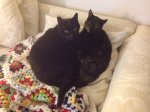
But here is a pic of my gals. heh
 

Attachments

  • photo-10.JPG
    photo-10.JPG
    83.2 KB · Views: 157
We'd love to see a Profile page telling us all about your special kitties!! Here's "How to create a Profile"....and you can add lots and lots of pictures too :)

Also, could you tell us your name or maybe add it to the info in your signature? Don't want to just keep calling you "Nimar's caretaker".....LOL
 
When you have a moment, could you add a few tidbits to your signature? It will help us give you feedback.

Editing your Signature

In the upper right corner of the screen, within the dark blue bar, you will see ID, Inbox, and Alerts

Click on your ID.

On the left, under Settings, Click on Signature.
This is where you will put information that helps us give you feedback.
This is where you paste the link for your spreadsheet, once it is set up.
Add any other text, such as
your name,
cat's name,
date of Dx (diagnosis)
insulin
meter
general location (city and state/province)
any other pertinent issues like if there are any food issues, history of DKA, hepatic lipidosis, pancreatitis, allergies, IBD, etc.
Click the Save Changes button at the bottom.

Always click the Save Changes button at the bottom when you have changed anything.
 
Hi @ryashani,
Wow! You've got your hands full! Sounds like you are doing everything possible to help regulate your beautiful boy. Have you ever thought of trying clicker training with him? I've never attempted it with a cat but I know it can be done (there's a trainer on youtube called Catmantoo with some pretty amazing videos of his cat). Zoos use this method to train large animals to accept handling and injections, etc. As smart as he is, if Nimar is at all food-motivated, it may be a way to help make testing and injections easier. If it works for lions and tigers...
I know the amount of time and patience required for training my dogs so I in no way mean for this to sound like a simple solution. Just wanted to to throw it out there.
Your girls are beauties too.
:cat:

Joan
 
Oh my goodness. Just read through this thread and while I thought that I had problems with my Morrigan....I am not going to complain as much anymore @ryashani. Good heavens you have your hands full! BEAUTIFUL cats by the way! I love seeing cat photos.

Are you sure Nimar isn't human? LOL Ripping out his own IV, bandages and removing his collar? I'm sure that his vets have taken up drinking. ;)

I don't know what to tell you to do with this because all of the information and tricks and hints seem to be above and beyond Nimar's intelligence levels! It's almost as though he's saying, "oh you think you're going to fool ME? HA! I'm going to mess with your head until you are in a straight jacket." I can hear his laughing now. ;)

I know that with Morrigan (who knows what she is..some think Maine Coon but, who knows?) fights me hammer, tooth and nails...ALL of them. I own stocks in the bandage companies but, I do have to say that Nimar takes the trophy for "Most Difficult Cat" and certainly takes Honours in Intelligence.

It sounds to me like you're going to have to do the best that you can, using the tools that you're using, notes, litter etc.. It sounds like your life is becoming a basket case scenario and it's not healthy for you either. That doesn't mean to give up on Nimar but, it does mean that you simply won't be able to do the same sort of testings that others in here are able to do on their more co-operative cats. Sounds like you have a lion...part human, part devil and that he owns you and the house....likely the car too! ;)

I think you're doing a phenomenal job, given all that you face with Nimar's antics and deserve both a medal and a vacation!

Hmmm...wondering if perhaps, you might get one of those vet techs who can deal with him best, to come over to your place for a fee to get him used to being tested at home? Maybe, they can get him used to it, get you to do it while they are there and then...fingers crossed...you might be able to carry on with it on your own?

In the meanwhile...I think you're doing all that you CAN do right now and the only thing you can do otherwise is to get what you can, where you can, however you can. You can't do more than that. You're only human while I think Nimar is super-human ;) LOL
 
I am still learning so much about feline diabetes, but I just wanted to say I know how difficult a Savannah can be, especially an F1! We have an F1 female and, honestly, if she became diabetic we would have the EXACT same issues with her. So, I commend you and applaud you because I know how difficult they are (but do we ever love them!)

Unfortunately, our F4 Savannah boy Caspian, was diagnosed with diabetes in early June. It's been very difficult for us because he does NOT like the shots at all. He growls and gets upset, but he does let us give him the shots. We are going to attempt to start home testing, but again, I'm not sure if he's going to make this possible for us or not. This whole thing is a nightmare. I lost my sweet DSH Darius to diabetes back in 2011. We are determined to get Caspian through this and get him regulated. Anyhow, I will post an entirely new thread about Caspian when I can and have the energy to do so, but I just wanted to say I completely understand what you're going through with your Savannah.

Take Care,
Tammie
 
See my signature link Secondary Monitoring Tools for some additional assessments you may make to evaluate how your cat is doing. There is an older protocol which uses some of these in addition to regular vet visits.
 
And we finally have answers to all of the weirdness we have encountered with his dosage and with his behavior. Acromegaly is the problem (confirmed with a blood test and CT scan that was sent out to two universities). There is a definite tumor that is causing the problem. Considering treatments and getting another CT scan and a chest xray very soon.
 
Glad you finally have answers! It's no good about the acro, but it's good to know what you are dealing with. You may want to start a new post, there are a lot of people here with acro cats, and several that have had treatment for it. You'll probably get some good responses.
 
I'm SO thankful that you now have an answer! Yes there's other 'acro' cats here - some undergone treatment, some not. I can't remember who but someone just went thru SRT treatment within the last few months. I second Meya's advice - start a new post with Acro in the title, you'll get lots of responses!
 
We tried to acclimate him to the clicking of the lancet, and honestly, that doesn't bother him at all. I can put it next to his face all day and pop it with no reaction. If I go to use it though, all bets are off. I have also tried just pricking with the lancet. Problem is, once he is on the defensive, you can't get near him. (as for the beep of the meter, my BF usually holds that out of site and does not push the stick in till the blood is already welling up… but we usually don't even get that far). We call the one vet tech his girlfriend, because he behaves for her in ways that he never does for us. lol

We did the fructosamine 7 times now (every other week), but the vet has pretty much written it off as a tool for the time being because it is always the same. When he has other work done we will still check it, but at this time, we are not relying on it.

I would love to even get a blood sugar just before insulin at some point. We have not had one in a very long time. The urinalysis tests come up slightly lower for glucose right before shot time than any other time of day (except today, for whatever reason I got a middle-of-the-road reading at approximately 1:30PM.

Like today I am home sick so have been checking his urine at every chance. The thing is what I am listing below is different than what we usually see (with lowest sugar of the day being int he hour before the shot). Occasionally we get these trace ketones in the morning, but they usually resolve by the time we are ready to do a shot in the evening. Lower sugar in mid afternoon would almost suggest a normal curve of some sort to me…. (but I don't know much, so, yeah….)

Before I woke up at 6:50AM - urine showed between negative and trace ketones (ketones were negative last night). Sugar was second from highest (1). Breakfast and shot at 7:10AM. Snack at 9AM. 9:30AM urine had trace ketones and sugar at 1 (second from highest). 10:40AM Ketones between trace and small, glucose at 1. 10:55 acting hungry, but not aggressive, and got another snack. Between 1-2 PM: Ketones NEGATIVE, Glucose was in the middle (.5). This is the lowest we ever see it, and even this is a very, very rare occurrence. 4:55PM Ketones negative, Glucose at 1.
Have you tried a manual lancet? I used this on Terry who is a scaredy cat and she was fine. I would imagine the clicking sound would be loud and scary in their ear
 
Status
Not open for further replies.
Back
Top