6/1 / Dino AMPS=144

Status
Not open for further replies.
the hard part about that for the rest of us.... is not knowing if that's a dramatic drop from the preshot.

those numbers tell us a lot of info....
maybe you could try testing him the minute he's done eating....
it takes 20-30 minutes for food to influence the numbers.... so it's better than no test data.
 
the hard part about that for the rest of us.... is not knowing if that's a dramatic drop from the preshot.

those numbers tell us a lot of info....
maybe you could try testing him the minute he's done eating....
it takes 20-30 minutes for food to influence the numbers.... so it's better than no test data.
That's a great idea. I will try that. Thanks so much.
 
I would also suggest maybe getting a +3.... let's see if he's going down.... and you need to boost him back up....
Yes, alright, I can do that as well. I feel so awful about poking him so much. I don't think it's hurting him but his ears are one red dot after another. Poor baby. Wish me luck.
 
The poking is hard to do, but it's what keeps them safe. If you compress the poke spot for about 20 seconds after, it helps heal the poke. And put a little dab of Neosporin with Pain Relief on after also helps.
 
The poking is hard to do, but it's what keeps them safe. If you compress the poke spot for about 20 seconds after, it helps heal the poke. And put a little dab of Neosporin with Pain Relief on after also helps.
Yes, that is exactly what I do but he's had so many pokes in a short time because I 'm still learning how to get the hang of it. Thank you for your support.
 
I haven't had a chance to welcome you yet.

I'm not sure if anyone's told you yet that low numbers - meaning numbers low enough that you need to intervene with carbs - are anything under 50. So the tests you've gotten in the 20's were extremely low. You are very lucky that you didn't seen symptoms. A hypo on Lantus or Levemir, the long-lasting insulins, can last as long as 16 hours or so.

So the fact that you have a 61 only 2 hours after his shot, and Lantus' action typically onsets (begins to take action) about +2 and the blood sugar usually drops after that, means that you've got to be extra vigilant tonight. His blood sugar may continue to go down over the next several hours. I'm not trying to scare you, but sometimes when a person is new they don't even know what questions to ask. We generally try to keep cats over 50, for safety.

Here is the How to Treat a Hypo document - if you can print it out, you should keep it available. I highlighted a few parts that seem relevent to your situation today. Good for you for getting into home testing - you're keeping him safe!


TREATMENT

During treatment for hypoglycemia, try to test every 15 - 20 minutes until you see the bgs begin to rise. Then continue to test until you are satisfied that the cat is out of danger.

VERY LOW NUMBERS – WITHOUT SYMPTOMS
Retest glucose using a large blood sample to make certain you have enough blood, and if you still get a very low number (under 40 mg/dL or 1.9 – 2.2 mmol/L) administer a teaspoon of corn syrup, liquid glucose, pancake syrup or honey, or INSTA-GLUCOSE and follow with food until the blood glucose numbers rise to acceptable levels. The syrup can be mixed with wet food or poured over dry if the cat will eat the mixture. If using liquid glucose, dilute with water for a thinner consistency.

LOW NUMBERS – WITHOUT SYMPTOMS
Retest glucose using a large blood sample to make certain you have enough blood, and if you still get a low number (40 – 60mg/dL or 2.2 – 3.3mmol/L) give food or treats until the blood glucose numbers rise to an acceptable level. If the cat refuses to eat even his/her favorite foods, you can syringe feed or administer a small amount of syrup.

LOW NUMBERS – MILD SYMPTOMS
Try feeding first or give a little syrup or honey followed by food until the blood glucose numbers rise to an acceptable level and the symptoms disappear. The syrup can be mixed with wet food or poured over dry if the cat will eat the mixture. If the cat will not eat, syringe feed. If your cat will eat dry food. the high carbs will help to increase his/her bgs quickly, but remember the effects of dry food usually takes longer to clear kitty's system once the crisis has passed. Feeding a high carb canned food is preferable to feeding a high carb dry food because the effects will clear kitty's system faster. You can then follow with his/her favorite canned food. Keep in mind that giving syrup (Karo, etc.) or honey is not enough because the effects wear off quickly. You need to follow with food.
IF IN ANY DOUBT, TELEPHONE YOUR VETERINARIAN.

LOW NUMBERS – MODERATE SYMPTOMS
Give a tablespoon of syrup, a teaspoon of liquid glucose, a tablespoon of honey or a tablespoon of sugar syrup followed by food and continue doing so until you see the blood glucose numbers rise to an acceptable level and all symptoms disappear. The syrup, honey, or glucose can be rubbed against the inside of the cat’s cheeks or on the gums for quick absorption. You can also mix the syrup with wet food or pour over dry if the cat will eat it. Continue to give syrup and food as needed and observe your cat for signs of recurring hypoglycemia. Keep in mind that giving syrup (Karo, etc.) or honey is not enough because the effects wear off quickly. You need to follow with food.
IF IN ANY DOUBT, TELEPHONE YOUR VETERINARIAN.

LOW NUMBERS – SEVERE SYMPTOMS
Rub syrup, honey, or glucose on the gums and cheeks if your cat will allow it. Another option for administering syrup, diluted liquid glucose, honey or sugar syrup to a cat who is seizing is to fill a needleless syringe with the mixture and insert via the rectum.
NEVER TRY TO SQUIRT SYRUP, HONEY, OR GLUCOSE TO A CAT WHO IS SEIZING AS THE CAT COULD CHOKE ON IT! RUSH TO EMERGENCY.

AGAIN! ANYTIME YOU CAT IS SEIZING OR LIMP, RUB KARO, GLUCOSE OR HONEY ONLY ON GUMS OR ADMINISTER RECTALLY AND GET TO EMERGENCY OR YOUR NEAREST CLINIC IMMEDIATELY!!!

Remember that syrup or any other sugared syrup/preparation will spike the blood glucose ONLY for a short period of time, so food is really important with mild and moderate symptoms. Dry food (high carbohydrates) will keep the blood glucose numbers elevated longer.

After a hypoglycemic episode cats may be more sensitive to insulin, so a reduction in dosage is generally required, especially considering too much insulin – whether due to dosage, inadequate food intake, or the cat’s changing insulin requirements – caused the hypoglycemic event in the first place. With moderate to severe episodes, your Vet may have you skip the next injection altogether.
IT IS VERY IMPORTANT THAT YOU DISCUSS YOUR CAT’S HYPOGLYCEMIC EVENT WITH YOUR VET, SO TOGETHER YOU CAN DECIDE UPON THE NEXT COURSE OF ACTION.

Always keep in mind that with low blood glucose and no symptoms, the BG you get is not as important as where it is headed. In other words, if you get a BG of 100 mg/dL or 5.6 mmol/L or less and there are still several hours or more before the insulin peaks, your need to watch your cat (and the numbers) carefully and take appropriate steps. With very low numbers and NO SYMPTOMS, a cat can be fine one moment and seizing the next.

BE PREPARED! KNOW THE SYMPTOMS AND KNOW THE TREATMENT!


Copyright © 1998-2010

Last edited by a moderator: Mar 17, 2015
Reason for edit: Edited to clarify the use of dry food and include the use of high carb canned food.
Melissa & Popcorn (GA) & Sushi (GA)
Joined the FDMB: February 25, 1998

 
I haven't had a chance to welcome you yet.

I'm not sure if anyone's told you yet that low numbers - meaning numbers low enough that you need to intervene with carbs - are anything under 50. So the tests you've gotten in the 20's were extremely low. You are very lucky that you didn't seen symptoms. A hypo on Lantus or Levemir, the long-lasting insulins, can last as long as 16 hours or so.

So the fact that you have a 61 only 2 hours after his shot, and Lantus' action typically onsets (begins to take action) about +2 and the blood sugar usually drops after that, means that you've got to be extra vigilant tonight. His blood sugar may continue to go down over the next several hours. I'm not trying to scare you, but sometimes when a person is new they don't even know what questions to ask. We generally try to keep cats over 50, for safety.

Here is the How to Treat a Hypo document - if you can print it out, you should keep it available. I highlighted a few parts that seem relevent to your situation today. Good for you for getting into home testing - you're keeping him safe!


TREATMENT

During treatment for hypoglycemia, try to test every 15 - 20 minutes until you see the bgs begin to rise. Then continue to test until you are satisfied that the cat is out of danger.

VERY LOW NUMBERS – WITHOUT SYMPTOMS
Retest glucose using a large blood sample to make certain you have enough blood, and if you still get a very low number (under 40 mg/dL or 1.9 – 2.2 mmol/L) administer a teaspoon of corn syrup, liquid glucose, pancake syrup or honey, or INSTA-GLUCOSE and follow with food until the blood glucose numbers rise to acceptable levels. The syrup can be mixed with wet food or poured over dry if the cat will eat the mixture. If using liquid glucose, dilute with water for a thinner consistency.

LOW NUMBERS – WITHOUT SYMPTOMS
Retest glucose using a large blood sample to make certain you have enough blood, and if you still get a low number (40 – 60mg/dL or 2.2 – 3.3mmol/L) give food or treats until the blood glucose numbers rise to an acceptable level. If the cat refuses to eat even his/her favorite foods, you can syringe feed or administer a small amount of syrup.

LOW NUMBERS – MILD SYMPTOMS
Try feeding first or give a little syrup or honey followed by food until the blood glucose numbers rise to an acceptable level and the symptoms disappear. The syrup can be mixed with wet food or poured over dry if the cat will eat the mixture. If the cat will not eat, syringe feed. If your cat will eat dry food. the high carbs will help to increase his/her bgs quickly, but remember the effects of dry food usually takes longer to clear kitty's system once the crisis has passed. Feeding a high carb canned food is preferable to feeding a high carb dry food because the effects will clear kitty's system faster. You can then follow with his/her favorite canned food. Keep in mind that giving syrup (Karo, etc.) or honey is not enough because the effects wear off quickly. You need to follow with food.
IF IN ANY DOUBT, TELEPHONE YOUR VETERINARIAN.

LOW NUMBERS – MODERATE SYMPTOMS
Give a tablespoon of syrup, a teaspoon of liquid glucose, a tablespoon of honey or a tablespoon of sugar syrup followed by food and continue doing so until you see the blood glucose numbers rise to an acceptable level and all symptoms disappear. The syrup, honey, or glucose can be rubbed against the inside of the cat’s cheeks or on the gums for quick absorption. You can also mix the syrup with wet food or pour over dry if the cat will eat it. Continue to give syrup and food as needed and observe your cat for signs of recurring hypoglycemia. Keep in mind that giving syrup (Karo, etc.) or honey is not enough because the effects wear off quickly. You need to follow with food.
IF IN ANY DOUBT, TELEPHONE YOUR VETERINARIAN.

LOW NUMBERS – SEVERE SYMPTOMS
Rub syrup, honey, or glucose on the gums and cheeks if your cat will allow it. Another option for administering syrup, diluted liquid glucose, honey or sugar syrup to a cat who is seizing is to fill a needleless syringe with the mixture and insert via the rectum.
NEVER TRY TO SQUIRT SYRUP, HONEY, OR GLUCOSE TO A CAT WHO IS SEIZING AS THE CAT COULD CHOKE ON IT! RUSH TO EMERGENCY.

AGAIN! ANYTIME YOU CAT IS SEIZING OR LIMP, RUB KARO, GLUCOSE OR HONEY ONLY ON GUMS OR ADMINISTER RECTALLY AND GET TO EMERGENCY OR YOUR NEAREST CLINIC IMMEDIATELY!!!

Remember that syrup or any other sugared syrup/preparation will spike the blood glucose ONLY for a short period of time, so food is really important with mild and moderate symptoms. Dry food (high carbohydrates) will keep the blood glucose numbers elevated longer.

After a hypoglycemic episode cats may be more sensitive to insulin, so a reduction in dosage is generally required, especially considering too much insulin – whether due to dosage, inadequate food intake, or the cat’s changing insulin requirements – caused the hypoglycemic event in the first place. With moderate to severe episodes, your Vet may have you skip the next injection altogether.
IT IS VERY IMPORTANT THAT YOU DISCUSS YOUR CAT’S HYPOGLYCEMIC EVENT WITH YOUR VET, SO TOGETHER YOU CAN DECIDE UPON THE NEXT COURSE OF ACTION.

Always keep in mind that with low blood glucose and no symptoms, the BG you get is not as important as where it is headed. In other words, if you get a BG of 100 mg/dL or 5.6 mmol/L or less and there are still several hours or more before the insulin peaks, your need to watch your cat (and the numbers) carefully and take appropriate steps. With very low numbers and NO SYMPTOMS, a cat can be fine one moment and seizing the next.

BE PREPARED! KNOW THE SYMPTOMS AND KNOW THE TREATMENT!


Copyright © 1998-2010

Last edited by a moderator: Mar 17, 2015
Reason for edit: Edited to clarify the use of dry food and include the use of high carb canned food.
Melissa & Popcorn (GA) & Sushi (GA)
Joined the FDMB: February 25, 1998
Hi, thank you. I can't believe how overwhelming this all is to me. So much to watch for and so much still to learn. Your information is so helpful I just hope I can understand everything and do everything I am supposed to do. About two months ago I caught Dino having a seizure and it scared me to death. At the time I had no clue what was wrong but now having read so much about feline diabeties I know what was. Home testing is a lot more important than I ever imagined. I so happy to be on this site being taken under all your wings to help me. Wish I could throw a party to everyone on this thread to show my appreciation.
 
Dino allowed me to test him after work BEFORE his meal, that was amazing in itself. So he was at 103 which is good. So do I still give him his shot tonight?
 
Since you are so new to testing, I think I'd lean to skipping tonight. Once you have more testing experience under your belt, it's a very shootable number. It will really help us help you if you can get a spreadsheet set up.

Great news that he let you test before eating. :)
 
Since you are so new to testing, I think I'd lean to skipping tonight. Once you have more testing experience under your belt, it's a very shootable number. It will really help us help you if you can get a spreadsheet set up.

Great news that he let you test before eating. :)
Dino wouldn't let me test this morning so no AMPS today. I have been writing down all my test times and results and will try to get a spreadsheet going soon. Thank you.
 
Are you giving him a treat with each time you test, even if you don't get blood? That can help him learn that the test equals a treat.

I cooked plain chicken breast, diced it small like 1/2", froze most of it and kept a couple days worth in the fridge To dole out for pokey treats. Some people buy freeze dried meats for treats. The important thing is you want pure meat so there's no added sugar.

If you're having trouble, just ask. The people here know a zillion tricks for getting testing and shooting done.
 
Are you giving him a treat with each time you test, even if you don't get blood? That can help him learn that the test equals a treat.

I cooked plain chicken breast, diced it small like 1/2", froze most of it and kept a couple days worth in the fridge To dole out for pokey treats. Some people buy freeze dried meats for treats. The important thing is you want pure meat so there's no added sugar.

If you're having trouble, just ask. The people here know a zillion tricks for getting testing and shooting done.
Yes, as a matter of fact Dino is very difficult. He just won't sit still. I talk in a relaxing voice, stroke him but he just wants to run away. If I would give him a treat he would just keep squirming around to see where I got the treat and beg for more. He LOVES food and could eat all day. The pre-shot tests are the worst because he wants food and wants it now. Oh well, I keep trying my best. I will try to give him a treat the minute the test is done. Thank you.
 
Hello and welcome aboard. With Dino getting such low numbers it really is vital to test before shooting - it is ok to let him eat and then test immediately if he's too impatient to wait but for safety's sake I would not shoot before testing. Looking forward to seeing his spreadsheet and, I must say, he's a very handsome kitty :)

Shhhh don't tell Vyktor I said that!
 
Hello and welcome aboard. With Dino getting such low numbers it really is vital to test before shooting - it is ok to let him eat and then test immediately if he's too impatient to wait but for safety's sake I would not shoot before testing. Looking forward to seeing his spreadsheet and, I must say, he's a very handsome kitty :)

Shhhh don't tell Vyktor I said that!
That is so funny. Thank you so very much. Vyktor is adorable!!! Of course I LOVE all cats. Everyone is so wonderful to me. The problem I am also having is I don't know how much to shoot even I if test first. Should I skip a shot if he's in a normal or low range? Should I give more when it's very high? Is that how it works?
 
That is so funny. Thank you so very much. Vyktor is adorable!!! Of course I LOVE all cats. Everyone is so wonderful to me. The problem I am also having is I don't know how much to shoot even I if test first. Should I skip a shot if he's in a normal or low range? Should I give more when it's very high? Is that how it works?
No, Lantus works best when dosed consistently, also Lantus doses are base on how low the BG gets in a cycle. Since there is a reserve built up in the body which needs to readjust w/ every dose change, we do not change dose until at least 6 cycles have passed. (Unless it takes the BG too low!) Other insulins used a sliding scale based on the preshot, but not Lantus or Levemir.

We actually give Tess her shot while she is eating, she is so intent on the food that she barely notices. You could try testing Dino once he dives into his food, he sounds like a very food focused kitty too.
 
I'm thinking the same thing that Ann's mentioned. The link Sienne gave you above has a ton of good tips on shooting and testing, so if you haven't looked at it yet, please do.

If I were you, I think I'd make the bathroom counter my testing place. This is what I would try. Have all the supplies there, bring Dino in and close the door. I'd have the meter ready with a strip halfway in, but not engaged all the way. Put him on the counter with a teaspoon of his regular low-carb food that you've added some water to, and then add a clean golf ball to the bowl to slow him down and while he's eating, you grab a test. A teaspoon of low carb (lc) food in some water isn't going to hurt anything. If he's food motivated, that might do the trick. He'll have to work to eat around the golf ball and you can test while he's eating. That'll give you a test result before he's chowed down his whole meal.

Then if it's shot time, you could do the test first and then go get his regular meal & insulin ready, take him back in the bathroom and let him eat on the counter there while you give him his shot. On this group, for new members we suggest going ahead with the regular dose as long as he is over 150 or so. For new members we suggest under 150 to hold off on food and post and ask for advice. Ultimately, you want to work up to shooting lower and lower numbers - for those who are following Tight Regulation Protocol they'll shoot everything over 50 on a human meter. With Start Low Go Slow it's 90.

Even whatever tests you have would be helpful to us in helping you. The spreadsheet doesn't have to be full. A sprinkle of tests here and there are usually enough for us to be able to help a person with dosing. I think as long as you are struggling to test, you will want to follow the Start Low Go Slow dosing method. Later as things get easier you can switch to the Tight Regulation Protocol if you want.

One thing that's super important that you need to know about is that diabetic cats have the potential to have their pancreas heal and begin producing insulin again. From your story, I'm thinking that you may have too high of a dose. Where 2u may have been ok in the beginning it may be too much now. Or it may have been too much from the start, because you have mentioned seizures and low numbers which are all signs of a hypoglycemic event.
If a cat's body spend time in the normal blood sugar range, 50-120 on a human glucometer, the pancreas can sputter back to life. If a person is testing, that shows up as low numbers. Getting low numbers means a dose reduction. So if the cat's body is healing, the dose will need to be reduced to prevent the cat from having a hypo. Does that make sense?

Just know that you are poking him to keep him safe - there is no other way to be certain what's goin on inside his body.
 
No, Lantus works best when dosed consistently, also Lantus doses are base on how low the BG gets in a cycle. Since there is a reserve built up in the body which needs to readjust w/ every dose change, we do not change dose until at least 6 cycles have passed. (Unless it takes the BG too low!) Other insulins used a sliding scale based on the preshot, but not Lantus or Levemir.

We actually give Tess her shot while she is eating, she is so intent on the food that she barely notices. You could try testing Dino once he dives into his food, he sounds like a very food focused kitty too.
Yes, Dino is VERY food motivated, however I can't test him while he is eating because he moves his head way too much. But giving him his insulin while he's eating is a piece of cake, no problem there, he doesn't even know I'm there. Thank you.
 
I'm thinking the same thing that Ann's mentioned. The link Sienne gave you above has a ton of good tips on shooting and testing, so if you haven't looked at it yet, please do.

If I were you, I think I'd make the bathroom counter my testing place. This is what I would try. Have all the supplies there, bring Dino in and close the door. I'd have the meter ready with a strip halfway in, but not engaged all the way. Put him on the counter with a teaspoon of his regular low-carb food that you've added some water to, and then add a clean golf ball to the bowl to slow him down and while he's eating, you grab a test. A teaspoon of low carb (lc) food in some water isn't going to hurt anything. If he's food motivated, that might do the trick. He'll have to work to eat around the golf ball and you can test while he's eating. That'll give you a test result before he's chowed down his whole meal.

Then if it's shot time, you could do the test first and then go get his regular meal & insulin ready, take him back in the bathroom and let him eat on the counter there while you give him his shot. On this group, for new members we suggest going ahead with the regular dose as long as he is over 150 or so. For new members we suggest under 150 to hold off on food and post and ask for advice. Ultimately, you want to work up to shooting lower and lower numbers - for those who are following Tight Regulation Protocol they'll shoot everything over 50 on a human meter. With Start Low Go Slow it's 90.

Even whatever tests you have would be helpful to us in helping you. The spreadsheet doesn't have to be full. A sprinkle of tests here and there are usually enough for us to be able to help a person with dosing. I think as long as you are struggling to test, you will want to follow the Start Low Go Slow dosing method. Later as things get easier you can switch to the Tight Regulation Protocol if you want.

One thing that's super important that you need to know about is that diabetic cats have the potential to have their pancreas heal and begin producing insulin again. From your story, I'm thinking that you may have too high of a dose. Where 2u may have been ok in the beginning it may be too much now. Or it may have been too much from the start, because you have mentioned seizures and low numbers which are all signs of a hypoglycemic event.
If a cat's body spend time in the normal blood sugar range, 50-120 on a human glucometer, the pancreas can sputter back to life. If a person is testing, that shows up as low numbers. Getting low numbers means a dose reduction. So if the cat's body is healing, the dose will need to be reduced to prevent the cat from having a hypo. Does that make sense?

Just know that you are poking him to keep him safe - there is no other way to be certain what's goin on inside his body.
Thank you! The bathroom idea is genius. I tried it today before his dinner He still wanted to get away but I kept putting him back on the counter. His did that about three times but I guess when he realized he couldn't leave the room he actually stayed still long enough for me to test. YAY. Hope he gets better with time.
Anyway I will be working on my SS this weekend. Thanks for your help.
 
Hi everyone. I did it, created a spreadsheet. If I made mistakes please let me know. Dino still swarms around and tries to get away. Now I put a large fluffy towel in the sink and place him on that. It works better but it's still a big ordeal trying to keep him still for testing everytime. Plus since I'm so new at this it sometimes takes three tries before I get any blood. Even just trying to warm his ear is a hassle. Hopefully he will let me test without hassle in the future.
 
Congrats on getting the SS up, it looks good. I think Dino is bouncing today after that 28, so you've got a little break, but they can clear the bounces quickly.

He'll get used to testing and so will you. Especially if he learns that there is a treat afterward. :woot:
 
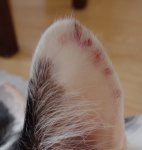
Take a look at poor Dino's ear. I know the testing is good but I can't help but feel bad about all these pokes. Breaks my heart.
 

Attachments

  • image.jpg
    image.jpg
    41.6 KB · Views: 92
Poor thing! Just keep up w/ the Neosporin and pressure. I just meant that w/ numbers that are higher you don't need to test as much.
 
I think your Dino may have been getting in lower numbers in the recent past. He got to 28 yesterday and was back at 49 today. Normally a cat that got into the 20's would bounce and be high for the following 3 days. The fact that he was back at 49 again today tells us that his body is used to being that low and isn't reacting to it as though it's a hypo.

This is telling us the dose is too large.

I'd suggest you decrease the dose by 0.25u to a new dose of 0.75u. Just measure it as best as you can - the important thing is to not shoot the 1.0u again. If it took him into the 20's before, it can do it again. That's dangerously low.

I hope you see this tonight, still, and can test him again this evening.
 
Okay. I thought if numbers are high tests are important to bring them down. But I assume low numbers are far more dangerous. Hope you are having a good weekend.
I think your Dino may have been getting in lower numbers in the recent past. He got to 28 yesterday and was back at 49 today. Normally a cat that got into the 20's would bounce and be high for the following 3 days. The fact that he was back at 49 again today tells us that his body is used to being that low and isn't reacting to it as though it's a hypo.

This is telling us the dose is too large.

I'd suggest you decrease the dose by 0.25u to a new dose of 0.75u. Just measure it as best as you can - the important thing is to not shoot the 1.0u again. If it took him into the 20's before, it can do it again. That's dangerously low.

I hope you see this tonight, still, and can test him again this evening.
This is exactly the kind of information I need. You make perfect sense. I am learning so much so thank you a million times. I will try to test again a bit later today and see where where he is. Again, thank so much.
 
You're welcome!

Most new people post every day so we can look out and help you understand what you're seeing. It's overwhelming at the beginning!

I'm so glad you saw this post, I was worried you might not.

While you're right that high numbers are a concern, low numbers are the most important numbers. Lantus dosing is based upon how LOW the dose can cause the cat to go. So you don't want to repeat a dose that gets a cat under 50 - not a newly diagnosed cat like Dino, at least.
 
oh - and would you start a new thread tomorrow? This one's getting long and a little unmangeable. We try to have everyone start a new thread (we call them condos) every day.

Great job getting the spreadsheet going, too. It REALLY helps!
 
oh - and would you start a new thread tomorrow? This one's getting long and a little unmangeable. We try to have everyone start a new thread (we call them condos) every day.

Great job getting the spreadsheet going, too. It REALLY helps!
Sure, how do I start a new thread and how will I know you will get it?
 
did you say you did use neosporin with pain relief? If you don't have that available, you want to get an antibiotic ointment with pain relief.
And looking at the picture of his ear.... You might be pressing a little harder than you need to. You'll find a balance over time.

to start a new thread.... at the top of the lantus levemir forum, is a box ... says "post new thread"
we put the date, name , amps ___ , and other info we want to say to get noticed... like question...or need input
 
did you say you did use neosporin with pain relief? If you don't have that available, you want to get an antibiotic ointment with pain relief.
And looking at the picture of his ear.... You might be pressing a little harder than you need to. You'll find a balance over time.

to start a new thread.... at the top of the lantus levemir forum, is a box ... says "post new thread"
we put the date, name , amps ___ , and other info we want to say to get noticed... like question...or need input
I'll start a new thread after this but I wanted to let you know that yes I do use the pain relief Neosporin. Also if I prick less hard I can't seem to get blood out of him. Sometimes it takes 2-3 pricks. Even after warming his ear. Oh well, I will keep practicing. Thank you.
 
Status
Not open for further replies.
Back
Top