Variety in food brands

Status
Not open for further replies.

ja9390

Member Since 2016
My 12 year old cat was diagnosed last Tuesday. I've been reading everything I can in my spare time about what is best to feed him (vet tried to sucker me into an 8lb bag of SD for $40...). Everything I've read said no more dry food, ever. I've heard great things about the popular brands of cheap canned cat food (FF, Friskies, 9lives, Special Kitty) in terms of their nutritional breakdown and their low carb content. So, I bought all of them.

I have 2 cats and have switched them both over to all canned food. I've offered them every brand to see what they like best and they seem to like them all. Will switching things up from day to day upset their digestion or should I stick with just one brand and keep it all consistent? I'm learning things as I go and hoping that the advice of others would help me to avoid making as many mistakes. One of my cats has ALWAYS had issues with eating too fast and then instantly regurgitating, which has happened a few times. The other one, the diabetic, has been on antibiotics for a cough so of course his normal microbiota has all been killed off. He's vomited quite a few times but I think it has more to do with the effects of the antibiotics.
 
Now that they have been transitioned to an all wet diet there really shouldn't be an issue when switching from one brand/flavor to another.

For your diabetic and the probable antibiotic residual issues, ask your vet for FortiFlora. It's a probiotic and will help replenish what the antibiotics killed off.
 
Good for you to refuse the dry food. Dry food is not good for any kitty let alone a diabetic kitty. If they have already made the switch to all wet food the feeding different varieties is fine as long as they are the pate type low carb wet foods. Some kitties will have stomach upsets when switching to an all wet food diet if they have been used to eating dry food on a regular basis.

Also if your diabetic kitty has been switched to just wet food from a usual dry food diet that can in some cases cause the glucose levels to drop, sometimes a lot, Plus if he is on an antibiotic there was some sort of infection. Once that is cleared up it can also cause glucose levels to fall, Dry food and infections can cause sometimes a big rise in glucose levels and once those are cleared up your kitty may need less insulin. If you are not already home testing, then it would be a good idea to start so that you can keep track of your diabetic kitty;s glucose levels and make dose changes as needed,
 
I will ask about the probiotics. Are human probiotic capsules any different than FortiFlora? I have a bunch of those already.

I've also heard about the drastic glucose drop that usually happens once you go all canned. He's only on 1 unit every morning for right now and next week I was instructed to come back and they'll do a curve on him to help determine what changes need to be made, if any. Before I switched his food I called the vet and made dead sure that his current dosage of 1 unit was still safe on a strict low-carb diet and was told it would be fine and that 1 unit is what all cats are started on at first. So far, so good. I was terrified that I would come home from work/school and find him having a hypoglycemic episode. I bought a small bottle of pancake syrup and keep it nearby in case anything like that were to happen. I've been so neurotic these past 11 days--I joked with all my friends that I can never have a human child now that I know how protective I can get over this cat child.
 
I will ask about the probiotics. Are human probiotic capsules any different than FortiFlora? I have a bunch of those already.

I've also heard about the drastic glucose drop that usually happens once you go all canned. He's only on 1 unit every morning for right now and next week I was instructed to come back and they'll do a curve on him to help determine what changes need to be made, if any. Before I switched his food I called the vet and made dead sure that his current dosage of 1 unit was still safe on a strict low-carb diet and was told it would be fine and that 1 unit is what all cats are started on at first. So far, so good. I was terrified that I would come home from work/school and find him having a hypoglycemic episode. I bought a small bottle of pancake syrup and keep it nearby in case anything like that were to happen. I've been so neurotic these past 11 days--I joked with all my friends that I can never have a human child now that I know how protective I can get over this cat child.


Some cats can drop a lot when they change to all wet food, PLUS if your kitty had an infection that can also raise glucose levels. Some people on here have been able to get their cat off insulin only by changing to a low carb wet food.

My non-diabetic cat had a UTI (urinary tract infection) and I had blood work done at the same time when I took her in for the antibiotics. She had a glucose level of 256 (14.2 mmol) using a pet meter and they told me she was diabetic. I disagreed and after 3 days on the antibiotics her levels were back down to 72 (4 mmol) using a pet meter. I test her every month or so just to check and her levels have never gone up since the UTI.

That is why it is very important to test at home. With changing the food and clearing the infection it is possible for glucose levels to drop quite a bit.
 
Yes, TuxedoMom is correct. I had both my kitties on prescription diet w/d dry for years. They both were diagnosed diabetics. When I found this site I decided to start introducing canned food. I was feeding about 1/3 can to each cat, twice a day and leaving the dry out for them because I knew sometimes they were going into hypo territory. I kept dropping Buzz's dose from 3 to 2 to 1. When I found this site I was feeding both dry and canned.
I knew it was only going to benefit my two cats if I learned how to home test. That is when I discovers that Buzz was hypoing twice a day. If you look at my spreadsheet (the second one) you will see that he was hypoing on 1 unit of Novolin and he still had the option of eating dry. During this time of seeing these hypos I was on this board getting advice from some wonderful people.
Please consider home testing and please do not take away the high carb food until you start home testing.
I will try to link my threads of this time to this post.

Woody is my other cat and switching to canned food made a difference to him, too. He was also hypoing when he had some of his meals as canned.. His spreadsheet is the first one.
 
Yes, TuxedoMom is correct. I had both my kitties on prescription diet w/d dry for years. They both were diagnosed diabetics. When I found this site I decided to start introducing canned food. I was feeding about 1/3 can to each cat, twice a day and leaving the dry out for them because I knew sometimes they were going into hypo territory. I kept dropping Buzz's dose from 3 to 2 to 1. When I found this site I was feeding both dry and canned.
I knew it was only going to benefit my two cats if I learned how to home test. That is when I discovers that Buzz was hypoing twice a day. If you look at my spreadsheet (the second one) you will see that he was hypoing on 1 unit of Novolin and he still had the option of eating dry. During this time of seeing these hypos I was on this board getting advice from some wonderful people.
Please consider home testing and please do not take away the high carb food until you start home testing.
I will try to link my threads of this time to this post.

Woody is my other cat and switching to canned food made a difference to him, too. He was also hypoing when he had some of his meals as canned.. His spreadsheet is the first one.


Thanks for posting your experience. Mum of two felines. :)

This is a great example of how a diet change can make a major difference in how much insulin is needed or whether a kitty even needs insulin
 
I've watched a few videos on the ear-prick procedure to read his sugars and I'm feeling confident that I can do it. I already have a glucometer here at home but no strips--will buy some more test strips tomorrow and get it done. Any tips besides just warm the ear up, prick the vein and go? I agree that precaution is the most important thing right now. I had one of those experiences at the vet where I was sent home with a prescription for insulin and not much else was said after that, so I'm just blindly following the doctor's instructions at this point. He hasn't acted hypo thus far but that doesn't mean he won't in the future. Some mornings he eats so little, or he'll throw his whole breakfast up (upset stomach still from the antibiotics) and I'm hesitant to even give him insulin at all. He gets his "breakfast" first thing when I wake up before I even make my coffee, I watch him eat at least a good couple of bites before I give the insulin and then I've been leaving out cans of food before I head out in the mornings just in case. The first week of doing this, I was terrified to leave his side at all. I have noticed he has his usual loving temperament back. He was feeling so bad before his diagnosis and now he's finally sleeping with me in the bed again and rubbing his face on mine like he always used to do.
 
Could you go to your profile and on the signature line put the insulin type you're using and the dosage. And when you start testing, could you also use the spreadsheet. These things are what helped the experienced FD people know what was going on with Buzz and Woody. I could have lost both my kitties if I wouldn't have been sharing information and taking their advice. I've switched vets because my previous one didn't want to learn or have an open mind to learning.

Here is the instructions for the spreadsheet setup. On the main forum page under the tech forum are instructions to help use the spreadsheet. http://www.felinediabetes.com/FDMB/threads/fdmb-spreadsheet-instructions.130337/
 
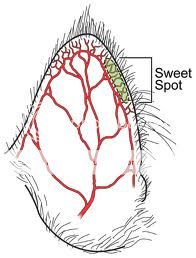
earpokey_zpsc6584fc3.jpg


This is the area of the ear that you want to poke for a blood sample. If the ear is warm you should be able to get a decent size blood sample.
 
Will switching things up from day to day upset their digestion or should I stick with just one brand and keep it all consistent?
Switching between brands shouldn't bother them at all. I do it all the time with the cats here (5 of them in total, but they all get fed the food that's OK for Rosa the diabetic with CKD - changing brands and flavors doesn't upset any of them). Rosa was another who was a dry food addict - she'd been on Royal Canin Urinary S/O dry for several years and, although it took her rather longer than Buzz or Woody to get off the insulin, she went from an at-diagnosis reading of 680 to OTJ in just 3 months...and has remained diet-controlled on her low carb wet food (anti-jinx) for over 9 months at this point.
 
Testing is important before giving each shot to make sure the numbers are high enough to give insulin. You should not feed 2 hours before doing the test since food can temporarily increase the glucose levels. It is best to test before each shot and again at some point during the cycle (time between shots).

The type of insulin you are using is important as well. Some of the harsher insulins such as Novalin or Vetsulin require that the kitty eat about 30 minutes before giving the shot. With Lantus or Levemir you can test, shoot and feed, as long as you know you kitty will eat. If your kitty continues to throw up after eating, and does not eat again soon afterwards then there may not be enough food to give a full shot.

As Mum of two felines said it would be most helpful to set up your signature with at least the type of insulin you are using and the dose. If you have any glucose readings you could put them in your post until you are able to get a spreadsheet set up. This will allow any of the members to have enough information to be able to offer advice. :)
 
The spreadsheet is a great idea when I start testing him. I plan on writing everything down in a notebook as well to take the doctor if I have to. I set my signature up, it should be visible now.
 
So with his insulin, I should wait after he eats before shooting. Good to know, as that was never mentioned to me at any point before this.
 
The spreadsheet is a great idea when I start testing him. I plan on writing everything down in a notebook as well to take the doctor if I have to. I set my signature up, it should be visible now.

Good work on the signature.

A couple of comments. Novalin is a harsher insulin which means it "hits" harder, so you should make sure your kitty has had food 30 minutes before the shot. Novaliin can drop the glucose numbers quite quickly so testing would be important about 1 hour after giving the shot to see how your kitty reacts to it, Also I see you are giving only one shot each day. Novalin is not a long lasting insulin so it will wear off long before the next shot. You could ask your vet about splitting the dose into 1/2 unit morning and 1/2 unit evening. Other good choices for insulin .....Lantus and levemir are 2 of the longer acting gentler insulins that many cats do well on. They also need to be given every 12 hours but they are not as harsh.
 
I see you are on Novolin. That's what my kitties were on. And I also see that your diabetic kitty is on antibotics. With the switch to wet and when the infection clears the BG could drop. I was asked to leave high carb food out if I wasn't around to monitor my kitties in case they started hypoing they could get the arbs to raise their BG. Matter of fact that is the only thing that was keeping them alive, I was free feeding them.
 
So with his insulin, I should wait after he eats before shooting. Good to know, as that was never mentioned to me at any point before this.


Yes since Novalin hits harder and quicker than some of the other insulins it is important to have food before giving the shot.
 
I need to sleep...I have to be up in 4 hours to give my kitty his next shot.

Mum of two felines has given you some good advice on Novalin and may have some other pointers for you as well. If you need more information than you have gotten please post using a "?" icon in your title and you could change your post title to something like "dosing advice" or whatever.

Good luck and I will check in tomorrow :)
 
So with his insulin, I should wait after he eats before shooting. Good to know, as that was never mentioned to me at any point before this.
You should wait for at least 30 minutes before giving him his injection. Also, when you start testing, test him before his shot, then +2 (which is two hours after his shot). If you could, then get a reading at +4 and +6. Let the board know when you start and if you don't have your spreadsheet up, put your numbers on. The more experienced members can watch those numbers and tell you if you need to start watching for him/her for hypo signs.
 
I just lived through this and I still remember the overwhelming confusion I had. I am now living through the knowledge that my vet almost had me killing my two little fur babies.
 
@Mum of two felines was this before you started home testing? That's scary to think of.

I was just told to make sure he eats before I give the insulin and to never give it if he hasn't eaten, so I've been shooting while he eats or right after. I will be sure to wait from now on, and I will get those testing supplies. Also, it seems to me that a 12 year old cat shouldn't be on anything that hits his system hard. His 7.5 lb little body is working hard enough as it is trying to fight his persistent cough which has come back twice now since November, then the abrupt and drastic change in diet, the vet visits... my poor baby. I'll ask my vet about making a switch to something gentler or at least cutting the dosage in half and administering the other half at night as suggested.
 
Both Buzz and Woody was hypoing before I started home testing. My vet didn't seem too concerned eve though they could have died, when I started home testing I saw they were hypoing but I didn't understand when to check them so I know they were going into hypo mode. The only good thing my vet said was to keep the dry out for them so they could regulate their BG. After I started putting the numbers on my spreadsheet the members here started helping me understand what was happening. Granted I was working with two kitties at the same time, and they both were being treated for infections on top of it, but I felt so inept. I made major mistakes, like giving Buzz 1 unit when he was in the 200's the members told me to watch him and sure enough he went hypo! My kitties are 12 and 13 so they are older just like yours.
 
@Mum of two felines was this before you started home testing? That's scary to think of.

I was just told to make sure he eats before I give the insulin and to never give it if he hasn't eaten, so I've been shooting while he eats or right after. I will be sure to wait from now on, and I will get those testing supplies. Also, it seems to me that a 12 year old cat shouldn't be on anything that hits his system hard. His 7.5 lb little body is working hard enough as it is trying to fight his persistent cough which has come back twice now since November, then the abrupt and drastic change in diet, the vet visits... my poor baby. I'll ask my vet about making a switch to something gentler or at least cutting the dosage in half and administering the other half at night as suggested.

I was also giving the shot when they were eating, but I learned from this board to wait :)
 
At least I now know a little about what not to do, and that I'm not the only one who has felt like a terrible mother at some point. Him being nonverbal and able to tell me what's going on really makes me doubt myself sometimes. It is 11:40 at night and I am up to my ears in microbiology readings, so I will check back on this thread in the morning and read back over it and all the great things that everyone has posted. Such wonderful suggestions have been made from the people on this forum already. Glad that I found y'all!
 
Status
Not open for further replies.
Back
Top