Urinating outside box

Status
Not open for further replies.

catlvr

Member Since 2013
Hello I am new to this site and in need of any advise about how to get my kitties excessive urination outside the box under control.

I have an 11 year old male diabetic cat, who was diagnosed over a year ago. He is on Lantus 10 units a day and his blood sugar levels are still consistently in the 400 range. I feed him prescription purina DM wet food. I have a mult-cat house hold so he does occasionaly get into the dry food. I am going to start feeding all my cats wet food, so he doesn't have any access to dry food what so evver.

I am looking for a good commercial wet food I can feed all the cats, and transition away from the prescribed wet food as that is very expensive. I know it will be expensive as it is to go to feeding all cats wet food only. So if any one has any suggestions of a good quality commercial wet food I can feed my kitties, that would be much appreciated.

My vet has suggested raising his Lantus to 6 units twice a day and feeding only prescribed wet food. I am hopeing I won't have to do that. But somehow I need to get his blood sugars down and excessive urinating to stop.

thank you for any suggestions.
 
Hello and welcome to the board!


First, those blood sugar levels, are they from vet tests or are you testing at home? Many cats are stressed at the vets so those numbers could well be wonky. Saying that though, the litter box issues say to me he isn't regulated yet. This could be a few causes, the dry food for sure, or too little insulin, or too much insulin.

Also to answer your question about food, many of us here feed the fancy feast classic pâtés, friskies pâtés or wellness grain free varieties as they are low carb but also relatively inexpensive. Wellness is the best quality of those three.

Now the issue is that if you stop feeding dry, his blood sugar levels could well drop and then you will be giving too much insulin and cause a hypo so home testing is critical first.. Home testing will also give you (and us ;)) a much better picture of what's going on with him.. Are you open to this?

Wendy
 
I am feeding 14 cats, so I'm feeding Friskies, in the 13 oz cans.

At WalMart, these are currently $0.78 per can (Columbus, OH)
 
Hello Wendy thank you for your reply.

I do test at home, using a sidekick glucometer, which is the same kind my vet uses. I usually test in the evening before his shot and feeding. This is usually 11 to 12 hours since his last shot, which I was told would be his highest levels for the day. I would have thought being on 10 units a day of lantus his bg levels shouldn't still be that high. The last 2 readings I got were 465 and 415.

The vet said to increase to 6 units twice a day but that would be as high as they would go with the lantus doses. I didn't think that too much insulin could cause high bg levels, would have thought the opposite.

Thank you for the advise of what commercial wet food to buy. I need to transition all 4 cats to wet food only, so there isn't any dry food in the house at all for my diabetic cat to get into. of course am looking for the most cost effective commercial wet food for all cats.

I wasn't going to increase the insulin until I could make sure my diabetic kitty was getting only wet food, the if bg levels are still high then go to 6 units twice a day and hopefully he won't still constantly urinate outside the box.

thank you again


Wendy&Tiggy said:
Hello and welcome to the board!


First, those blood sugar levels, are they from vet tests or are you testing at home? Many cats are stressed at the vets so those numbers could well be wonky. Saying that though, the litter box issues say to me he isn't regulated yet. This could be a few causes, the dry food for sure, or too little insulin, or too much insulin.

Also to answer your question about food, many of us here feed the fancy feast classic pâtés, friskies pâtés or wellness grain free varieties as they are low carb but also relatively inexpensive. Wellness is the best quality of those three.

Now the issue is that if you stop feeding dry, his blood sugar levels could well drop and then you will be giving too much insulin and cause a hypo so home testing is critical first.. Home testing will also give you (and us ;)) a much better picture of what's going on with him.. Are you open to this?

Wendy
 
Hi, how are you. I would have him tested for a urinary tract infection. Any behavior consistent with urinating outside of the box is consistent with that. You can ketone test him also since he is so high. Wishing you well.
 
That's great you are home testing but dose changes should be made on the lowest point of the day, not the highest.. Since you don't want him dropping too low. Since you are home testing, if you can get a few extra tests over the next few days we should be able to get a better idea of what's going on. So for the next few days can you get a test mid cycle, say 5-7hours after the morning shot, and another test before bed?

Also can you set up a spreadsheet? Again that will help us help you a lot!! http://www.felinediabetes.com/FDMB/viewtopic.php?f=6&t=18207
 
Hello

I have taken a urine sample to the vet about a month ago and they said no infection or ketones, just very high glucose levels in his urine. This urinating outside the box has been going on for a few months now.

I haven't had a chance to get recent blood glucose levels from him. He isn't a very cooperative cat so can be hard to get blood samples. Sometimes when I try to get samples I don't get enough blood or any blood for a sample. I don't want to poke him more than 3 times then he gets very upset and just stresses him out. I always use the ear to test, was told that was the best and easiest place to get blood, however nothing is easy with my cat :smile:

The only time can do 5 or 6 hour testing after first shot is on the weekends due to my work schedule

so will attempt that this weekend.
Thank you for your help

Theresatramondo said:
Hi, how are you. I would have him tested for a urinary tract infection. Any behavior consistent with urinating outside of the box is consistent with that. You can ketone test him also since he is so high. Wishing you well.
 
Ok good to know..

If he has high sugar in his urine that means his blood sugar is high a lot of the time. So he will drink a lot to try and clear it, and drinking a lot means a full bladder and not enough time to reach the litter box!!

Also high sugar means you want to test for ketones yourself on a regular basis. We recommend ALL diabetic cat owners test their cats for ketones twice a week or when over 340. You can get a pack of strips from Wlamart for like $8 (relion ketone test strips). We have tips for how to get a urine sample I can give you. If ketones develop its very very serious and expensive to treat.. if its treatable at all :(

Here are some blood testing tips which might help you get more of a sample. https://docs.google.com/document/d/13c_CPZVKz27fD_6aVbsguadJKvjSrSAkD7flgPPhEag/pub . We might be able to refine your technique a bit to help you get more blood - are you freehanding the lancet or using a lancet tool?

The only time can do 5 or 6 hour testing after first shot is on the weekends due to my work schedule
thats totally fine - get the preshot tests and a before bed every day during the week. And if the before bed is more than 50 points lower than the preshot, set the alarm for a test a few hours later.

Wendy
 
He isn't a very cooperative cat so can be hard to get blood samples. Sometimes when I try to get samples I don't get enough blood or any blood for a sample. I don't want to poke him more than 3 times then he gets very upset and just stresses him out. I always use the ear to test, was told that was the best and easiest place to get blood, however nothing is easy with my cat :smile:

Are you bribing him with low carb healthy treats for the testing? List of low carb healthy treats.

Have you read this wonderful writeup by member Kpassa on getting your cat more comfortable with the process? ear testing psychology

Perhaps if you can explain your testing process, we can suggest improvements.
 
Wendy&Tiggy said:
Ok good to know..

If he has high sugar in his urine that means his blood sugar is high a lot of the time. So he will drink a lot to try and clear it, and drinking a lot means a full bladder and not enough time to reach the litter box!!

Also high sugar means you want to test for ketones yourself on a regular basis. We recommend ALL diabetic cat owners test their cats for ketones twice a week or when over 340. You can get a pack of strips from Wlamart for like $8 (relion ketone test strips). We have tips for how to get a urine sample I can give you. If ketones develop its very very serious and expensive to treat.. if its treatable at all :(

Here are some blood testing tips which might help you get more of a sample. https://docs.google.com/document/d/13c_CPZVKz27fD_6aVbsguadJKvjSrSAkD7flgPPhEag/pub . We might be able to refine your technique a bit to help you get more blood - are you freehanding the lancet or using a lancet tool?

The only time can do 5 or 6 hour testing after first shot is on the weekends due to my work schedule
thats totally fine - get the preshot tests and a before bed every day during the week. And if the before bed is more than 50 points lower than the preshot, set the alarm for a test a few hours later.

Wendy

Thank you for the information about ketone testing, my vet had told me that since my kitty is on Lantus there is a very small chance of him getting ketones since that insulin has a good track record of keeping kitties ketone free. I will however home test just to be on the safe side. I know it's going to be a challenge to get a urine sample especially in a multi-cat household. I usually don't catch him in the act when he pees on the carpet, so I can't get a sample before it absorbs into the carpet.

When I test his blood I use a lancet pen, I seem to have more success using the pen than freestyle. However I do use the superfine lancets, I read you recommended using 28 or 29 gauge, I will give those a try and maybe that will make a difference. I take the blood from the outer edge of the ear and try to get as close to the vein as possible, of course this isn't always easy to see, and him being a black cat makes it very difficult to see the vein. I do warm his ear first with a rice warm that I heat in the microwave. I used to put neosporin on before taking a sample now I just do it afterwards, wasn't sure if the neosporin affected the blood sugar results. So anyway a lot of times it is hit and miss, also my glucometer errors out pretty quickly once the testing strip has been in it too long, so by the time I get a sample I get an error reading, very frustrating.

thank you wendy for your reply.
 
Those lancets (27-29 gauge) with the bigger pin for pricking are sometimes labeled "for alternate site testing".

Here's an idea for you since you mentioned you meter times out. Get everything setup, test strip out but only inserted partially into the meter, not enough to turn the meter on. Prick the ear and then push the test strip all the way in to turn it on. Takes a bit of coordination but works like a charm if your meter is timing out on you.

Other ideas to resolve the issues you are having.
1. Try using a small flashlight shining up from inside the ear to see the vein and capillary rich area better.
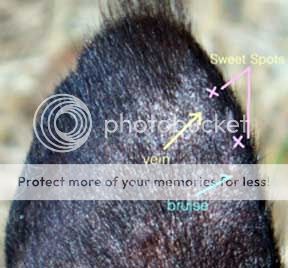
2. Shave a tiny patch on the ear to see better or test from the inside edge of the ear. (Wink has long black hair and black ear edges. I shaved a teeny patch on the top of his ear to help me see the vein better.
3. bright light to help you see better
4. magnifiers. clip-ons for your glasses, a visor if you don't wear glasses are 2 ideas.

The ears will actually "learn to bleed". They grow new capillaries over time to make it easier to get blood. :cool: Angiogenesis.
 
Does this help?

ear_web1_zps0bf45a17.jpg
 
For testing a cat with black or dark hair, it's easier to poke on the underside of the ear, and for some cats, one ear seems to bleed better, so try both. You don't need to shave a part of the ear.
I also agree with using the lancet device because it's consistent and your cat knows exactly what to expect.... freehand is NOT consistent, so the convenience is just for the human and not the cat.
I have never had to warm my cats ears; if the device is set to a proper depth, you will get a drop of blood.
As for difficulty testing, how are you going about testing him? You may try to secure him on your lap for testing; I have had great luck with some cats by wrapping them with a towel, like a loose cocoon, and I think it gives them a secure feeling. No rush, just have the meter, lancet device and strips by you and then when he's calm, you can poke the ear. having the test strip only partly put into the meter will save the timeouts.... just push the strip all the way in once you have a drop of blood on the ear. Cats can sense if you are frustrated and they will pick it up themselves.

When did your cat start urinating outside the box? That point in time is important. Is it consistent for the diabetic cat, and please try to test when you catch him. You can also pick up a container of KETOSTIX to test him for ketones yourself.... ketones can occur at high BG and low BG, and it had absolutely nothing to do with what insulin you are using - I don't know where your vet got that info.
It seems that some cats are prone to getting ketones, and some are not, so you want to test daily for ketones or whenever possible until you know if he's prone or not.... and remember: ketone prone cats show traces even at low BG, so no need to wait for higher numbers, OK?

For the urinating outside the box, there can be a few reasons, and not always an infection. My acro, Shadoe urinated outside the box almost all the time; she began and that's how she was diagnosed as having diabetes and then acro shortly after that.
It could be if BG is high or low or if there is a big drop, or even waiting till the bladder is too full and just lets go.
What times of day, and places does he urinate? When does he use the box? Does he have troubles stepping into the box? How many boxes do you have, and could he be better if he had his own?

The dose you are giving is quite high for feeding wet food with a bit of stolen dry.
If you can do a curve, testing every 2 hrs between 2 shots, and you will see how he is reacting to the dose.

Most people are working or at school or away during the week so don't worry about curves during your work days. What you can do is to get tests here and there during the week.
To use my routine before, I would be up at 5-6am, test both cats, then start getting myself for work. I would then test them just before shot time of about 7am, then get their food and shots ready, shoot and leave for work.
I'd get home before shot time, so I would pick up their food, test them when I got home around 5 or 530pm, then start dinner. At 7pm, I'd have their food ready, test them and feed & shoot. I would also get one or two test in the evening with one of them being the before bed test.
On the weekend, I try and get a curve or two done, testing every 2 or 3hrs, here and there.... it does not have to be all the same because you want to find out what's going on at diff spots along the cycles.

OK for the dose, until you know what's doing on mid-cycle, do not increase the dose. Wait until you have done some curves on the weekend to see what's happening with the dose you are giving now.
You could well be getting BG numbers at shot time in the 400s, but what is in the middle? What is the 5u shot doing? It could be pulling the numbers down to 40 and then he's bouncing right back up to the 400s again.... that would tell you to chop that dose down a few units and do another curve....

Keep getting tests at shot times and if you can, get that before bed test as many cats go lower in the evening/night. Once the weekend arrives, you will be better at getting tests and the curve should go smoothly, giving you data to know where you go with dosing.

Gayle
 
Hi Catlvr!

Just wanted to welcome you to the FDMB - you've found a great place with so many experienced & supportive people - they've been lifesavers for me! I'm new & can't advise on dosing, but you already have some great advice from other knowledgeable people.

Re. ketones & Lantus - My cat Tigger is on Lantus and had some cautionary ketone readings - no actual DKA yet, but it's something I definitely watch. You might do the same just to be on the safe side. DKA is a dangerous & potentially fatal situation, but possible to avert if one has enough advance warning. The ketone test strips are an inexpensive way to do this, & with urine outside the box, its even easier to test.

You might want to try low carb freeze-dried chick treats (purchased in dog size at any petstore or online) that you bribe with lots of praise after testing (whether successful or not) & with insulin shots if you don't dose while kitty is eating. You might also want to try some practice ear tests - no needle - just go through the procedure & let kitty hear the noise of the lancet - & get a treat & praise afterwards! Soon kitty will be more focused on the after-treat than the test - & you'll relax more, too! All I do now is shake the treat bag & Tigger comes & plops in my lap for his test - he'll also wait for me at his test spot for his shot. He loves his treats! And once you're used to it, testing only takes a minute. Like others suggested, have everything ready in a box & pre-loaded, & you're good to go each time.

Lastly, for urinating outside the box, I'd also suggest checking for a urinary infection. I understand you got a test a month ago, but one can have developed since then. Also, since you have multiple cats, it may be helpful for you to set up some other boxes around the house in case kitty is having a hard time getting to his box when he needs to go. Some just can't hold it at all once they get the urge to go, especially when they're drinking more due to the DM. Others may have painful urination & associate the litterbox with their pain, so try urinating elsewhere to avoid the pain. For mine, having multiple well-placed boxes, & keeping them cleaned in the AM & PM (I have one that doesn't like ANY dirt in the box) takes care of the problem, unless there is an infection.

You're doing a great job, and being an excellent caregiver. Hope kitty is felling better soon!
 
Hi and welcome!

Blue said:
For the urinating outside the box, there can be a few reasons, and not always an infection. My acro, Shadoe urinated outside the box almost all the time; she began and that's how she was diagnosed as having diabetes and then acro shortly after that.
It could be if BG is high or low or if there is a big drop, or even waiting till the bladder is too full and just lets go.
What times of day, and places does he urinate? When does he use the box? Does he have troubles stepping into the box? How many boxes do you have, and could he be better if he had his own?

Tigger's Friend said:
Lastly, for urinating outside the box, I'd also suggest checking for a urinary infection. I understand you got a test a month ago, but one can have developed since then. Also, since you have multiple cats, it may be helpful for you to set up some other boxes around the house in case kitty is having a hard time getting to his box when he needs to go. Some just can't hold it at all once they get the urge to go, especially when they're drinking more due to the DM. Others may have painful urination & associate the litterbox with their pain, so try urinating elsewhere to avoid the pain. For mine, having multiple well-placed boxes, & keeping them cleaned in the AM & PM (I have one that doesn't like ANY dirt in the box) takes care of the problem, unless there is an infection.

I agree with both of these assessments. I also wanted to add that when Mikey was first diagnosed, his problem was that he was put off by the smell of his high-sugar urine and would only use a box once (this is even after his UTI cleared up but he was still in high numbers). A well-informed pet store employee mentioned other diabetic cat owners having similar problems and said that they'd discovered it was related to the urine smell and switching litters would help. The two litters that seemed to work best in those instances were the Dr. Elsey's Cat Attract and the Green Tea Leaves.

So, it could be the litter you're currently using is not masking the smell to his liking. In Michelangelo's case, I switched from Feline Pine to Green Tea litter and his LB issues immediately cleared up. I eventually switched back to Feline Pine again when I couldn't stand the Green Tea litter any longer, but no LB problems since he became better regulated (and that was 9 months ago :-D ).
 
Tip number 3 from top Ear Testing Tips document.

3.Furry ears? You might want to shave them first to thin the fur out with a safety razor.
It's your decision to shave your cat's ear or not. We're simply providing the suggestions that have been gathered over many years. What works for one person may not work for another person. Maybe one cat does not need it's ear warmed. Maybe another cat does need the ear warmed. ECID.

Every caregiver does things differently too. Find what works for you. That's the best way.

Top Ear Testing Tips Maybe there will be some other tips in here that you would like to try.
 
Blue said:
For testing a cat with black or dark hair, it's easier to poke on the underside of the ear, and for some cats, one ear seems to bleed better, so try both. You don't need to shave a part of the ear.
I also agree with using the lancet device because it's consistent and your cat knows exactly what to expect.... freehand is NOT consistent, so the convenience is just for the human and not the cat.
I have never had to warm my cats ears; if the device is set to a proper depth, you will get a drop of blood.
As for difficulty testing, how are you going about testing him? You may try to secure him on your lap for testing; I have had great luck with some cats by wrapping them with a towel, like a loose cocoon, and I think it gives them a secure feeling. No rush, just have the meter, lancet device and strips by you and then when he's calm, you can poke the ear. having the test strip only partly put into the meter will save the timeouts.... just push the strip all the way in once you have a drop of blood on the ear. Cats can sense if you are frustrated and they will pick it up themselves.

When did your cat start urinating outside the box? That point in time is important. Is it consistent for the diabetic cat, and please try to test when you catch him. You can also pick up a container of KETOSTIX to test him for ketones yourself.... ketones can occur at high BG and low BG, and it had absolutely nothing to do with what insulin you are using - I don't know where your vet got that info.
It seems that some cats are prone to getting ketones, and some are not, so you want to test daily for ketones or whenever possible until you know if he's prone or not.... and remember: ketone prone cats show traces even at low BG, so no need to wait for higher numbers, OK?

For the urinating outside the box, there can be a few reasons, and not always an infection. My acro, Shadoe urinated outside the box almost all the time; she began and that's how she was diagnosed as having diabetes and then acro shortly after that.
It could be if BG is high or low or if there is a big drop, or even waiting till the bladder is too full and just lets go.
What times of day, and places does he urinate? When does he use the box? Does he have troubles stepping into the box? How many boxes do you have, and could he be better if he had his own?

The dose you are giving is quite high for feeding wet food with a bit of stolen dry.
If you can do a curve, testing every 2 hrs between 2 shots, and you will see how he is reacting to the dose.

Most people are working or at school or away during the week so don't worry about curves during your work days. What you can do is to get tests here and there during the week.
To use my routine before, I would be up at 5-6am, test both cats, then start getting myself for work. I would then test them just before shot time of about 7am, then get their food and shots ready, shoot and leave for work.
I'd get home before shot time, so I would pick up their food, test them when I got home around 5 or 530pm, then start dinner. At 7pm, I'd have their food ready, test them and feed & shoot. I would also get one or two test in the evening with one of them being the before bed test.
On the weekend, I try and get a curve or two done, testing every 2 or 3hrs, here and there.... it does not have to be all the same because you want to find out what's going on at diff spots along the cycles.

OK for the dose, until you know what's doing on mid-cycle, do not increase the dose. Wait until you have done some curves on the weekend to see what's happening with the dose you are giving now.
You could well be getting BG numbers at shot time in the 400s, but what is in the middle? What is the 5u shot doing? It could be pulling the numbers down to 40 and then he's bouncing right back up to the 400s again.... that would tell you to chop that dose down a few units and do another curve....

Keep getting tests at shot times and if you can, get that before bed test as many cats go lower in the evening/night. Once the weekend arrives, you will be better at getting tests and the curve should go smoothly, giving you data to know where you go with dosing.

Gayle
Thank you for your reply

To answer your question about where he urinates and what times of day, well he is picked a couple areas on my bedroom floor and keeps going in those same spots on a daily basis. I have gotten the puppy training pads now to protect my carpet and make clean up easier. I haven't noticed and special time of day, he will do it in the afternoons and evenings. There has even been a few times he has urinated on my bed. He will use the litter box aswell, I haven't noticed him having any problems with using the boxes. I have 4 boxes and 4 cats. He has even gone potty in my bath tub so I have put a litter box in there also. some one had mentioned changing cat litter and using the green tea litter or dr. elseys cat attract.

The vet had told me another reason that he may not be responding to his insulin and am having a hard time getting his bg levels down is if he has acromegaly, he said this makes it hard to regulate diabetic cats. I guess there is a test you can have done for it however I was told there isn't anything they can do for it. I will just make it harder to regulate his diabetes.

I plan on doing a blood glucose curve just so I can see where is levels are at throughout the day and to also test him myself for ketones.
 
Hi ~ listen ~ u have gr8 providers here. I'm new but I have to share w you tiffy's help strategies. She is doing better. Depending on ur wallet, id do evo. 94 percent protein ~ wag.com has it. This will bring the bg down ~ i.e., see tiffy's ss.
Also set up another box for this specific cat. Id give him his own space until u reg him also. Id feed him separetely too. You might want to buy a 44 inch gate to do this. Separating him will give him his own toilet and food/water dish in this crazy time.
Buy freezed dried chix treats in dog size. And bring him to vet for urine sample one more time. Let him syringe the urine out and test. That way it is pure and u can set things aside.

I think if u listen to deb w all the advice on bg~ing and the rest And do the above ~ in a month u will see results. I don't know what insulin u have but deb can help w dosing or beejay or carl
 
Omg catlovr ~ I'm sorry. U need to do a ss for ur baby if u really want to groove and u need to do ur signature. We need to see dosing and what insulin and the meter ur on. Also ss values. This IS A MUST IF U LOV THIS CAT
 
Sure he may have acromegaly but lets rule out the more common issues first

1. dry food - get rid of it once testing

2. test to check for bounces - if he is bouncing off a low his blood sugar could be high and he could be getting too much insulin. i.e.

When a cat is first diagnosed, the blood glucose has probably been high for a while. As the insulin starts to take effect and numbers start to come down, the liver has to learn to adjust to the lower numbers. We call this "liver training school". But before it relearns that low numbers are ok, when the BG drops to a number lower than the liver is accustomed, or if BGs drop low, or if the BG drops suddenly, the liver”panics” and reacts by releasing counterregulatory hormones and glucagon. This drives the BG back up. This is what we call a "bounce". Bounces can take up to 72 hours to clear so we are generally careful about increasing doses during the bounce. Once the bounce clears, then you can see the "real" numbers and determine if the dose needs to go up or down.

Wendy
 
Status
Not open for further replies.
Back
Top