Update on how we feel :)

Status
Not open for further replies.

Dante

Member Since 2021
Hello to all! This week we find out that our 10 year old cat has diabetes. I’m so glad I discovered catinfo.org. All information will be very helpful. We no longer give dry food, although the vet highly recommends "Royal canin Diabetc" dry food.

Now our cat eats "Specific" branded canned food for diabetic cats. Contains 4.9 g of carbohydrates (per 100 grams): https://www.specific-diets.co.uk/cat/special-care-diets/weight-reduction-frw-gb
But the food is like a pate, sticking to the cat’s palate. I would like to find more suitable food.

Today I found Mac's canned food for cats from Germany. The ingridiants looks very good.
For example: https://www.macs-tiernahrung.com/00808-2/

Ingridients: Meat (min. 20% duck, min. 25% turkey, min. 25% chicken) and animal by-products (duck heart, duck liver, duck lung, turkey heart, turkey stomach, chicken heart, chicken liver, chicken stomach), minerals.

ANALYTICAL COMPONENTS
Crude protein 10.4%
Raw fat 5.8%
Raw ash 2.5%
Crude fiber 0.5%
humidity 79.0%

Is this cannerd food good enough? Pure meat makes up about 70%.
 
Hi there, and welcome!

Here is a food list for the UK: https://docs.google.com/spreadsheets/d/1J5JpMe6TDXrHq_aTl9hUtHy6Gs9oRBqlz4nPGKxtySA/pubhtml

We try to stick to 5% kcal from carbs or less, looking at that list most of the Mac's foods seem to be ok (there are a few around 7%, not the end of the world).

As for the pates, you could also try adding a little water, some cats prefer it that way.

Have you started insulin yet? If so, which insulin and what dose? If switching the carb content of the diet significantly, we'll have to do it slowly and carefully so BG doesn't drop too low.

Have you familiarized yourself with Home Testing?

If you're planning on sticking around the forum, please the Help Us Help You thread to get started.
 
Hi there, and welcome!

Here is a food list for the UK: https://docs.google.com/spreadsheets/d/1J5JpMe6TDXrHq_aTl9hUtHy6Gs9oRBqlz4nPGKxtySA/pubhtml

We try to stick to 5% kcal from carbs or less, looking at that list most of the Mac's foods seem to be ok (there are a few around 7%, not the end of the world).

As for the pates, you could also try adding a little water, some cats prefer it that way.

Have you started insulin yet? If so, which insulin and what dose? If switching the carb content of the diet significantly, we'll have to do it slowly and carefully so BG doesn't drop too low.

Have you familiarized yourself with Home Testing?

If you're planning on sticking around the forum, please the Help Us Help You thread to get started.

Hi!

Thank you so much for that food list and your answer. It' really helpful.

Dante will be diagnosed with diabetes on October 13th. Glucose was 26.9 mmol/L. The veterinarian injected the insulin immediately. We give only wet food from yesterday, Oktober 16th. A visit to the vet is twice a day, he measures glucose and then decides if insulin is needed. Last evening glucose was 7.6 mmol/L, insulin allowed 0.02. This morning the glucose was 8.6. The vet did not give the insulin, we’ll see how much it will go up by this evening without insulin. :)
 
Hi!

Thank you so much for that food list and your answer. It' really helpful.

Dante will be diagnosed with diabetes on October 13th. Glucose was 26.9 mmol/L. The veterinarian injected the insulin immediately. We give only wet food from yesterday, Oktober 16th. A visit to the vet is twice a day, he measures glucose and then decides if insulin is needed. Last evening glucose was 7.6 mmol/L, insulin allowed 0.02. This morning the glucose was 8.6. The vet did not give the insulin, we’ll see how much it will go up by this evening without insulin. :)
Are the vet visits and vet administration required in Lithuania? If not, you can do all that at home and save some money. Those are pretty good numbers! If you're aiming for remission, we like to see the numbers a little lower.

Do you know what insulin the vet is using?
 
Are the vet visits and vet administration required in Lithuania? If not, you can do all that at home and save some money. Those are pretty good numbers! If you're aiming for remission, we like to see the numbers a little lower.

Do you know what insulin the vet is using?

Yes, it is possible to do it at home ourselves, but we are not ready yet. In Lithuania it is not so expensive, we pay up to 10 € per day for two glucose tests and insulin in the clinic. Of course, at home would be cheaper and less stressful for Dante, because he is very angry at the vets. I think in the next few days we will try to take a glucose test ourselves.

I know insulin is for animals. Thats all. :oops:
 
Yes, it is possible to do it at home ourselves, but we are not ready yet. In Lithuania it is not so expensive, we pay up to 10 € per day for two glucose tests and insulin in the clinic. Of course, at home would be cheaper and less stressful for Dante, because he is very angry at the vets. I think in the next few days we will try to take a glucose test ourselves.

I know insulin is for animals. Thats all. :oops:
No worries! It can be very expensive here in the US so just wanted to make sure. When you're ready, let us know, we'll be happy to help!
 
No worries! It can be very expensive here in the US so just wanted to make sure. When you're ready, let us know, we'll be happy to help!

Well, it will be tomorrow. :( The vet gave the insulin, the syringes, because from tomorrow we will have to inject the insulin ourselves for 5 days. Glucose now is 14.6 mmol /L. Insulin should be injected in 0.02 ui in the morning and evening.
Insulin is like this: https://discountpetmeds.com.au/caninsulin-2-5ml-x-10-vials/
 
Last edited:
Insulin should be injected in 0.02 ml
Insulin is typically measured in units, not mls.
Do you mean 2 units of caninsulin?
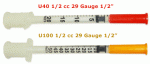
Your syringes should be U40 syringes with a red cap like the top one.
Ulticare-Syringes-Comparison.gif
 

Attachments

  • Ulticare-Syringes-Comparison.gif
    Ulticare-Syringes-Comparison.gif
    8.8 KB · Views: 526
If you can get your signature and spreadsheet set up (I linked earlier in this thread) that will be helpful.

I'd suggest starting with 0.5U of caninsulin given that you just changed the diet, it will take some time for him to adjust...given the low numbers the vet saw, lack of midcycle testing, and now these higher numbers I suspect he might be bouncing from going low (meaning he may be getting too much insulin).

Does he have a history of ketones or diabetic ketoacidosis? And he's only been given insulin twice so far, correct? If you don't have a meter yet, I'd almost rather hold off until you have one because caninsulin can be harsh.
 
An important note on when to feed your cat: Because Caninsulin/Vetsulin has an early onset, you want to have fed your cat 20 – 30 minutes before you give a shot. The order for this process is (1)test , (2) feed (3) wait 20 – 30 minutes (4) shoot.
 
Welcome. Are you using a pet or human meter? This information will be helpful.
https://felinediabetes.com/FDMB/threads/introduction-to-cannisulin-vetsulin-n-nph.231602/

https://felinediabetes.com/FDMB/threads/beginners-guide-to-caninsulin-vetsulin.231587/

I have not used caninsulin but reading the second link 2.0 is too high. Most start at .50 if eating low carb or 1.0 if dry.
Hello. Thanks, I will read the texts in the links later. 0.5 U was allowed by the veterinarian for the first time when the glucose was 26.9 mmol / L. Within days, the vet determined the correct dose for Dante and it is very low, only 0.02 U of insulin.
 
If you can get your signature and spreadsheet set up (I linked earlier in this thread) that will be helpful.

I'd suggest starting with 0.5U of caninsulin given that you just changed the diet, it will take some time for him to adjust...given the low numbers the vet saw, lack of midcycle testing, and now these higher numbers I suspect he might be bouncing from going low (meaning he may be getting too much insulin).

Does he have a history of ketones or diabetic ketoacidosis? And he's only been given insulin twice so far, correct? If you don't have a meter yet, I'd almost rather hold off until you have one because caninsulin can be harsh.

The vet determined that the insulin dose for Dante is 0.02 U. This is very low, right? Within 4 days of diagnosing diabetes, the veterinarian not injected insulin twice when glucose was lower. Other times, insulin was injected at different doses depending on glucose levels.

Today I injected myself 0.02 U, it was easy and no stress for the cat. Today I will buy a glucometer and be sure to measure glucose before injecting insulin. The veterinarian said I can always call and ask about the right dose. I trust him and don’t want to set the dose myself.

On the first day, the clinic did extensive blood tests. There was no mention of ketones that there was something wrong. I would show tests results, but I can't attach photos.
 
An important note on when to feed your cat: Because Caninsulin/Vetsulin has an early onset, you want to have fed your cat 20 – 30 minutes before you give a shot. The order for this process is (1)test , (2) feed (3) wait 20 – 30 minutes (4) shoot.

The vet told us the following procedure:
measure glucose, inject insulin and give immediately to eat.

To make it easier to inject, especially for the first time, the vet said I can inject while he eats.
 
I wonder whether the vet has given you regular tuberculin syringes rather than insulin syringes. In some countries, we’ve seen the dose measured in mls rather than units because they’re not using insulin syringes. A dose of 0.02 mls makes more sense than a dose of 0.02 units.

The type of syringe matters when deciding what line to draw to for the recommended dose. Please do NOT inject more insulin than the vet showed you. It might be necessary to inject less based on the blood glucose readings you get.

Again, regardless of what dose has been suggested here, please do NOT draw to that line on the syringe. (For example, don’t draw to the 0.5 line rather than 0.02 line). We might be speaking in different units of measure! 0.5 units is not the same as 0.5 mls.

We need to sort out the syringe and insulin issue before we can determine the actual number of units you’re giving.

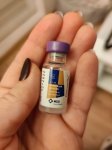
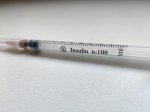
When you have time, please provide the info that is imprinted on the syringe as well as confirm the insulin you’re giving (I believe I saw reference to Caninsulin?). Photos of both would also be helpful — you can copy and paste them into the messsge.

EDITED TO ADD: The 0.02 line on a 1 ml tuberculin syringe would be 0.8 units of insulin (assuming Caninsulin u-40 strength).
 
Last edited:
I wonder whether the vet has given you regular tuberculin syringes rather than insulin syringes. In some countries, we’ve seen the dose measured in mls rather than units because they’re not using insulin syringes. A dose of 0.02 mls makes more sense than a dose of 0.02 units.

The type of syringe matters when deciding what line to draw to for the recommended dose. Please do NOT inject more insulin than the vet showed you. It might be necessary to inject less based on the blood glucose readings you get.

Again, regardless of what dose has been suggested here, please do NOT draw to that line on the syringe. (For example, don’t draw to the 0.5 line rather than 0.02 line). We might be speaking in different units of measure! 0.5 units is not the same as 0.5 mls.

We need to sort out the syringe and insulin issue before we can determine the actual number of units you’re giving.

When you have time, please provide the info that is imprinted on the syringe as well as confirm the insulin you’re giving (I believe I saw reference to Caninsulin?). Photos of both would also be helpful — you can copy and paste them into the messsge.

EDITED TO ADD: The 0.02 line on a 1 ml tuberculin syringe would be 0.8 units of insulin (assuming Caninsulin u-40 strength).
Okay, my mistake. The syringe is for insulin (u-100). And the dose is 0.02 mls.
 
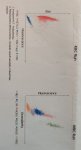
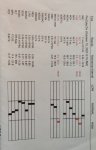
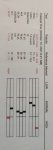
Here are the results on the first day.

upload_2021-10-18_11-18-20.jpeg

upload_2021-10-18_11-18-29.jpeg

upload_2021-10-18_11-18-37.jpeg
 

Attachments

  • upload_2021-10-18_11-18-20.jpeg
    upload_2021-10-18_11-18-20.jpeg
    25.2 KB · Views: 312
  • upload_2021-10-18_11-18-29.jpeg
    upload_2021-10-18_11-18-29.jpeg
    41.5 KB · Views: 320
  • upload_2021-10-18_11-18-37.jpeg
    upload_2021-10-18_11-18-37.jpeg
    21.6 KB · Views: 297
upload_2021-10-18_11-23-50.jpeg

upload_2021-10-18_11-24-1.jpeg
 

Attachments

  • upload_2021-10-18_11-23-50.jpeg
    upload_2021-10-18_11-23-50.jpeg
    31.7 KB · Views: 316
  • upload_2021-10-18_11-24-1.jpeg
    upload_2021-10-18_11-24-1.jpeg
    51 KB · Views: 302
The syringe is for insulin (u-100). And the dose is 0.02 mls.
Ok, great. Thanks for the photos—they help.

We speak in actual units of insulin here rather than mls because there are different insulins, different strengths of insulin, different syringes, etc., so it can get confusing. Knowing the actual units of insulin being dosed helps keep everyone on the same page and prevent accidents. (No need to apologize; Some vets do recommend dosage in mls rather than units).

I assume you’re drawing to the first short line, correct? (Similar to where the plunger is in the photo)

Bottom line: you’re giving 0.8 units of Caninsulin per dose (0.02 ml)

Explanation: Caninsulin has 40 units of insulin per milliliter (hence the U-40).

Therefore 0.02 mls is 0.8 units of insulin.
(40 units/ml x .02 ml = 0.8 units)

A 1 ml syringe (insulin syringe or not) holds 40 units of Caninsulin. Each short line on your syringe represents 0.02 mls (0.8 units).

Typically, one matches the type of insulin syringe to the strength of the insulin. For example, you use a u-40 insulin syringe with a u-40 insulin and a u-100 insulin syringe with a u-100 insulin. That allows you to speak and dose more easily in “units” and makes dosing simpler. For example, if you were using a u-100 insulin, the line you’re now drawing to would be 2 units (rather than 0.8 units) because u-100 insulin is “stronger” with 100 units per ml. (There’s a conversion when mixing and matching insulin strengths and syringes but we’ll leave that for later).

It’s great that you’re going to check blood glucose (BG) at home. Stress at the vet clinic can elevate BG values so it is wise to see what the numbers are at home.
 
The vet told us the following procedure:
measure glucose, inject insulin and give immediately to eat.

To make it easier to inject, especially for the first time, the vet said I can inject while he eats.

I'm sorry but your vet is wrong
  • Because this insulin can drop BG quickly, it is important to feed your cat 20 - 30 minutes before giving insulin. This ensures there is food on board for when the insulin starts to work. So, the sequence would be: (1) Test BG. (2) Feed. (3) Wait 20 - 30 mins. (4) Give the insulin shot. (If you are not yet home testing it is still advisable to feed and then wait before giving the shot).

 
Ok, great. Thanks for the photos—they help.

We speak in actual units of insulin here rather than mls because there are different insulins, different strengths of insulin, different syringes, etc., so it can get confusing. Knowing the actual units of insulin being dosed helps keep everyone on the same page and prevent accidents. (No need to apologize; Some vets do recommend dosage in mls rather than units).

I assume you’re drawing to the first short line, correct? (Similar to where the plunger is in the photo)

Bottom line: you’re giving 0.8 units of Caninsulin per dose (0.02 ml)

Explanation: Caninsulin has 40 units of insulin per milliliter (hence the U-40).

Therefore 0.02 mls is 0.8 units of insulin.
(40 units/ml x .02 ml = 0.8 units)

A 1 ml syringe (insulin syringe or not) holds 40 units of Caninsulin. Each short line on your syringe represents 0.02 mls (0.8 units).

Typically, one matches the type of insulin syringe to the strength of the insulin. For example, you use a u-40 insulin syringe with a u-40 insulin and a u-100 insulin syringe with a u-100 insulin. That allows you to speak and dose more easily in “units” and makes dosing simpler. For example, if you were using a u-100 insulin, the line you’re now drawing to would be 2 units (rather than 0.8 units) because u-100 insulin is “stronger” with 100 units per ml. (There’s a conversion when mixing and matching insulin strengths and syringes but we’ll leave that for later).

It’s great that you’re going to check blood glucose (BG) at home. Stress at the vet clinic can elevate BG values so it is wise to see what the numbers are at home.

Thank you a lot! :bighug:

I bought a glucometer today. Not the best, as it measures from 1-2 μl of blood. Initially, I was unable to measure glucose even for myself. I already thought I would throw out that machine. But we managed to measure the glucose ourselves and then we immediately tried on Dante. Succeeded a second time. He even liked it (murmurs). :cat: But I was only able to measure glucose later when I had already injected insulin. BG is 16.4 mmol/L. :(
 
I'm sorry but your vet is wrong
  • Because this insulin can drop BG quickly, it is important to feed your cat 20 - 30 minutes before giving insulin. This ensures there is food on board for when the insulin starts to work. So, the sequence would be: (1) Test BG. (2) Feed. (3) Wait 20 - 30 mins. (4) Give the insulin shot. (If you are not yet home testing it is still advisable to feed and then wait before giving the shot).


Thank you! :bighug:

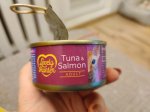
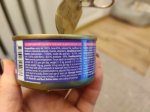
It’s very hard with canned food, he doesn’t like almost anything. It eats from the beginning, but not much. What he ate before is unsuitable because it contains sugar.
Now he only likes tuna... Today I tried to mix tuna with pate.

What do you think about canned tuna and other fish?

upload_2021-10-18_22-15-53.jpeg

upload_2021-10-18_22-16-1.jpeg
 

Attachments

  • upload_2021-10-18_22-15-53.jpeg
    upload_2021-10-18_22-15-53.jpeg
    54.8 KB · Views: 299
  • upload_2021-10-18_22-16-1.jpeg
    upload_2021-10-18_22-16-1.jpeg
    68.7 KB · Views: 284
Hi I'm sorry I can't suggest any wet food , I know Melissa (@FrostD gave you a link for UK foods . One think I know is that you should not feed fish everyday because of the mercury in it. Once and awhile is ok.
I'm trying to remember who I can tag that is from the UK and see what they have to say.


Tagging a couple of UK members
@Elizabeth and Bertie
@Diana&Tom

Hi ladies any suggestions about food
Please see post #1 and #27
Thank you
 
Hi I'm sorry I can't suggest any wet food , I know Melissa (@FrostD gave you a link for UK foods . One think I know is that you should not feed fish everyday because of the mercury in it. Once and awhile is ok.
I'm trying to remember who I can tag that is from the UK and see what they have to say.


Tagging a couple of UK members
@Elizabeth and Bertie
@Diana&Tom

Hi ladies any suggestions about food
Please see post #1 and #27
Thank you

I'm not from UK. From Lithuania, another country in Europe. So that link with chart is only partly useful.
 
What do you think about canned tuna and other fish?
Hi, it looks like the food you've got there is a 'complementary' one and not a complete food. But it could be OK as a treat.

Because you are in Europe the labelling on your pet foods is likely to be much more accurate than those in the US. (European foods 'usually' give the data on the label as 'typical analysis').
So, you may find the carb calculator linked below useful in working out the carb content of any foods that you are considering. It easily calculates the 'percentage of calories from carbs'.
...Do you have Zooplus in Lithuania? If so you may find many suitable foods there.

Link to calculator:
https://secure.balanceit.com/tools/_gaconverter/index.php?

Eliz
 
Hi, it looks like the food you've got there is a 'complementary' one and not a complete food. But it could be OK as a treat.

Because you are in Europe the labelling on your pet foods is likely to be much more accurate than those in the US. (European foods 'usually' give the data on the label as 'typical analysis').
So, you may find the carb calculator linked below useful in working out the carb content of any foods that you are considering. It easily calculates the 'percentage of calories from carbs'.
...Do you have Zooplus in Lithuania? If so you may find many suitable foods there.

Link to calculator:
https://secure.balanceit.com/tools/_gaconverter/index.php?

Eliz
Hi. Thank you! It's very helpful for us. :cat:
 
The vet determined that the insulin dose for Dante is 0.02 U. This is very low, right? Within 4 days of diagnosing diabetes, the veterinarian not injected insulin twice when glucose was lower. Other times, insulin was injected at different doses depending on glucose levels.

Today I injected myself 0.02 U, it was easy and no stress for the cat. Today I will buy a glucometer and be sure to measure glucose before injecting insulin. The veterinarian said I can always call and ask about the right dose. I trust him and don’t want to set the dose myself.

On the first day, the clinic did extensive blood tests. There was no mention of ketones that there was something wrong. I would show tests results, but I can't attach photos.

How do you measure such a low dose of insulin? What kind of syringe do you use? What kind of insulin?
 
Status
Not open for further replies.
Back
Top