Newly diagnosed with questions

Status
Not open for further replies.

SandyS

Member Since 2016

Dear everyone,
Thank you in advance for your input! I have read lots of pages on the site- thank God for the person on the IBD Facebook page who told me about it. What an oasis of information. I’ve been taking notes as I read and I think I am reaching maximum saturation for my brain, so I would like to list my notes/questions here and if anyone could take some time and give them a glance and let me know if I am on the wrong track, I would be most grateful. Also I am trying to highlight where I have a question as in my newbie anxiety I am sure I am blathering on far too long leading up to the questions. :) I am very sorry if this is too long, I am just so afraid of doing the wrong thing for Macy. Apologies if the spacing is weird in the post, it looks different when I am typing it than in the preview. Ack, I am really nervous about posting this many questions, I really am sorry for having so many!!

I know myself well enough to know that I will do a much better job for Macy if I have kind of a set routine with fairly exact timing and stuff in the beginning, so that is what I am focusing on at the moment. I gather that changing her food not only can wait but should wait until we get her glucose under control. And I understand that things can and will change but I really need a framework to build on, I guess.

First, my husband thinks we can fix this simply by adjusting food type and amount. I don’t think that is true at all, I think she medically requires insulin to get her glucose under control AND THEN if we change food to low carb and get her weight down, she might go into remission. He is understandably anxious about killing her with hypoglycemia but I don’t think his approach will work.

Background information: I read on the site in a few places where diabetes involves “persistently” elevated glucose in blood and/or urine. Macy has had a single blood glucose that was abnormal. Her last labs in 11/2014 had a glucose of ~120. Yesterday [5/6/16] she had a fasting glucose of “475+” after a 10 hour fast. She had a urine glucose of 1000 [no reference range or UOM provided in report], urine protein 30, negative for ketones, and blood was 10. She has “cocci too numerous to count”, and she is being treated for a UTI [she had progressive leaking from her vulvar region which is why I took her to the vet]. Macy weighed 12 lbs 15 oz at the office yesterday.

Questions:

  • What is your opinion regarding her diagnosis of diabetes? Is it too soon to call it diabetes? Between the stress [she has to be sedated to have them even touch her at the office] and the UTI, is it possible the combination would throw her glucose that far out of whack?
  • What does ‘persistent’ mean, exactly? Is it over X period of time or X number of consecutive abnormal readings higher than X?
Regarding the way I need to proceed with administering the insulin, this is what I have written down, can you tell me if I am interpreting things correctly here?

1. First thing in the morning, test Macy’s glucose level.
  • Question: If <200, then no insulin? Test again later? Vet said goal is to keep her 'in the 200 range'. Her fasting glucose 5/6/16 was "475+" after 10 hour fast.

2. Feed her 2/3 of the normal breakfast.

  • Questions: I think the recommendation is to not change food right now. They are free feed with dry food at this time. Both of them eat Hills I/D and Purina E/N [my other cat is IBD and vet said they could both eat the same food]. How would this affect my findings/plan/etc? Saw somewhere else on site to give 1/2 daily food in the morning and leave the remainder out for them to eat throughout the day. Also with free feed, I'm not sure she will ever truly be fasting for a specified amount of time unless I take the food up. Should I do that?

3. Wait 30 minutes after eating, then administer insulin [1u]

  • Questions: If her glucose bottoms out, when is the most likely time for this to happen post-insulin? The insulin we are going to use is Vetsulin. I just want to make sure I have eyes on her during the most common ‘dangerous’ times.
4. After X amount of time, [I can’t find this page again, how much time? ] give the other 1/3 breakfast [again, how is this impacted by free feed dry food]

5. Test glucose after 1 hour, 3 hours, 10 hours and record. Question: How do I know what the expected nadir time is for this type of insulin? [Vetsulin]

Q: Regarding the abbreviations in the spreadsheet: I can’t quite suss what AMPS and PMPS means [I am guessing AM and PM something] and then are the +1,+2 etc columns where I record her glucose level at different intervals?

Q: Critter Mom advised getting some ketostix and testing Macy’s urine. Any advice on how to manage this? We use clumping litter so I guess I would have to catch her in the act?
If you are still reading, bless your heart and thank you! I will not make such a long post in the future [I hope], just have a lot of questions getting started. :)
Sandy
 

Dear everyone,


Background information: I read on the site in a few places where diabetes involves “persistently” elevated glucose in blood and/or urine. Macy has had a single blood glucose that was abnormal. Her last labs in 11/2014 had a glucose of ~120. Yesterday [5/6/16] she had a fasting glucose of “475+” after a 10 hour fast. She had a urine glucose of 1000 [no reference range or UOM provided in report], urine protein 30, negative for ketones, and blood was 10. She has “cocci too numerous to count”, and she is being treated for a UTI [she had progressive leaking from her vulvar region which is why I took her to the vet]. Macy weighed 12 lbs 15 oz at the office yesterday.

Questions:

  • What is your opinion regarding her diagnosis of diabetes? Is it too soon to call it diabetes? Between the stress [she has to be sedated to have them even touch her at the office] and the UTI, is it possible the combination would throw her glucose that far out of whack?
  • What does ‘persistent’ mean, exactly? Is it over X period of time or X number of consecutive abnormal readings higher than X?
Regarding the way I need to proceed with administering the insulin, this is what I have written down, can you tell me if I am interpreting things correctly here?

1. First thing in the morning, test Macy’s glucose level.
  • Question: If <200, then no insulin? Test again later? Vet said goal is to keep her 'in the 200 range'. Her fasting glucose 5/6/16 was "475+" after 10 hour fast.

2. Feed her 2/3 of the normal breakfast.

  • Questions: I think the recommendation is to not change food right now. They are free feed with dry food at this time. Both of them eat Hills I/D and Purina E/N [my other cat is IBD and vet said they could both eat the same food]. How would this affect my findings/plan/etc? Saw somewhere else on site to give 1/2 daily food in the morning and leave the remainder out for them to eat throughout the day. Also with free feed, I'm not sure she will ever truly be fasting for a specified amount of time unless I take the food up. Should I do that?

3. Wait 30 minutes after eating, then administer insulin [1u]

  • Questions: If her glucose bottoms out, when is the most likely time for this to happen post-insulin? The insulin we are going to use is Vetsulin. I just want to make sure I have eyes on her during the most common ‘dangerous’ times.
4. After X amount of time, [I can’t find this page again, how much time? ] give the other 1/3 breakfast [again, how is this impacted by free feed dry food]

5. Test glucose after 1 hour, 3 hours, 10 hours and record. Question: How do I know what the expected nadir time is for this type of insulin? [Vetsulin]

Q: Regarding the abbreviations in the spreadsheet: I can’t quite suss what AMPS and PMPS means [I am guessing AM and PM something] and then are the +1,+2 etc columns where I record her glucose level at different intervals?

Q: Critter Mom advised getting some ketostix and testing Macy’s urine. Any advice on how to manage this? We use clumping litter so I guess I would have to catch her in the act?
If you are still reading, bless your heart and thank you! I will not make such a long post in the future [I hope], just have a lot of questions getting started. :)
Sandy

Hi Sandy and welcome! These are not "too many questions". Everyone who answers your post started here with a diabetic cat, scared and with lots of questions.

I am wondering if she is really as high as she looked in the vet office. As you say, she was scared and had an infection which can both raise glucose levels. I think a good approach might be learning to test her blood glucose levels at home first, see where her levels are and then decide whether a change in diet might be enough or whether she needs insulin.

For reference, we consider a cat generally regulated if they are in the mid 200s at shot time and in the 100s or lower at nadir (the lowest point in the cycle) but not below 50 on a human meter or 68 on a pet meter, ranges in the hypo range.

Here is a primer on Vetsulin

http://www.felinediabetes.com/FDMB/threads/vetsulin-caninsulin-user-guide.302/

Amps is the morning number, before food and insulin. Pmps is the evening number before food and insulin. With Vetsulin you do want food on board before giving the shot as it can have a fast onset. We say to withhold food 2 hours before the evening and morning shot, so the number you are basing your dose on is not influenced by food. Otherwise, we don't do fasting levels in the middle of the cycle

Keep reading, asking questions. This is a big learning curve at first but you will be amazed how powerful you feel the more you learn.
 
Don't feed for two hours before testing the blood glucose in the morning. With vetsulin test feed then wait 30min and give injection. The nadir can be like +2 +3 . Also 12 hours between injections. You will need to setup a spreadsheet. I also recommned to keep a hard copy.http://www.felinediabetes.com/FDMB/threads/fdmb-spreadsheet-instructions.130337/
There is two ways to test for ketones either by a meter or the urine way.
As for food/diet well there is a whole lot of information for that. http://www.catinfo.org/#Prescription/Therapeutic_Diets_

did they teach you about handling insulin and how to draw blood from the ear to meter test?
 
Thanks, Sue & Oliver and Scoobydoox! I will have to give some thought to the timing of the morning dose [if indeed she really does need insulin] if there's a two hour pre-test window. So I would withhold food for two hours, then test her, then feed her and 30 minutes later give the insulin? Maybe I could have my husband take up the food before he comes to bed [around midnight] and then test her when I get up at 3 or 4...hmm.

Re: the handling of insulin, the vet said it has to be refrigerated and gently inverted to remix it if it looks like there is sediment when I pick it up. And that if it gets really thick it has gone bad. I didn't get any information about how to get the blood specimen but thanks to the information here I am feeling fairly confident about that part now. I used to be a phlebotomist years ago so at least I'm not squeamish [that's probably the only thing I have going for me at this stage, lol].
 
I asked my vet the same question about if insulin was necessary. I said since there is an infection going on and that is being treated what is the chance he may not be diabetic and the numbers are off because of the infection? He told me that a lot of times an infection occurs and that unmasks diabetes. They go hand in hand. The percent is pretty high your cat may need insulin.

 
Sandy dont worry about too many questions, if you dont ask it, you wont know. Plus someone else may be wanting to ask the same thing and too scared or shy to do it, so you may be helping someone along the way :)

I sympathize with the free feeding dilema, I have it here as well. I wound up picking up the food before bed, and 2 hours before his evening preshot to start with. Will Macy eat any wet food? Cooter was a dry only cat, but I started with testing him and feeding most of a can of wet, then giving the insulin a half hour later. He figured it was a treat so it really helped with getting him used to testing. I am now not giving him any dry food because I see how high it takes his glucose readings.

The dont inject under 200 is a safety net. Until you know how Macy will react to the insulin, it is safer not to do it. There are some folks that have been using their parcticular insulins for awhile and know how to adjust or do what they need to safely shoot under 200, but I know I'm not one of them :)

The Nadir on vetsulin is usually between 4-6 hours, but it can be a little earlier or later. Cooters seemed to be between 3-4 hours in. There is also a second Nadir with vetsulin, but it is usually not a big drop

The ketostix are pretty easy depending on your kitty, I picked some up at walmart, the relion brand. They are in the same area as the meters and lancets. They are about 4" long, and if you can put them under Macy when she pees, otherwise you will have to collect a sample in a container or others have used plastic over the box to catch some.

AMPS and PMPS are AM preshot and PM preshot, if you give the injection at 8am the +1 would be 9am, +2 10am etc. Here is a little more info on the spreadsheet: http://www.felinediabetes.com/FDMB/threads/understanding-the-spreadsheet-grid.156606/
 
See my signature link Secondary Monitoring Tools for some tips on urine ketone testing as well as other assessments you may find helpful in evaluating your cat.
 
Thanks, everyone! I need to go re-watch the videos on getting the blood from the ear because it has been a big fail so far. It clearly doesn't hurt her but I'm not getting enough blood for the test, despite having what I thought was a fairly juicy drop. I will have to find a way to warm her little ear up quickly. She will flop down and let me rub her belly or anything else for hours but she has issues with being restrained in any way, so I have to move quickly to get the blood. I'm delighted to see with my own eyes that the actual ear prick doesn't bother her, though. Wish me luck.
 
I will have to find a way to warm her little ear up quickly

A small sock with some dry rice in it and microwaved makes a good ear warmer, as does a small pill bottle filled with warm water.

And actually, I have to go with your husband on the food....Usually the first thing we tell people to do here is get the cat off the high carb kibble and onto a low carb canned or raw diet. Just as with humans, diabetic cats need to be eating low carb foods (less than 10% carbs)

There's a lot of great information (including a chart with carb percentages) on Dr. Lisa's Feline Nutrition website. It's very much worth the time to read through!

It's safer to transition onto low carb food before you start insulin...and in some cats, the food change is all it takes to control the diabetes!
 
I also will encourage you to consider changing the food to low carb wet before you start insulin. The website that Chris mentions above is excellent reading and is well worth the time you spend reading there. I was amazed at how much my cat's health improved when I began feeding him wet food.
 
Thanks, Chris and China! I will never be so happy to eat crow as I will be if Macy ends up never having to go on insulin, that's for sure! I was confident-ish that we would be able to control it with diet eventually but I had the idea that it was just too high to not get it under control with insulin first. If I ever succeed with getting her glucose level at home I think it'll be very informative, too.

Now, regarding the food transition--I was thinking that I wasn't supposed to attempt to change her food just yet because of the vet saying she needs to start insulin? Are you saying that it would be safe to completely transition her to low carb over a week or two and then put her on insulin if her glucose is still elevated? Would you say that rarely/sometimes/often works?

thank you for your help!
 
Thanks, Jan! I forgot to mention above that I have been trying to transition my cats to wet or home cooked or raw for a couple of years with no success. My other cat has IBD, so that's the reason why I've been trying. I have tried virtually every canned food out there; have tried freeze dried raw like primal and stella and chewy, tried raw with radcat, tried home cooked with different proteins using Alnutrin and Food Fur Life additives, made bone broth, and they won't eat it. They are very hard core with the kibble. I will keep trying--have had many good suggestions and I think I have tried them all so far. But I really do keep trying--it would be better for both of them to be on at a minimum wet food and ideally raw, considering both of their health issues. It is a great sadness to me, because the only reason they were put on 100% kibble was at our old vet's advice. And we always were so careful never to let them have people food, thinking it wouldn't be good for them, so they've never developed a taste for it at all, more's the pity.
 
Are you saying that it would be safe to completely transition her to low carb over a week or two and then put her on insulin if her glucose is still elevated? Would you say that rarely/sometimes/often works?

Yes, it's safer to go ahead and transition onto wet food now.....depending on your cat, it doesn't have to take very long. If she tolerates the new food well, you can give her 25%new/75% old the first day, 50/50 the 2nd day, 75%/25% on day three and 100% canned, low carb on day 4.....if she doesn't tolerate it well, you'd just slow it down a little

If she's still over renal threshold when she's 100% on low carb food and completely over her UTI, you'd want to start insulin....but by going ahead and getting her on the low carb now, it can only help to bring her numbers down some
 
Thanks, everyone! I need to go re-watch the videos on getting the blood from the ear because it has been a big fail so far. It clearly doesn't hurt her but I'm not getting enough blood for the test, despite having what I thought was a fairly juicy drop. I will have to find a way to warm her little ear up quickly. She will flop down and let me rub her belly or anything else for hours but she has issues with being restrained in any way, so I have to move quickly to get the blood. I'm delighted to see with my own eyes that the actual ear prick doesn't bother her, though. Wish me luck.

The getting blood can be tricky at first, but every prick you do whether it is enough blood or not is a step forward. Macy will develop capilaries in here ear the more you do it, and more capilaries means more blood, so easier testing :) I hope the diet change can get her regulated, that would be the best outcome, much easier on both of you! If you manage to get some successful tests it will be a big insight into how elevated her levels really are, and you wont have to worry about the stress factor from the vet, just whatever elevation the UTI is causing right now. Hoping her number look good and perhaps it isnt really that high at all :cat:
 
Thanks Chris & China! I am taking another look at Dr. Pierson's site--I remember visiting it after Pixie was dx'd with IBD but it has been a while. Re: a novel protein--I was about to say 'I will have to feed her crickets for it to be something new' but then I realized that, even though I have offered her everything from kangaroo to buffalo, she never actually eats it, so I guess there are still quite a few novel proteins out there that I can revisit.

Edited to add=you mentioned if she's still over renal threshold, what's that?
 
Thanks, Sarah! I'm going to take up their food tonight and give it another try tomorrow morning. Wish me luck! :) I really appreciate your support!
 
It sounds like you have been trying to help your kitty family feel better for a while now and you are doing so many things well. Macy is a very lucky kitty to have you and your husband to look after her. One thing you might try to help her be more interested in meat is to warm it to a nice "mouse temperature". My little guy often prefers to eat warm meat.
 
Over renal threshold is the point at which there's so much sugar that the kidney's can't process it and it spills over into the urine

The point where that happens varies from cat to cat, but can be anywhere from a blood glucose of 140 to 280

Any time they're over the renal threshold, their kidneys are working harder than we want them to. Kidney failure is the main complication of diabetes in cats (which is also another reason we want them on canned....the extra water in a canned diet helps to keep those kidneys flushed out and healthier!!)

If you want to "tag" someone, put the @ sign in front of their name...Like @SandyS
 
Hi again, Sandy.

Did your vet run a fructosamine test as part of the diagnostics or was it just a spot check BG test during the exam plus the urine test result upon which he based the preliminary diabetes Dx?

Re ketone testing, some people find it handy to put some plastic food wrap over the spot(s) where the kitty prefers to pee in the litter box so that it will collect some urine for testing with the Keto-diastix.


Mogs
.
 
Hi again, Sandy.

Did your vet run a fructosamine test as part of the diagnostics or was it just a spot check BG test during the exam plus the urine test result upon which he based the preliminary diabetes Dx?

Re ketone testing, some people find it handy to put some plastic food wrap over the spot(s) where the kitty prefers to pee in the litter box so that it will collect some urine for testing with the Keto-diastix.


Mogs
.
Hi @Critter Mom --no fructosamine test. I have a note for myself that we will need to do one every 3 months if uncontrolled and every 6 months if her glucose is controlled, I hope that is right. It was just the chemo profile and the urinalysis Friday. The vet just said 'Macy has diabetes' and that we need to start her on insulin.

Is the fructosamine test similar to a glycohemoglobin for people?

Feeling pretty discouraged this morning--still can't get a specimen from Macy for the glucose test. I am sure I could pin her down and force it but I don't want to turn this into a traumatic thing for her because we will have to do it so frequently, ya know? She has smaller ears than our other girl Pixie and they are very soft and slick, so between her pulling away and my clumsy fingers I am getting nowhere fast. She's a slippery little beastie. Thankfully, she's not mad at me, once I let go of her ear she is fine again [so far].

She has such a thing about being restrained in any way- when we had a holistic vet come to the house to see her [because she was having the drainage that led to her dx], she was fine with being petted by the doctor and was friendly and sweet like always but the second the vet sort of picked up her back end to palpate her abdomen, she went crazy, biting, hissing, scratching and fighting to get loose, all in the span of about 1.5 seconds. The vet actually pointed out that it was the being restrained that was her trigger--we'd only ever seen it before at the regular vet's office and didn't make the connection. She has to be knocked out for them to even examine her at the vet's office, and she is very very sensitive to any and all meds, so I surely don't want to have to put her under anesthesia several times a week to get her glucose checked. That can't be good for her. So I will just have to make this work somehow. I must be the most incompetent cat lady ever.
 
Dont know if this will help, but it works for my boy, he is very food motivated! To get him to sit still long enough when hes being antsy I crack the tab on the can of food, it opens it just enough to smell, but he cant eat it yet. He cant help but start sniffing at it and it occupies him long enough for me to get the test done. I know others have some great tricks for you to try as well :)
 
You want to be sure and heat the ear until very warm - it gets the blood flowing thru the capillaries. And often a larger lancet helps - humans use 30/31 gauge lancets to make a tiny hole. Cats may need 25-27 gauge (called alternate site lancets) to make a big enough hole at first. It's also okay to make a quick second poke in the same place.

Have you tried Stella and Chewy's? It's a manufactured raw food (low carb) that has a drier texture and is sometimes appealing to hard core kibble cats.

We have seen cats who go into remission with only a diet change. I'd say it isn't terribly common, but happens. More common is a kitty who improves with a diet change but still needs a small amount of insulin to go into remission. And then, of course, there are cats who take months or years of insulin. As insulin is a hormone, it is very dependent on the cat's own body chemistry.

Be sure to offer a favorite low carb treat every time you poke - successful or not. Bonito flakes and PureBites are popular at my house, but lots of people just bake a chicken breasts without spices and cut into tiny pieces as a treat.
 
Sandi, your signature states you haven't started insulin yet and also it will be once a day? Please check with your vet, when started it should be at least twice a day. It is a short term fast acting insulin. It will drop the glucose quickly but will not hold him through the entire day.

You have an IBD kitty also. Have you tried making the bone soup on their website. You could try and add a little to entice him to eat the wet. It is now the only way Smokey will eat venison food.
 
Thanks, everyone! @Woodsywife and @Sue and Oliver (GA) -I have tried Stella and Chewy--it probably came the closest of anything. They at least lapped up the excess water when I rehydrated it, but only the very first time. lol. I made the bone broth not too long ago and they had no interest in it, unfortunately. I think I did them a disservice by being so strict about ever letting them taste table food, because they just don't have a taste for it 'people food' at all. I saw on the site somewhere [or maybe Dr Pierson's site] to try a little parmesan cheese sprinkled on top so I will give that a shot. @Sarah Smith --that was an excellent idea--I tried it and she was kinda 'meh' but it got me to thinking and she really likes drinking water out of a coffee mug with a little bit of ice, so I took some of that and got her occupied with the water while I was trying to get to that little ear--didn't exactly work today due to my own slowness but I think it has potential, so I am feeling good about that! :)

I think I saw that Fancy Feast pate is a decent grocery store kind of food, so I may pick up a few cans of that today and see if she will at least try it after not eating for several hours [I am trying Dr. Pierson's suggestion of feeding twice daily and taking the food up in between]. I am really hoping and praying that doing that doesn't send my IBD kitty into a tailspin.

Regarding her blood sugar--SUCCESS finally getting the meter to read. Her glucose is 382 at 11am--she is not fasting. This is 2.25 hours after having some dry food. I know her other fasting value of 475+ at the vet's office was high, but is 382 a couple hours after eating dry food a bad value? I can't find what the value should be a couple hours after eating and without any insulin. I'll get another one tomorrow morning [hopefully] before she eats, too.

Turns out I was doing the Alpha Trak incorrectly--in my other glucometer that I used to have, and in the videos that I saw [that were not alpha trak], the blood went into the middle portion of the tip of the strip. In alpha trak, it has to go onto the side. Once I did that today it registered and reported the value lightning fast so while it will probably still take me all day to actually get her to hold still long enough to lance her ear, at least I know that I can get the darned machine to tell me what her glucose is once I get a drop of blood.

Almost forgot- @Woodsywife -I haven't started her on insulin yet--thankfully someone sent me here and I have been trying to learn as much as possible first. The veterinarian told us 2U once daily [and in fact gave her 2U Friday in the office]. So that's her prescription but I don't think we are going to give her that much [and I think we are going to see if we can hold off on starting insulin, depending on what y'all think about her blood glucose today].[/USER]
 
382 is not terribly high, but not a normal number. BUT in many cats, dry food can raise the numbers over 100+ points. So, your job will be to get her on wet food only, asap. Some people have to feed the cats separately, watch while they are eating and then take up the dry.

Another possibility is FortiFlora. It is a probiotic with the enzyme that makes dry food so irrestible; you sprinkle it on the wet. It is magic for some cats; not so much for others. You can get it through your vet sometimes - also online.

Fancy Feast is a good choice and often very popular. It helps there are so many flavors. Stick with the pate classics. My cat likes a little warm water mixed in to make a gravy.

We consider a cat in remission if they range from 40 - 120 off insulin with a human meter. I gave you the regulated numbers earlier - mid 200s at preshot, 100s and below at nadir, but not below 68 on your pet meter.
 
Yay for the first hometest!! :D It honestly gets easier from here :cat: 382 is high, not sure how much itis being driven from the dry food though. I know someone with more knowledge will be along shortly to give you some insight on that. I do know that dry food was totally driving Cooters numbers through the roof. We are now 5 days into him not eating any dry and his numbers look SO much better! He was consistently reading in the 500-600+ (my meter doesnt read any higher then 600) at his preshot tests, even with me picking his food up 2 hours earlier. His AM number this morning was 294, just shows what kind of an impact it could be having. If you can, try to decide what time you may do injections (if it comes to that) and pick up her food 2 hours before then. Get a test, sort of like a dry run with no injection, and see what her number looks like. That may give you an insight into how she's really doing. Once again your doing doing a great job! :bighug::bighug:

Edit: Theres a link on my signature with a list of low carb wet foods under 8% if you want to take a look
 
Thank you, @Sarah Smith , you've been a great support! I will definitely check out the shopping list, and I've added my spreadsheet [I hope], thanks to your siggie link. :)

@Sue and Oliver (GA), @Woodsywife, does the following sound reasonable? My hubs picked up some fancy feast classics at the grocery today so we are going to try to get Macy Grace started on some wet food this evening [warmed for a few seconds in the microwave]. In the event she refuses to eat it within the time recommended [20-30 mins], I guess it would be all right to give her some young again dry food? I have some of the Young Again Zero Mature Health, which I think is low/no carb kibble that I could give her. I will try wet food again in the morning before I go in to work and back up with young again if she declines it? I guess I am worried about making her glucose get worse if she doesn't eat at all. I don't really understand how diabetes works yet.

Macy last ate at 8:45 this morning, so I am planning on feeding her at 6pm tonight and then at 4:30 am tomorrow [I get up at 2am so I could feed her earlier if need be, but I have to leave for work by 5am so I want to give them time to eat]. I get the idea from Dr. Pierson's site that I should be aiming for 12 hours between feeds?
 
Yes, it is important, especially in the beginning, that she eat. Sometimes the transition is a slow process, a bit of new food at a time. You don't want it to become a battle of wills. I think the vet on www.catinfo.org took a month or more to transition a very stubborn cat.

Her glucose can drop if she doesn't eat - this happens a lot if a shot is given and the cat vomits right after. But it isn't a good thing. The insulin or their pancreas isn't dropping their levels; a lack of food is. Their body doesn't process the food efficiently when unregulated, so they usually require more food in the beginning. Some cats do fine with feeding every 12 hours; some seem to do better with smaller more frequent meals.
 
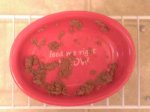
Wow!!!! Macy did much better than expected--this is what remains of her can of fancy feast classics. Unfortunately, Pixie [my IBD kitty] only nibbled at hers for about a minute and then walked away, so she is once again proving to be the tough cookie. I will see if Pixie will eat more tomorrow morning because she will certainly be hungrier by then. I can't let it go much longer than that for Pixie, though, so please send any spare good wishes our way.

The cans say 1 can per 3.5 lbs of cat per day, so I think Macy at 12 lbs 15 oz would need around 3.5 cans per day [since she is transitioning and may require more food to start?]. I'm so proud of her, can't believe how well she did with this today--she's sitting here taking a nice luxurious bath and seems very pleased. :)
MacyDay1.jpg

Forgot to add, @Sue and Oliver (GA) , I like your idea of more frequent meals, so I think we will try 3 day, which dovetails nicely with her needing 3 cans of food daily. Thank you so much, all of y'all, for your helpful advice!
 
Nice job being persistent and warming the food to a lovely warm mouse temperature. :cat::) Good job Macy on cleaning your dish.

With my cat, when he's not wanting to eat, it can help him to raise his dish about 6 inches or so off the floor. Sometimes Radar just needs encouragement to get started and Bonito flakes sprinkled on top of his food is extremely attractive to him. It doesn't take much but wow does it work and every time too.
I have also found that frequent meals really help Radar's tummy issues. Even a few bites of chicken really seems to help him so his tummy isn't completely empty.
 
Thanks, @Jan Radar for that great tip! I tried a different flavor with Pixie a little while ago and she didn't even lick it, but then I remember someone said that cats often love Parmesan cheese so I put a tiny bit on top and she lapped at it and ate a little bit of the food. Which is pretty close to a miracle in these parts. :)
It's hard to tell in my pic, but I have the dish on a little wire rack and it works very well with Macy. Pixie won't eat it on the rack but I have a raised food bowl that I use with her and she is fine with it. She is soooo hard to convince to change anything. I have tried those flakes with Pixie and she didn't like them. A non cat person wouldn't believe the number of treats and toppings I have in the pantry to try to entice Pixie. Lol. She is like a little kid in that she strongly disapproves of mixing textures together. But she's my baby so she's infinitely worth it. Love my girls.

I'm starting to be hopeful of getting them to eat home cooked or even raw someday.....
 
Status
Not open for further replies.
Back
Top