Newbie - help understanding timeline for improvement

Status
Not open for further replies.

Pixie's Mom

Member Since 2023
My Pixie was diagnosed diabetic at her annual visit end of Dec '22. She was 10 - turning 11 now. At that visit her glucose was 550. Mid Feb at the serum fructosamine test it actually was slightly higher at 567; insulin increased slightly. Checkup this week glucose was 380 - which is certainly an improvement but wondering how long it typically takes to regulate the glucose? Especially if increases to insulin have to be stepped up gradually in small increments?

Separate question but throwing it in there - my vet has not really worked with a continuous monitor (Freestyle) but is absolutely open to it. My research seems to indicate that is close to accurate. Since insulin has to be adjusted slowly MY thought would be to look at utilizing that when she gets closer to her target numbers to better understand any remaining fluctuations to dial the dosages in better. Does that seem like a good plan?

Really appreciate any insight.
Just a mom trying to learn what is best without totally freaking out. :)

Pixie's Mom
 
Welcome @Pixie's Mom

Blood sugar regulation can take a few months. Some cats get regulated faster than others. We like to say that feline diabetes is a marathon and not a sprint.

Has Pixie been switched to a low carb food? Which insulin are you using? Are dose increments made in multiples of 0.25U-0.5U? Vets often start a cat at too high a dose and make dose changes in whole units which is too much for a cat.

Are you hometesting? The occasional curve at the vet does not give you an accurate picture of how she is doing on a particular dose. In fact, without enough tests to see how low a dose is taking her, too much insulin can actually look like too little insulin! What happens when the dose is too high is the cat's body fights to stay alive. The insulin may be trying to drive the blood glucose down too low and the pancreas will release stored hormones and sugars to bring it back up fast so too much insulin can actually look like it's not enough! Also, testing done at the vet's office is unreliable due to vet stress which can increase it as much as 200 points.

The Libre is becoming more and more common and can be a useful tool, but it doesn't take place of testing with a blood glucose meter. Even the Libre instructions tell you if you get a very low or high number, you should verify it with a re-test with a meter. Also, the Libre will occasionally produce an icon that looks like a magnifying glass next to a blood drop which is it's way of telling you that you need to verify the number. The biggest complaint seems to be the sensor quitting before the 14 days is up (we've had them fail in the first 24 hours) as well as the cat knocking it off through scratching or rubbing against anything it can find. When it works, it's a nice adjunct to testing with a meter and takes some of the pressure off newly diagnosed cat caretakers who are already overwhelmed at the idea of giving shots twice a day.

Here's a detailed document on the Libre written by an FDMB member:
https://docs.google.com/document/d/...f13UiOiEM-6MsrFNpR9ztaPawF6dLk2b906QZ6VP6/pub
 
As Bhooma (Bandit's Mom) noted, there's no "one size fits all" answer to your question about timeline. The sooner you can get your cat into better numbers, the greater the chance for either regulation or remission. If there's a reason for the diabetes, such as the diabetes being steroid-induced, often cats may go into remission relatively quickly. We've also had cats take 2 years to go into remission. Some cats never go into remission but their overall numbers improve. It just depends on how much a cat's pancreas has been affected by diabetes.

There are also some insulins that are better than others for managing diabetes. For example, Lantus (glargine) has an impressive record for getting cats into remission. In part, Lantus has been used in research more than some of the other types of insulin so there have been researchers who have looked at remission. This isn't necessarily the case with other insulin.
 
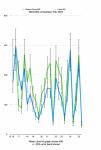
BGs from a Libre sensor and from ear sticks can vary. Here is graph I did comparing BG readings from Libre 2 and Relion Prime, a Walmart human meter. As time went on BGt here was less difference between the two devices.
Merle Feb 2023 BG Comparison.png
 

Attachments

  • Merle Feb 2023 BG Comparison.png
    Merle Feb 2023 BG Comparison.png
    111.7 KB · Views: 225
Bandit's Mom & Gabby - Pixie is on ProZinc. Initial dose was 1/1 morning and night. Then in mid Feb, 6 weeks after starting - it was increased to 1.5 morning and 1 in evening. Vet said that increase is always done slowly.

Food - yes while vet had said that she could stay on the prescription w/d (high fiber) I had slowly moved her to primarily wet with higher protein and limited carbs. Dry (since she still likes the concept of going to that bowl first) is primarily a combination of an Orijen (11% carb) and Indigo Moon (19% carb). Started mixing the Indigo because it is a higher calorie count and it is becoming a challenge to get her to eat "enough". Enough to give the shot but also to keep weight. Initially thru Feb her weight was consistent fluctuating between 13.2-13.8 (she is a Maine Coon mix). Since mid Feb she likes the concept of morning/evening meals but has been more licking the food, taking a few bites then walking away. She used to want to eat ANY wet food now not so much. She is down to about 12#.

I had vet run her senior panel again to ensure that nothing new was showing up (kidneys etc) at this week's visit. (In for a penny in for a pound) Fortunately all of her other levels look good. It is just that darn glucose. Don't get me wrong, finally showing something in the downward direction makes me happy but just wondering if the qty change to insulin is low and spaced out, how long it might take to regulate.

And there has not been a determined reason for the diabetes. She isn't on steroids, no meds. Everything else in her blood work looks good.

I have not been testing at home. She is not really a cat that will do well with that. She doesn't like her ears or paws touched at all. That has been one reason why doing the serum fructosamine test which vet told me captures the average over the previous two weeks.

I will read that link you shared - thank you so much.

Really appreciate the insights. This has all been stressful - and just a LOT. :)

Pixie's Mom
 
Hi and welcome,

Unfortunately, the dry food you’re feeding her is too high in carbs. Do you think she’d let you test her paws instead? Dosing based on the spot check and the fructosamine tests alone is not safe. The only way to keep your cat safe is to monitor the bg daily and see how low the dose is taking her. Btw, you don’t need to spend the money on the fructosamine. It’s only needed to help diagnose the diabetes and after that it’s not necessary at all. You could consider spending the money on the libre instead?

Most vets do not know a lot about feline diabetes….they have many animals to look after and they all have different diseases and treatments. Vets also get their information about nutrition from the big cat food manufacturers so they are biased in what they recommend. A dry high carb diet is not good for any cat, especially a diabetic cat. That’s like feeding your diabetic child a diet of biscuits, ice cream and sweets.

With a diabetic cat you need

  • A low carb wet diet that is 10% carbs or under. Most of us use around 4-7% carbs
  • A suitable insulin such as Lantus or Prozinc which are long acting, more gentle insulins than the old insulins.
  • We recommend hometesting the blood glucose with a human meter…it is not necessary to use a pet meter which is expensive to run and is no better. It will keep your kitty safe and you will know how the dose is working for your kitty. Only testing every so often will not tell you what is happening in between those times and an awful lot can happen in even a day.
  • HELP US HELP YOU has information about the spreadsheet, signature and hypo box which you will need to be able to look after your beloved kitty properly
 
Ale & Minnie - unfortunately Pixie will not eat enough wet to have that the only part of her consumption. While the dry I noted above isn't as low as optimum in carb it is lower than the prescription w/d that she (and her sister) had been eating. Since she would not eat enough wet her vet said it was more important to ensure that she is eating. If you know of a lower carb dry food I will certainly try that right away. If she would eat enough wet I would be happy.

She is on ProZinc now. If folks think I should ask to switch to Lantus pretty sure my vet would be open. He has been consulting with an internal med specialist as well to make sure we are covering all the bases.
 
There are only a handful of dry foods that are low in carbs. Dr. Elsey's CleanProtein and Young Again Zero Carb (it's not really zero carb -- it's about 5%) are the two that are low in carbs.

If you're concerned about Pixie's weight, look through this food chart for a low carb, high calorie food. The one that comes to mind is Wellness. It tends to be higher in fat.

Prozinc is a good insulin for cats. Both Prozinc and Lantus are recommended by the American Animal Hospital Assn for the treatment of feline diabetes.
 
There are only a handful of dry foods that are low in carbs. Dr. Elsey's CleanProtein and Young Again Zero Carb (it's not really zero carb -- it's about 5%) are the two that are low in carbs.

If you're concerned about Pixie's weight, look through this food chart for a low carb, high calorie food. The one that comes to mind is Wellness. It tends to be higher in fat.

Prozinc is a good insulin for cats. Both Prozinc and Lantus are recommended by the American Animal Hospital Assn for the treatment of feline diabetes.
I don’t want to hijack the thread, but in your opinion, is the Young Again dry food good to feed, or is it just a “better than the alternatives” situation?

I’m feeding the FF pate, but he’s just not enthusiastic about it, and I worry he doesn’t eat enough.
 
I don’t want to hijack the thread, but in your opinion, is the Young Again dry food good to feed, or is it just a “better than the alternatives” situation?
Both Young Again and Dr. Elsey's are better quality dry foods than most other dry foods. And not just because they are low carb. However, they are still dry food and do not provide cats with much needed hydration. If Tux will eat wet food, you want to see if it's the FF pates he doesn't like and will eat other brands/flavours/textures in wet food. Some cats don't like the pate texture. Also, a diabetic cat's appetite reduces as its numbers improve. Unregulated diabetic cats cannot process their food which is why they are always starving.
 
I can't vouch for the foods as my cat would happily inhale canned food. I'm fortunate in that I've never had a cat that was a fussy eater. The people that have used either of those brand foods found them to be good alternatives. The only cautionary note is to transition a cat gradually, but that's true with introducing any new food. Some cats have a GI reaction to a switch in foods.

Just an FYI, there appears to be a supply chain problem with Dr. Elsey's at the moment.

One other option are there are air dried or freeze dried raw foods. They have a texture that's closer to dry food. ZiwiPeak has an air dried line of food.
 
I have not been testing at home. She is not really a cat that will do well with that. She doesn't like her ears or paws touched at all. That has been one reason why doing the serum fructosamine test which vet told me captures the average over the previous two weeks.

Hi Pixie's Mom!

I have a spicy cat as well. When I first joined the forum, I was really unsure I'd ever be able to test her. I didn't really believe the other members who told me that patience and lots of trial and error works with almost every cat. But, I tried a bunch of different things with Pumpkin and we've now got a system down that works for us.

With Pumpkin, the trick was that she's super food motivated. While she's eating, I can handle her ear, poke it with a lancet (I don't think she feels that part because there are very few nerves at the edges of the ear), and scoop up a blood sample. As soon as she's done, it's hands off. So we do all our testing while she eats.

Pixie has her own unique personality, so my method might not work, but I bet if you take things slow, use everything you've learned about Pixie, and keep trying different approaches, you'll eventually get a home testing routine down.

The testing is important because doses need to changed based on the lowest blood glucose level to keep Pixie safe. If, for example, her average level is 200, but she's occasionally dropping down to 50, then a dose increase would be very dangerous. The fructosamine test won't tell you the lowest value (what we call the nadir), but home blood glucose testing will.

I hope you'll give home testing a try. I know from my experience it's not easy with the spicier cats, but there are lots of great folks on this forum who can help you work through it.
 
So update....Pixie not cooperating with testing. She used to be VERY food motivated but over the past couple of weeks she has not been eating well. Very interested in the "concept" of eating but only a couple of bites and walks away. She has lost over a pound in the last few weeks. Her vet not familiar with the continuous monitor but open to trying it. Picked up the script/unit from the pharmacy on Monday; vet closed Tues. Brought her in today and her monitor was placed mid afternoon. I am hoping that we can get data to better help to change insulin dose as needed. Vet did agree that since she has been running so high- even though the typical is to ensure she eats enough before the shot (and not give it to her if she doesn't eat) - I can give her the prescribed doses and then just watch her readings close. Unlikely though that it would drop down so significant to be dangerous. He also agreed to give her a cerenia shot as I am not sure if she just isnt eating because she is nauseated. I figured that if that helped we would know almost immediately - if an improvement I will ask him for 5-7 days on that to get her back to eating.
TRULY appreciate all of the info and insights from everyone. Have been (still am) very worried since it could take time to regulate but she is losing weight so quickly that she will be microscopic long before her insulin is regulated.
REALLY puzzles me though that when she was diagnosed late Dec she was just 13.4-13.8#. She was eating normal; was drinking a lot and going pee a lot. Insulin started then and for Jan thru mid Feb she was still eating, not drinking excessively or excess pee - but weight had dropped a bit and was ranging from 12.8-13.2. But since then steady loss and minimal eating. She is 11.2# this morning. Puzzled because in theory the high glucose should make her want to eat more (even if she still loses) but she is not really wanting to eat. Seems like even if she still loses she should still be just eating excessively....
Either way, just happy to have somewhat of a plan.
Again really appreciate all of the insight.
 
So update....Pixie not cooperating with testing. She used to be VERY food motivated but over the past couple of weeks she has not been eating well. Very interested in the "concept" of eating but only a couple of bites and walks away. She has lost over a pound in the last few weeks. Her vet not familiar with the continuous monitor but open to trying it. Picked up the script/unit from the pharmacy on Monday; vet closed Tues. Brought her in today and her monitor was placed mid afternoon. I am hoping that we can get data to better help to change insulin dose as needed. Vet did agree that since she has been running so high- even though the typical is to ensure she eats enough before the shot (and not give it to her if she doesn't eat) - I can give her the prescribed doses and then just watch her readings close. Unlikely though that it would drop down so significant to be dangerous. He also agreed to give her a cerenia shot as I am not sure if she just isnt eating because she is nauseated. I figured that if that helped we would know almost immediately - if an improvement I will ask him for 5-7 days on that to get her back to eating.
TRULY appreciate all of the info and insights from everyone. Have been (still am) very worried since it could take time to regulate but she is losing weight so quickly that she will be microscopic long before her insulin is regulated.
REALLY puzzles me though that when she was diagnosed late Dec she was just 13.4-13.8#. She was eating normal; was drinking a lot and going pee a lot. Insulin started then and for Jan thru mid Feb she was still eating, not drinking excessively or excess pee - but weight had dropped a bit and was ranging from 12.8-13.2. But since then steady loss and minimal eating. She is 11.2# this morning. Puzzled because in theory the high glucose should make her want to eat more (even if she still loses) but she is not really wanting to eat. Seems like even if she still loses she should still be just eating excessively....
Either way, just happy to have somewhat of a plan.
Again really appreciate all of the insight.

I’m sorry to hear Pixie isn’t eating. That’s just so nerve wracking of an issue to deal with.

It’s great you got the FreeStyle Libre. That’ll be a huge help to start adjusting Pixie’s dose. I’d suggest continuing to try to figure out manual testing. You’ll likely need to test long-term, and most people eventually find manual testing is less of a hassle. It’s great that there’s an option for those especially tricky cats who can’t be tested with an ear prick though.

Have you tried mirtazapine for the appetite? It’s a topical cream that you rub on their ears, so it’s easy to administer to most cats, even if they aren’t eating.

Have you looked into pancreas issues? If you have any recent lab reports, some experienced members can take a look and give you suggestions about what to follow up with the vet.
 
I’m sorry to hear Pixie isn’t eating. That’s just so nerve wracking of an issue to deal with.

It’s great you got the FreeStyle Libre. That’ll be a huge help to start adjusting Pixie’s dose. I’d suggest continuing to try to figure out manual testing. You’ll likely need to test long-term, and most people eventually find manual testing is less of a hassle. It’s great that there’s an option for those especially tricky cats who can’t be tested with an ear prick though.

Have you tried mirtazapine for the appetite? It’s a topical cream that you rub on their ears, so it’s easy to administer to most cats, even if they aren’t eating.

Have you looked into pancreas issues? If you have any recent lab reports, some experienced members can take a look and give you suggestions about what to follow up with the vet.

Yes started the Mirataz transdermal a few days ago. Struggle is real to even get that applied to her ear daily but have managed it.
Had all bloodwork ran again (full senior panel) a couple of weeks ago even though it was just done end of Dec. Outside of glucose, all of her other levels looked good. Everything else was within normal ranges.
Vet said next step would likely be ultrasound to check everything internal. Since she would have to be sedated for that, with her recent weight loss I wanted to hold off on that for a little while if at all possible. But if the eating doesn't get better and she keeps losing weight I will have to take that risk and have the ultrasound done/her sedated.
 
Status
Not open for further replies.
Back
Top