Meter and Test Strip Options

Status
Not open for further replies.

yukon25

Member Since 2016
I'm using the AlphaTrak meter. I saw where a few folks suggested using the FreeStyle Lite strips instead of the AT strips. Will the readings be the same or do I have to do a conversion of some sort? Does the FreeStyle strip require the same or more blood as the AlphaTrak strips?

I've also seen suggestions for the Relion meter from Walmart. Will I have to convert #s if I move over to this meter?
 
If you use the Freestyle Light strips in the AT meter, you don't do anything different. Both the AT and FreeStyle Light are made by the same company. They are identical. The only thing you have to watch for is to make sure you get the Freestyle LIGHT. I accidentally bought some of the non light Freestyle strips. They don't work.
 
I've also seen suggestions for the Relion meter from Walmart. Will I have to convert #s if I move over to this meter?
There's no direct conversion between human and animal meters.

If you decide to switch to the Relion, you'll just need to use a different BG reference range suitable for measuring a cat's BG using a human meter. I think most FDMB members in the US use human meters because the test strips are so much more affordable (especially the Relion/Arkray Glucogard strips). The Relion Prime has the cheapest strips but it needs a larger blood sample size than the Relion Confirm or Micro. The strips for the Confirm/Micro meters cost a little more than the Prime strips but they are still affordably priced.

(If you do switch you'll need to put a clear marker in your spreadsheet to show the break between pet and human meter readings so that both you and others will be able to understand the BG readings correctly.)


Mogs
.
 
I use FS strips in my AT meter. Have a look at the AT/FS comparison sheet on Teasel's SS.
Very interesting that the Alphatrak Meter/FS strip combo readings are on average higher than the AT/AT combo. Might be an idea to work with a slightly higher hypo threshold number when using the FS strips, perhaps (i.e. greater than 68mg/dL)?


Mogs
.
 
have used both at and fs--usually within 5 points or the exact same...the most difference was 10 and that was a high number...the lower seems more the same.
 
As others have indicated use of a human meter is a perfectly good alternative. If using the AlphaTrak 2 meter with the FS strips there are a few thing you need to know.

Having thoroughly investigated the FS vs AT strips (checking patents, manufacturing location, assay used in the strips, calling both human and animal divisions of Abbott etc.) I am 99.9% sure the FS strips and AT strips are identical in their physical composition. The AT strips however have been batch tested to determine what code on the AT meter will produce a reading closest to animal lab values. Without the AT code for each vial of FS strips, your results will not be as accurate as those using AT strips with the meter set to the appropriate code. My own cross checking elicited results within 10% of the AT strips. Others have indicated their results were within 5%. The difference may depend on how high or low the reading being compared is and what cat code your meter is set on.

I am not advocating use of the FS strips in the AT meter, but they will work. If you choose to do so, it is imperative that you have your AT meter set on one of the cat codes (known codes are 08, 37, 38 and 93) to get a reasonably accurate result. Do NOT use the code on the FS strip vial as that is for use only with older FS human meters and DO NOT use the code 7 as that is for use with the older AT meter.

It is also imperative that you keep some AT strips on hand to do baseline checks of your results with the same drop of blood, each time you open a new vial of FS strips or alternately, use AT meter control solution to ensure the strips are readings within the expected range. Also double check any unexpected, especially low FS strip readings using an AT strip with the meter set to the correct code.

All meters have an allowed variance in their results of up to +/- 20% and using the FS strips in the AT meter adds another variance into the picture so your results, while in the ballpark, may not be as accurate as is possible.

 
It appears Abbot has caught onto the switching since all the pricing I saw on the FSL strips were the same as the AT2 strips. No real savings to speak of by switching strips. I'm thinking of switching over to the ReLion meter and strips instead, even though my cat's vet wasn't happy whne I originally asked about it. I figure they'll get over it. I'm not happy with the treatment instructions they gave (more like lack of!), so we'll be even.
 
Here in Canada the FS strips are almost half the cost of the AT strips and non-taxable to boot. I was surprised a while back when someone else from the US told me how expensive the FS strips were in their area, so I am not surprised you've made the decision to get with the Relion meter.
My vet originally looked at me like I had horns growing out of my head when I showed her 2 spreadsheets; one of AT readings and one with FS readings for comparison. Fast forward and she had a new client who wanted to use a human meter so she sent me an email asking for the human meter reference numbers. Perhaps if you tell your vet that the "normal" range on a human meter is between 50 & 120 and any number below 50 needs to be dealt with as a potential hypo, he/she will see the light and feel more comfortable with your decision.
 
I hope to be moving to another city in January, so we'll be looking for a new vet then. Meanwhile, the current one (who IS very good, honest) will just have to deal with me changing meters :D

I was surprised to see that the FS strips were the same price as the AT, TBH.
 
As others have indicated use of a human meter is a perfectly good alternative. If using the AlphaTrak 2 meter with the FS strips there are a few thing you need to know.

Having thoroughly investigated the FS vs AT strips (checking patents, manufacturing location, assay used in the strips, calling both human and animal divisions of Abbott etc.) I am 99.9% sure the FS strips and AT strips are identical in their physical composition. The AT strips however have been batch tested to determine what code on the AT meter will produce a reading closest to animal lab values. Without the AT code for each vial of FS strips, your results will not be as accurate as those using AT strips with the meter set to the appropriate code. My own cross checking elicited results within 10% of the AT strips. Others have indicated their results were within 5%. The difference may depend on how high or low the reading being compared is and what cat code your meter is set on.

I am not advocating use of the FS strips in the AT meter, but they will work. If you choose to do so, it is imperative that you have your AT meter set on one of the cat codes (known codes are 08, 37, 38 and 93) to get a reasonably accurate result. Do NOT use the code on the FS strip vial as that is for use only with older FS human meters and DO NOT use the code 7 as that is for use with the older AT meter.

It is also imperative that you keep some AT strips on hand to do baseline checks of your results with the same drop of blood, each time you open a new vial of FS strips or alternately, use AT meter control solution to ensure the strips are readings within the expected range. Also double check any unexpected, especially low FS strip readings using an AT strip with the meter set to the correct code.

All meters have an allowed variance in their results of up to +/- 20% and using the FS strips in the AT meter adds another variance into the picture so your results, while in the ballpark, may not be as accurate as is possible.

Hello,
I just purchased the AlphaTrak on Amazon as directed by my vet. I thought I was purchasing the alphatrak2 but but the original showed up. Do you know the main differences between the original and the AT2? I was trying to use the FL strips in my AT. Will the FL strips work if I have the original AT (code 7)? Any help would be appreciated.

Thanks,

Deena
 
That's interesting. What makes you think it's the original meter? What colour is the meter? The box it comes in is labeled AlphaTrak and doesn't have the number on it. The number was simply used to discern the difference between the meters and the coding to be used for the strips. The meter should be a pinky mauve shade. The old AT meter was a different colour and unless the meter is used, I don't think you can get them anymore. The AT meter was being marketed by Abbott but is now owned by Zoetis. .
 
That's interesting. What makes you think it's the original meter? What colour is the meter? The box it comes in is labeled AlphaTrak and doesn't have the number on it. The number was simply used to discern the difference between the meters and the coding to be used for the strips. The meter should be a pinky mauve shade. The old AT meter was a different colour and unless the meter is used, I don't think you can get them anymore. The AT meter was being marketed by Abbott but is now owned by Zoetis. .

Ah! So glad you wrote back! The box that it comes in just says AlphaTrak but the actual Unit does say AT2 and is a mauve color! I'm unsure why the directions said to use the coding #7 then as I've read that's the coding for the old Unit? Any suggestions?
 
Ah! So glad you wrote back! The box that it comes in just says AlphaTrak but the actual Unit does say AT2 and is a mauve color! I'm unsure why the directions said to use the coding #7 then as I've read that's the coding for the old Unit? Any suggestions?
If a vial of AT test strips came with the meter, look at the label on the vial to see what code you need to set for cats for that particular batch of strips. Then, look at the instructions that came with the meter to see how to set that code.
 
You must set the meter to one of the known cat codes which are 08, 37, 38, 92 and 93. One of those will produce as accurate readings as would AT2 strips with the meter set to the code on the vial for those specific AT2 strips. The other cat codes will produce close results as a slightly different algorithm is used for each code. If you have some AT strips and want to find the most accurate you could check that way using the control solution but the difference is probably negligible and doing this kind of checking with the AT2 strips kind of negates the savings of using the FS strips.
 
If a vial of AT test strips came with the meter, look at the label on the vial to see what code you need to set for cats for that particular batch of strips. Then, look at the instructions that came with the meter to see how to set that code.

Ok so if my Label says to set it to code #7 (which I did), when I receive the FreeStyle Lite test strips, do I just leave the AT2 coding to 7 then? Thanks :) youve been a lot of help!
 
Ok so if my Label says to set it to code #7 (which I did), when I receive the FreeStyle Lite test strips, do I just leave the AT2 coding to 7 then? Thanks :) youve been a lot of help!
Yes, leave it there when you try comparison testing with FS strips. The cat code can vary vial to vial for AT strips but my last several all had the same code. To keep it simple use that code, do several comparisons on the same blood drop to know what the approximate difference is. Once you feel more confident with this process you can switch totally to the FS strips and then just do a random check. I always do a comparison check if a number looks wonky to me.
 
Deena, you have several threads going on the same topic right now and this is getting confusing and could cause some issues going forward when others do searches for the same info. Can we stick with one thread? I have recently responded to this question on one of the other threads.

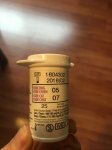
I have never seen code 7 used anywhere other than in the literature that accompanies the AT2 strips so I am very curious as to where you are seeing that information. To my knowledge code 7 is only used with the older AT meter and the new AT2 strips or the FS strips. The new meter codes we know of for cats are 08, 37, 38, 92 and 93. If you can post a picture of where you are seeing code 7 on the vial of AT2 strips, I would be most grateful because if the codes have changed that is important information we need make sure we have available for anyone making similar inquiries. do NOT use the code on the vial of strips unless they are AT2 strips.
 
Here is my Alphatrak 2 and the AT strips that came with it. Code for cats is 7.
Glad you posted this. That's exactly the meter I have and it's good to see a vial with a 7 on it. They're out there even though I've never had one, only 93 or 38 so far.
 
@Pati Thank you for posting. We will add code 7 to our list of known cat codes. This surprises me but there really is no reason code 7 wouldn't apply to some of the AT2 strips as I am 99.9% sure the AT2 strips are FS strips that have been batch tested to find the most accurate animal lab equivalency readings and rebranded as AT2 strips.
 
You must set the meter to one of the known cat codes which are 08, 37, 38, 92 and 93. One of those will produce as accurate readings as would AT2 strips with the meter set to the code on the vial for those specific AT2 strips. The other cat codes will produce close results as a slightly different algorithm is used for each code. If you have some AT strips and want to find the most accurate you could check that way using the control solution but the difference is probably negligible and doing this kind of checking with the AT2 strips kind of negates the savings of using the FS strips.
Deena, you have several threads going on the same topic right now and this is getting confusing and could cause some issues going forward when others do searches for the same info. Can we stick with one thread? I have recently responded to this question on one of the other threads.

I have never seen code 7 used anywhere other than in the literature that accompanies the AT2 strips so I am very curious as to where you are seeing that information. To my knowledge code 7 is only used with the older AT meter and the new AT2 strips or the FS strips. The new meter codes we know of for cats are 08, 37, 38, 92 and 93. If you can post a picture of where you are seeing code 7 on the vial of AT2 strips, I would be most grateful because if the codes have changed that is important information we need make sure we have available for anyone making similar inquiries. do NOT use the code on the vial of strips unless they are AT2 strips.

Hi there,
Sorry for all the threads. I'm new to this and will try and keep things organized from here on out...
My vial which is an AT2 has #7 listed as the code and the expiration date is 2/2018. So in assuming I can just leave my meter at #7 when using the FS Lite strips and do a comparison? Also, does anyone know the best/most cost effective place to purchase the FSLite strips? Thanks to all!
 

Attachments

  • image.jpeg
    image.jpeg
    31 KB · Views: 51
Status
Not open for further replies.
Back
Top