Introducing Luna

Status
Not open for further replies.

Laura&Luna

Member Since 2021
Hello, I am Laura and my good kitty-girl is Luna. She was diagnosed in early March after I realized that I hadn't become neglectful and forgotten to give her water and clean her box, she really was drinking and peeing like six cats.

I like my vet. He has a diabetic dog and the office cat is also diabetic. He had me change her diet to all wet food and started her on 1.5 units of Lantus twice a day. She's a bigger cat than she looks-- about 14 pounds currently, and 12 when she was super fit. He sent me links to glucose/ketone strips and non-absorbent litter. They brought me in to train me on the office cat as mine was deemed "not appropriate for training.". He said that a few patients did glucose curves at home, but not many.

I did this for two weeks, reading a lot online, here and elsewhere. I didn't feel up to tight regulation, but I still toyed with the idea of getting a monitor.

Then, two weeks in, we had a bit of a fuss. She vomited up a tiny hairball before breakfast. Then we did our routine, but she vomited again a bit after I gave her the shot. That had happened before. She usually eats again easily. This time it she didn't and, of course, it was Sunday. She got a bit listless. Not unresponsive, but just off. I got all worried and coaxed her to eat a few of her favorite (now forbidden) treats, and finally some food. Lots of worry and internet and cursing my lack of monitor. So, I ordered the one my vet said he used--Alphatrak. I discontinued insulin and called the vet Monday morning.

Her test that morning and 48 hours later were normal and she was declared in remission and I'm supposed to keep her new feeding program and keep a close eye on her. I mentioned the monitor and the vet suggested that I figure it out and practice some during the remission.

Today I finally tried it. I had to stick her 3 times because the first two didn't bleed enough. So I got her ear nice and warm and then, the third time, she bled enough to make me feel bad (like three big drops, but still!) I got a reading of 111 on the Alpha track, which looks good, I think.

I could use some support with the ear pricking. It's hard enough that I feel uncomfortable, but easy enough that it's obvious that kitty should have her curves done in the comfort of her own home, even if I find it scary.

Thanks for helping over the last month and a half. I decided I wanted to come out of the woodwork.
 
Hi Laura and Luna and welcome to the forum.
Your vet sounds good, and supportive which is great.

I’m glad you have bought a glucose meter and are home testing.
111 on the alphatrak meter is within normal limits.
What I would do it set up a spreadsheet so you can track the BG reading. Here is a link to setting it up. If you have any trouble let me know.
You will need to get 14 days of BG numbers in the normal range for her to be declared in remission. You want a strong remission so make sure you go through this process, as you don’t want her falling out of remission is a few months.
https://www.felinediabetes.com/FDMB/threads/how-to-use-the-spreadsheet.241653/

I would test before the two main meals of the day and again about 3 hours later. This will give us a good idea if the pancreas is producing insulin on its own.

I will also send you a link on hints for home testing. It gets much easier for both of you. Are you giving Luna a treat every time you test? Even if unsuccessful?
https://www.felinediabetes.com/FDMB/threads/hometesting-links-and-tips.287/

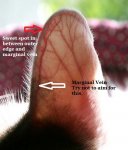
Here is a photo of the cats ear and the best places to prick it. If you shine a torch behind the ear you will see all the veins. You want to aim for between the edge of the ear and the vein, try not to hit the vein. After you collect the blood, firmly hold the ear on both sides with some cotton wool or a tissue to prevent a bruise.

im glad you decided to post. Keep asking questions. You will have to continue with a low carb diet for Luna for the rest of her life as she will always be a diabetic, just a diet controlled one.


upload_2021-4-22_16-22-38.jpeg
 

Attachments

  • upload_2021-4-22_16-22-38.jpeg
    upload_2021-4-22_16-22-38.jpeg
    79.2 KB · Views: 152
Thanks for those links! They were really useful. Something else I had read told me to aim for the ear vein. That must have been why she bled so. Also, I stabbed too hard and too straight and she jerked.

I had no hesitation about the injections, but I find I am surprisingly troubled by the ear thing--especially as they don't feel as necessary if I am not injecting insulin. My husband is generally awesome, but this hits at a weak point of his. He'd rather not even hear about it and, while he would try to help if I asked, it wouldn't actually be helpful.

She gets freeze-dried chicken or bonito flakes for pokes. I started that with the insulin injections and she would stroll over and wait for them.

She is definitely staying on a low-carb diet forever. That's no problem.

Can you explain or link to something about just what I am looking for to see if she's in remission or what makes a remission strong vs. not or anything about strategies to keep her there? That might shore up my ear resolve.

I looked at the food chart. We are doing pretty well, with a range of FF classic pates, a pretty low carb Weruva, and some TikiCat.
 
I tried to add a spreadsheet, but I am not sure how to record things if I am not dosing. Do I time it from when I would give her the shot if she were still on Lantus? I tested her about an hour before feeding and three hours after. At 6:05 she was 165, which worried me Fed at 7 and at 10 pm, 85.
 
I can see the spreadsheet.
I would test before you give any food at the two main mealtimes ....as you did when giving insulin. Test immediately before feeding the main meals.
Record that in the AMPS and PMPS columns. Add 0 for insulin given.
Then if you test 3 hours after the meal put that test in the +3 column.

Can you put in the remarks column each day what you feed and when please? That would be helpful

A strong remission is when the cats has received insulin for as long as possible so that the Pancreas can heal. Some vets stop the insulin as soon as the cat gets into lower numbers but we have found that if you can keep going with the insulin for as long as is safe to do so, the cat has a better chance of staying in remission.

If a cats BG drops a couple of hours after he has eaten, that indicates the pancreas Is producing some insulin.
Keep posting and we can have a look at the SS and see how Luna is going.
Are you giving snacks during the cycle?

Re the 165 this morning. I would give a small snack at +9 each cycle to see if that brings down the AMBG and PMBG. We call it the AMBG (am blood glucose) now not the AMPS because you are no longer giving any insulin.
 
Luna would LOVE a snack at +8 or +9! My cat officially loves you for suggesting it. How much is a snack? 1/4 of a small can? However, +8 or +9 on the other end is 3-4 in the morning and I am really not sure we can accommodate it long term. Her morning numbers today looked better than yesterday's pre-dinner numbers. Is night time different from day?
 
I can see the spreadsheet.
I would test before you give any food at the two main mealtimes ....as you did when giving insulin. Test immediately before feeding the main meals.
Record that in the AMPS and PMPS columns. Add 0 for insulin given.
Then if you test 3 hours after the meal put that test in the +3 column.

Can you put in the remarks column each day what you feed and when please? That would be helpful

A strong remission is when the cats has received insulin for as long as possible so that the Pancreas can heal. Some vets stop the insulin as soon as the cat gets into lower numbers but we have found that if you can keep going with the insulin for as long as is safe to do so, the cat has a better chance of staying in remission.

If a cats BG drops a couple of hours after he has eaten, that indicates the pancreas Is producing some insulin.
Keep posting and we can have a look at the SS and see how Luna is going.
Are you giving snacks during the cycle?

Re the 165 this morning. I would give a small snack at +9 each cycle to see if that brings down the AMBG and PMBG. We call it the AMBG (am blood glucose) now not the AMPS because you are no longer giving any insulin.

The small snack seems to really help her PMBG. Thanks for the suggestion. I think I may go back into the woodwork, but I didn't want to fade away without thanking you. Luna is also super-happy with you.
 
Luna would LOVE a snack at +8 or +9! My cat officially loves you for suggesting it. How much is a snack? 1/4 of a small can? However, +8 or +9 on the other end is 3-4 in the morning and I am really not sure we can accommodate it long term. Her morning numbers today looked better than yesterday's pre-dinner numbers. Is night time different from day?
A 1/4 can is a good snack. Have you thought about a timed autofeeder? I had one for Sheba for snacks during the night. Most diabetic cat owners who buy them find them invaluable.


The small snack seems to really help her PMBG. Thanks for the suggestion. I think I may go back into the woodwork, but I didn't want to fade away without thanking you. Luna is also super-happy with you.
I’m very happy to help anytime.
Don’t go back into the woodwork. We really need to see that Luna is managing to maintain normal BGs for 2 weeks otherwise she may need more insulin.
Any numbers above 150 on the alphatrak is of concern.
 
I agree with Bron. We typically encourage people who's cats are working on remission to to a "trial" -- test at the usual shot times and often grab another test during the AM and PM cycle to see where the numbers are. If after 2 weeks, the numbers are in a normal blood glucose range, your cat is officially OTJ (off the juice). Right now, it may be a bit too early to declare that Luna doesn't need insulin.
 
Status
Not open for further replies.
Back
Top