? II Have To Ask

Status
Not open for further replies.

Summer and Susie (GA)

Member Since 2020
Okay, folks. Thanks for the explanations below. I thought normal was 80 - 120 and that is why I was questioning the movement to get lower. I have been straightened out. Love this group. Always patient with my questions.

Sorry for the second post of the day but I have to ask this question.

I have been following this site for three months now. I have received some wonderful advice and information. I have also been very nervous when I have seen so many people experience low numbers to the point where they need help. Some of these people are long, time members.

I'm also seeing a lot of kitties with extracurricular problems and I'm wondering if the drive to bring them down, below normal (80-120) numbers isn't contributing to some of these medical issues.

I know that a lot of you want to get your cats into remission but how long does that really last? Most of them come out of remission at some point. I'm sure I am off point but wouldn't it be safer to keep them in the normal numbers for a cat? I just worry about what we are doing to them by pushing them farther and farther below the norm.

Feel free to criticize my question but please offer me an explanation of why "normal" is not good enough. I am grateful for everyone's help but I worry about the drive to go lower and lower.
 
Last edited:
Hi Summer, I’m sorry you feel like that.
Some cats go into remission really easily. Sheba went into remission after 3 months and that was well before I joined the forum and looking back I really didn’t know what I was doing (In comparison to what I know now) and she stayed in remission for well over 2 1/2 years and I am sure if she hadn’t kept getting pancreatic flares she would have remained in remission. Once she fell out of remission I could not get her back into it.
So it is very worth while trying for remission but first the cat has to be regulated before there is any hope of remission.

For the Pancreas to heal and start producing insulin again on its own, it needs the support of insulin in the meantime and for the blood glucose to get back to normal numbers as soon as possible. But we always say FD is a marathon not a race and you need patience.

If you are following one of the two documented dosing methods here, you are not “ pushing them further and further below the norm”.

Of course if your cat has concurrent issues then they must be taken into consideration when treating any disease. For example you need to be very cautious if your cat has heart issues and you want to give subQ fluids. We always advise to ask your vet before giving those..But I would imagine treating FD would help the cat who has any other issues as well.

I’m not sure what you mean by “normal is not good enough.” The normal numbers for a cat are 50-120. Those are the BG numbers we say are the numbers that will promote healing of the pancreas.
Our TR method has the take action number of below 50 which means that is when the CG needs to give food to bring the numbers up higher into the normal range.
We do not advocate keeping a cat in numbers under 50. If they drop below 50, the cat earns a reduction in dose.
The SLGS method has a take action number of below 90 and if it drops below 90 a reduction is taken.
Does that help explain things?
 
I'm also seeing a lot of kitties with extracurricular problems and I'm wondering if the drive to bring them down, below normal (80-120) numbers isn't contributing to some of these medical issues.
Besides the fact as Bron said that normal is actually lower, even in the 40's for non diabetics, there is also an issue with keeping a cat in high numbers. If you have a cat with kidney disease, as I did, then my goal was to keep her below renal threshold as much as possible, to give her kidneys a break. Since Neko had acromegaly, remission was more of a dream and not really under my control. I just wanted her happy and healthy and numbers that were easy on her body.
 
” The normal numbers for a cat are 50-120. Those are the BG numbers we say are the numbers that will promote healing of the pancreas.
Hi @Bron and Sheba (GA)
Sorry to hijack the thread @Summer and Susie
Can i ask you a question Bron
You say normal range is 50-120, now Duke regularly drops to those healing ranges, but not at the moment due to other issues he's having but i'm sure will soon be resolved, fingers crossed. Anyway i understand that the low numbers are healing ranges but during the day/night time when he's not in the healing range like approaching and leaving his nadir and going back to the blues and yellows does this mean that any repairs done are getting damaged again. I'm confused by that.
 
Last edited:
Can you provide examples? I am not aware of any "extracurricular problems" caused by by getting BG below the normal range but not in hypo range.
No particular examples to give, Larry, as I don't know when a lot of these cats with extra medical problems were diagnosed. I don't know if the other medical problems occurred before the diabetes diagnosis or after.
 
Hi @Teetee (UK)
Looking at Dukes SS he looks as if he is under the renal threshold a good deal of the time and that is something which you want to aim for as it is harder on the kidneys when the BG is higher.
He is also spending a lot of his time is lovely numbers ....if you see using a human meter you would be seeing more green and possibly blue BGs.
He is also reducing his need for insulin slightly......all these Things are good signs.
I would keep doing what you are doing.
 
Hi Summer, I’m sorry you feel like that.
Some cats go into remission really easily. Sheba went into remission after 3 months and that was well before I joined the forum and looking back I really didn’t know what I was doing (In comparison to what I know now) and she stayed in remission for well over 2 1/2 years and I am sure if she hadn’t kept getting pancreatic flares she would have remained in remission. Once she fell out of remission I could not get her back into it.
So it is very worth while trying for remission but first the cat has to be regulated before there is any hope of remission.

For the Pancreas to heal and start producing insulin again on its own, it needs the support of insulin in the meantime and for the blood glucose to get back to normal numbers as soon as possible. But we always say FD is a marathon not a race and you need patience.

If you are following one of the two documented dosing methods here, you are not “ pushing them further and further below the norm”.

Of course if your cat has concurrent issues then they must be taken into consideration when treating any disease. For example you need to be very cautious if your cat has heart issues and you want to give subQ fluids. We always advise to ask your vet before giving those..But I would imagine treating FD would help the cat who has any other issues as well.

I’m not sure what you mean by “normal is not good enough.” The normal numbers for a cat are 50-120. Those are the BG numbers we say are the numbers that will promote healing of the pancreas.
Our TR method has the take action number of below 50 which means that is when the CG needs to give food to bring the numbers up higher into the normal range.
We do not advocate keeping a cat in numbers under 50. If they drop below 50, the cat earns a reduction in dose.
The SLGS method has a take action number of below 90 and if it drops below 90 a reduction is taken.
Does that help explain things?

I made the mistake of thinking normal numbers were between 80 and 120. Seems I have seen this information on the Internet in numerous places so that was why I was questioning the effort and/or acceptability of numbers as low as 50.
https://www.vin.com/animalicious/de...od glucose levels in,will look and act normal. I know you can't believe everything you read on the Internet.

It is also interesting that when I look at Susie's lab work the range for normal glucose is listed as 64 -170. Thanks for the information, Bron. I will go with the advice of the experts on this site stating that normal is 50 to 120.
 
Besides the fact as Bron said that normal is actually lower, even in the 40's for non diabetics, there is also an issue with keeping a cat in high numbers. If you have a cat with kidney disease, as I did, then my goal was to keep her below renal threshold as much as possible, to give her kidneys a break. Since Neko had acromegaly, remission was more of a dream and not really under my control. I just wanted her happy and healthy and numbers that were easy on her body.
What is the renal threshold? Is it a number? Is it the same as normal numbers for a diabetic cat? 50 -120? Thanks, Wendy. Sorry Neko had kidney disease.
 
Hi @Bron and Sheba (GA)
Sorry to hijack the thread @Summer and Susie
Can i ask you a question Bron
You say normal range is 50-120, now Duke regularly drops to those healing ranges, but not at the moment due to other issues he's having but i'm sure will soon be resolved, fingers crossed. Anyway i understand that the low numbers are healing ranges but during the day/night time when he's not in the healing range like approaching and leaving his nadir and going back to the blues and yellows does this mean that any repairs done are getting damaged again. I'm confused by that.

Good question, Tee.
 
What is the renal threshold? Is it a number? Is it the same as normal numbers for a diabetic cat? 50 -120? Thanks, Wendy. Sorry Neko had kidney disease.
It's a number, 12-16 mmol I think, it varies from cat to cat. That's what started my journey. I thought Mauer had arthritis in her hindlegs and thats why she sat down in her pee in the litter box. It was sugar in her urine, sugar is sticky..
 
It's a number, 12-16 mmol I think, it varies from cat to cat. That's what started my journey. I thought Mauer had arthritis in her hindlegs and thats why she sat down in her pee in the litter box. It was sugar in her urine, sugar is sticky..
How do I determine what my cat's renal threshold is and how does it relate to diabetes? Diabetes is pancreas and renal is kidney. I'm confused.
 
How do I determine what my cat's renal threshold is and how does it relate to diabetes? Diabetes is pancreas and renal is kidney. I'm confused.
Hi Summer,
We check Duke everyday for ketones and glucose in his urine with dip sticks and when he was first diagnosed his urine was really bad with glucose meaning the glucose was overflowing from his kidneys into his urine and in turn causes increased thirst because the glucose drags lots of water out in his urine and then they become dehydrated. As his numbers gradually dropped so did the glucose in his urine and now he's clear, all numbers below the renal threshold reduces stress and damage to his kidneys.
I have read conflicting numbers regarding the renal threshold some say 11.1 mmol (200 mg/dl) up to 14 mmol( 250 mg/dl) but i go with the 11.1 mmol (200 mg/dl) figure.
As for diabetes being pancreas related your right but uncontrolled diabetes can damage the kidneys as well due to the massive amount of extra glucose in their bodies which the kidneys have to process and can't cope with it, combined with the dehydration the kidneys have to work extra hard to try to keep up.
 
Hi Summer,
We check Duke everyday for ketones and glucose in his urine with dip sticks and when he was first diagnosed his urine was really bad with glucose meaning the glucose was overflowing from his kidneys into his urine and in turn causes increased thirst because the glucose drags lots of water out in his urine and then they become dehydrated. As his numbers gradually dropped so did the glucose in his urine and now he's clear, all numbers below the renal threshold reduces stress and damage to his kidneys.
I have read conflicting numbers regarding the renal threshold some say 11.1 mmol (200 mg/dl) up to 14 mmol( 250 mg/dl) but i go with the 11.1 mmol (200 mg/dl) figure.
As for diabetes being pancreas related your right but uncontrolled diabetes can damage the kidneys as well due to the massive amount of extra glucose in their bodies which the kidneys have to process and can't cope with it, combined with the dehydration the kidneys have to work extra hard to try to keep up.
Thanks for the explanation Tee. Is the renal threshold measured on the ketone strips or is that just a measurement on the glucose meter (200 - 250)?
 
Thanks for the explanation Tee. Is the renal threshold measured on the ketone strips or is that just a measurement on the glucose meter (200 - 250)?
Hi Summer
How it works is you check Susie with the glucose meter and get your BG readings, but the urine strips it tell you if there is glucose in her urine, as @Bron and Sheba (GA) says it's not a current reading with the urine as it's been sitting in her bladder for hours, it's a past reading if you know what i mean.
If you get some strips and check Susie everyday when she pee's (we use an old egg cup and hold it under Duke as he doing his business) and if it's showing positive for glucose on the strip then she's above the renal threshold and as you check her daily and as her BG comes down you will see that the glucose in her urine will gradually disappear then you will get an idea of her renal threshold by comparing the meter reading to the sticks, for instance Susie's glucose meter reading might be 250 mg/dl and on the urine strip it could be at 500 mg/dl (light brown) or even 1000mg/dl (dark brown) but as Susie drops down to say 230 mg/dl on the glucose meter the urine strip might show 250 mg/dl (dark green) and when you get below the renal threshold on the glucose meter the urine strips will show negative.
I and most others on the forum use the Keto-Diastix Reagent Strips for Urinalysis as these strips check for ketones and glucose in the pee.


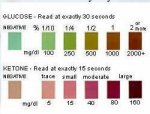
Keto-Diastix Reagent Strips for Urinalysis.jpg


This is the chart on the bottle that you check the pee against for ketones and glucose.
When duke was first diagnosed he was up to 1000 mg/dl on the scale but now he shows negative as his BG came down.

Ketodiastix.jpg
 

Attachments

  • Keto-Diastix Reagent Strips for Urinalysis.jpg
    Keto-Diastix Reagent Strips for Urinalysis.jpg
    37.2 KB · Views: 497
  • Ketodiastix.jpg
    Ketodiastix.jpg
    11.2 KB · Views: 456
Just wondering if you have any references that says keeping BG below the threshold does any good
@Larry and Kitties
I have found this article about it in the Pathophysiology section
https://lbah.com/feline/diabetes-mellitus-sugar-diabetes/
Glucose is one of the many molecules that is returned to the bloodstream after it has passed through the kidney filters. Once the glucose exceeds 180 mg per deciliter (this varies by species, cats tend to be higher) in the bloodstream though, the kidneys can no longer selectively return all of this glucose back into the bloodstream. This is called “exceeding the renal threshold”, and is a very important part of diabetes mellitus.

As a result, glucose spills into the urinary tract and bladder in excessive quantities. Since glucose attracts water (called the osmotic effect) it pulls fluid out of the pet and causes polyuria. To compensate for this excess urination the pet drinks more water, and now has polydypsia. It now has the symptoms we abbreviate as PU/PD.

Eventually it causes dehydration when the pet can’t drink enough water to keep up with the increased urination. In addition, the excess urination pulls important electrolytes out of the bloodstream like sodium and potassium, which leads to lethargy and weakness. The loss of glucose also depletes the body of its primary energy source, so additional weight loss occurs. To further add to a diabetic pet’s woes, the excess glucose that builds up in the bladder feeds bacteria that can cause a urinary tract infection.
 
Hi Summer
How it works is you check Susie with the glucose meter and get your BG readings, but the urine strips it tell you if there is glucose in her urine, as @Bron and Sheba (GA) says it's not a current reading with the urine as it's been sitting in her bladder for hours, it's a past reading if you know what i mean.
If you get some strips and check Susie everyday when she pee's (we use an old egg cup and hold it under Duke as he doing his business) and if it's showing positive for glucose on the strip then she's above the renal threshold and as you check her daily and as her BG comes down you will see that the glucose in her urine will gradually disappear then you will get an idea of her renal threshold by comparing the meter reading to the sticks, for instance Susie's glucose meter reading might be 250 mg/dl and on the urine strip it could be at 500 mg/dl (light brown) or even 1000mg/dl (dark brown) but as Susie drops down to say 230 mg/dl on the glucose meter the urine strip might show 250 mg/dl (dark green) and when you get below the renal threshold on the glucose meter the urine strips will show negative.
I and most others on the forum use the Keto-Diastix Reagent Strips for Urinalysis as these strips check for ketones and glucose in the pee.


View attachment 60302


This is the chart on the bottle that you check the pee against for ketones and glucose.
When duke was first diagnosed he was up to 1000 mg/dl on the scale but now he shows negative as his BG came down.

View attachment 60303
 
Hi Summer
How it works is you check Susie with the glucose meter and get your BG readings, but the urine strips it tell you if there is glucose in her urine, as @Bron and Sheba (GA) says it's not a current reading with the urine as it's been sitting in her bladder for hours, it's a past reading if you know what i mean.
If you get some strips and check Susie everyday when she pee's (we use an old egg cup and hold it under Duke as he doing his business) and if it's showing positive for glucose on the strip then she's above the renal threshold and as you check her daily and as her BG comes down you will see that the glucose in her urine will gradually disappear then you will get an idea of her renal threshold by comparing the meter reading to the sticks, for instance Susie's glucose meter reading might be 250 mg/dl and on the urine strip it could be at 500 mg/dl (light brown) or even 1000mg/dl (dark brown) but as Susie drops down to say 230 mg/dl on the glucose meter the urine strip might show 250 mg/dl (dark green) and when you get below the renal threshold on the glucose meter the urine strips will show negative.
I and most others on the forum use the Keto-Diastix Reagent Strips for Urinalysis as these strips check for ketones and glucose in the pee.


View attachment 60302


This is the chart on the bottle that you check the pee against for ketones and glucose.
When duke was first diagnosed he was up to 1000 mg/dl on the scale but now he shows negative as his BG came down.

View attachment 60303
Thanks, Tee. I have the strips but they are for ketones only and I rarely am around her litter box when she is doing her business. I have a large ladle ready in the bathroom along with the test strips and my clock with the second hand (to check within 15 seconds). I haven't tried the saran wrap over the litter yet. Timing has not been good for me and she doesn't let me know when she needs to go. Okay, so the urine test strips, compared with the meter results, will help me determine what my Susie's renal threshold would be. Thanks, again.
 
@Larry and Kitties
I have found this article about it in the Pathophysiology section
https://lbah.com/feline/diabetes-mellitus-sugar-diabetes/
Glucose is one of the many molecules that is returned to the bloodstream after it has passed through the kidney filters. Once the glucose exceeds 180 mg per deciliter (this varies by species, cats tend to be higher) in the bloodstream though, the kidneys can no longer selectively return all of this glucose back into the bloodstream. This is called “exceeding the renal threshold”, and is a very important part of diabetes mellitus.

As a result, glucose spills into the urinary tract and bladder in excessive quantities. Since glucose attracts water (called the osmotic effect) it pulls fluid out of the pet and causes polyuria. To compensate for this excess urination the pet drinks more water, and now has polydypsia. It now has the symptoms we abbreviate as PU/PD.

Eventually it causes dehydration when the pet can’t drink enough water to keep up with the increased urination. In addition, the excess urination pulls important electrolytes out of the bloodstream like sodium and potassium, which leads to lethargy and weakness. The loss of glucose also depletes the body of its primary energy source, so additional weight loss occurs. To further add to a diabetic pet’s woes, the excess glucose that builds up in the bladder feeds bacteria that can cause a urinary tract infection.
Good gosh. Unregulated and untreated diabetes is a nightmare for pets and humans. I still feel like I need to be a rocket scientist (or an MD) to fully understand all of this.
 
Thanks, Tee. I have the strips but they are for ketones only and I rarely am around her litter box when she is doing her business. I have a large ladle ready in the bathroom along with the test strips and my clock with the second hand (to check within 15 seconds). I haven't tried the saran wrap over the litter yet. Timing has not been good for me and she doesn't let me know when she needs to go. Okay, so the urine test strips, compared with the meter results, will help me determine what my Susie's renal threshold would be. Thanks, again.

Hi Summer
You need the strips that check Susie's glucose in her pee, not the ketone ones as they are different.
 
Thanks, Tee. I have the strips but they are for ketones only and I rarely am around her litter box when she is doing her business. I have a large ladle ready in the bathroom along with the test strips and my clock with the second hand (to check within 15 seconds). I haven't tried the saran wrap over the litter yet. Timing has not been good for me and she doesn't let me know when she needs to go. Okay, so the urine test strips, compared with the meter results, will help me determine what my Susie's renal threshold would be. Thanks, again.

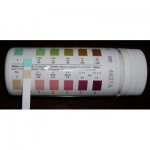
Summer you will know this already but just to double check the glucose part on the strip requires exactly 30 seconds wait, the ketone part is exactly 15 seconds.
Your ketone strips will have only one pad whereas the Keto-Diastix Reagent Strips have two pads, one to check for ketones and one for glucose like the one below.

keto diastics detail-400x400.jpg
 

Attachments

  • keto diastics detail-400x400.jpg
    keto diastics detail-400x400.jpg
    19.6 KB · Views: 216
I'm wondering if the drive to bring them down, below normal (80-120) numbers...
(Emphasis mine)
Fair question, though I think there might be a misperception.

I believe the goal is “normal” numbers as much as possible, not “below normal.”

The stated “normal” range of 80-120 (or thereabouts based on the source) represents what is normal on lab-based equipment, or a human using a human BG meter, or a cat when tested on a pet meter (such as an AlphaTrak).

The 50-xx range only applies when you’re testing a cat using a human meter (that 50 is definitely considered low on a pet meter). We know based on the difference in cat vs human blood (as well as much data) that a cat’s BG will read artificially low on a human meter so the “normal” range is adjusted accordingly. The BG is not truly 50, it’s probably more like 70 if tested on more accurate lab equipment, but that doesn’t matter as long as we accommodate the adjustment in our expectations.

EDITED TO ADD: Years ago I had a car in which the speedometer was off. I knew that when the gauge said I was driving 55, it was really more like 65-70. So I was really going the desired speed even if the gauge gave me a lower reading. Same thing with BG meters, really. You just adapt a bit.
 
Last edited:
(Emphasis mine)
Fair question, though I think there might be a misperception.

I believe the goal is “normal” numbers as much as possible, not “below normal.”

The stated “normal” range of 80-120 (or thereabouts based on the source) represents what is normal on lab-based equipment, or a human using a human BG meter, or a cat when tested on a pet meter (such as an AlphaTrak).

The 50-xx range only applies when you’re testing a cat using a human meter (that 50 is definitely considered low on a pet meter). We know based on the difference in cat vs human blood (as well as much data) that a cat’s BG will read artificially low on a human meter so the “normal” range is adjusted accordingly. The BG is not truly 50, it’s probably more like 70 if tested on more accurate lab equipment, but that doesn’t matter as long as we accommodate the adjustment in our expectations.

EDITED TO ADD: Years ago I had a car in which the speedometer was off. I knew that when the gauge said I was driving 55, it was really more like 65-70. So I was really going the desired speed even if the gauge gave me a lower reading. Same thing with BG meters, really. You just adjust adapt a bit.
So what you are saying is that a human meter reads "artificially" lower than the true BG value when testing on a cat (or dog). That is why we have the allowance for 50 - 120, when testing with a human meter, and hoping for "normal numbers". And, that is also why when we are using a pet meter it is more important to make sure the BG does not drop as low as when using a human meter. Am I understanding this correctly, JL? I thank you for your comment. Are you also saying that a pet meter is more accurate when determining the true BG of a cat?

I'm so sorry that all your kitties are gone. Hope you have a healthy one at home.
 
Last edited:
True and true... it depends on weather you stick to the chosen meter. Before the pet meter was invented vets used human meters, some still do, mine does for example.
But pet meters read higher, therefore the take action number is 68, instead of the 50 of a human meter.

The dosing methods is based on human meters, and most use human meters because pet meters is very expensive.

That's why we have two spreadsheets, one for pet meters and one for human meters.
 
True and true... it depends on weather you stick to the chosen meter. Before the pet meter was invented vets used human meters, some still do, mine does for example.
But pet meters read higher, therefore the take action number is 68, instead of the 50 of a human meter.

The dosing methods is based on human meters, and most use human meters because pet meters is very expensive.

That's why we have two spreadsheets, one for pet meters and one for human meters.
More confused than ever. One meter typically reads lower and the other reads higher. I will stick with the human meter although now I am more worried than ever that Susie' BG is actually higher than what I am perceiving.
 
now I am more worried than ever that Susie' BG is actually higher than what I am perceiving.
One word of advice I received when I first joined was to remember that it’s about a lot more than just the BG numbers. How is the “whole cat report”? How are the 5 P’s: peeing, pooping, purring, playing, preening?

Cats tend to tolerate higher BG better than humans and with fewer long-term effects. That doesn’t mean that we don’t try to get the numbers down and be serious about treatment. But we do need to tamp down the fear and panic and remember to breathe. Data is knowledge and you’re here, you’re following a dosing method, you’re collecting data, you’re asking questions and educating yourself, and you’re advocating for your cat. Sounds like you’re doing a lot right. So take a deep breath, remind yourself that this is a marathon not a sprint, and stay the course. You’ll get there.
 
Perhaps the story of Olive and Ruby will put your mind at ease:

Ruby had a really good day today, with numbers ranging between 51-86. I have been aiming for numbers like these since I joined this group about 6 months ago. I know these are good numbers because I poke my civvie Olive every once in a while out of curiosity and get numbers in the 60s and 70s. I use the same human meter on both cats. Olive has had bloodwork done at the vet recently and she does not have diabetes. Ruby's blood glucose levels have been during the course of today much like her non-diabetic sister. Therefore, I know that the meter is telling me the right information about Ruby's levels, and that she is doing well.

I'm not sure I understand your concern about numbers in lower ranges causing problems for cats. In addition to her diabetes, Ruby has a lot of concurrent issues, like vomiting, constipation, nausea, but they are likely caused by kidney disease (possibly from being over renal threshold for too long when her diabetes was uncontrolled) and inflammation in her gastrointestinal tract as a result of eating too much kibble and being overweight most of her life. Because I am home and can watch her vigilantly, Ruby has never had a symptomatic hypoglycemic episode and I hope to keep it that way.

In short, there is no danger to keeping a cat in the 50-80 range on a human meter or 68-120 on a pet meter. Poke any non diabetic cat and they will tell you it's gonna be all right. What's crazy is that most vets don't even know this. The accumulated years of experience of people on this board has built more knowledge around the subject of feline diabetes than any veterinarian could ever learn in school.
 
Status
Not open for further replies.
Back
Top