
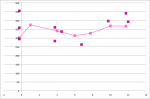
Curve for Celle after 4 days at 0.5. What now?

Status
Not open for further replies.

Melissa and Celle

Member Since 2011
Well, I guess this is what we were hoping for right now (stabilized in the 300s without the rebound)? It has only been four days at this dose though. Should we give it more time in spite of my eagerness to get her numbers down? We don't have a good opportunity for another curve anytime soon. Assuming spot checks indicate that she stays in this range, I gather we want to increase dose very slowly? I think I can reliably do a 0.7 that is slightly more than 0.5, but not a 0.6 -- it's too hard to differentiate such small doses. What will keep her from swinging again when we increase the dose?
 

Attachments

  • 0.5 Units Levemir.png
    0.5 Units Levemir.png
    48.3 KB · Views: 735
Next Sunday is the next opportunity for a curve during the day. Assuming we don't see anything in the spot checks that raise alarms, we'd rather sleep through the night and wait until then for the curve.

I'm just confused. Why is it that we think 0.7 will be different now than just a few days ago?
 
Melissa and Celle said:
Next Sunday is the next opportunity for a curve during the day. Assuming we don't see anything in the spot checks that raise alarms, we'd rather sleep through the night and wait until then for the curve.

I'm just confused. Why is it that we think 0.7 will be different now than just a few days ago?

Oh, Melissa, that's a VERY good question!!

I suppose the best way to explain it is the "shed" theory. Because Levemir has to build up in the system so that you create enough "shed" to maintain steady numbers, you also cannot overflow the shed, so if you're giving too much insulin and overflowing the shed already, you have to drain the shed a little and work on refilling it, making it easier to not overflow it! So although .7U might be a good dose, if you had continued to do .7U and the shed was still overflowing, you wouldn't be able to tell it was good.

By dropping well below the point at which the shed overflows, you allow the system time to drain the excess and essentially start over. That's why you're seeing steadier numbers without rebounds now, even though the numbers are higher.

Hope that makes it clear as mud!
 
I see she was solidly in the 300s. That's actually pretty good.

If her shed depleted enough, she might be able to handle the .7U without a big drop in BG.

You asked in your first post of this thread what would keep her from swinging again. The answer to that is probably a very small increase. An increase from .5U to .7U is actually a 40% increase!! That's quite a lot. I know you mentioned it would be very hard to do .6U but if you could manage one drop more than .5U it would probably amount to .6U. .6U is only a 20% increase. If you tried .6U and she stayed in the 300s then a further increase would be warranted and you would probably be able to tell that in only a couple days.

There's nothing wrong with going to .7U though, I just wanted to answer that question from your original post.
 
Thank you for the explanation! I actually tried to do 0.6 units, although it really seems like I'm doing about the same as at 0.5 units. I was worried about such a huge leap up. I don't want to have to go back down again. Too early to say though if it is working.
 
I can't tell when Celle eats at night due to multiple cats, but she did eat before bed at +4. I chalked up the 130 to an error. I can't understand how she'd be so low at that time, and I don't think she's ever climbed so fast.
 
Remember the meters can be + or - 20% or the "true" value.

true value range with single test
100 means the true value is between 80 and 120, a range of 40 points
150 means the true value is between 120 and 180, a range of 60 points
200 means the true value is between 160 and 240, a range of 80 points
and so on.

It may be useful to double test when you get an unanticipated value. By double testing, you narrow the range in which this must lie, which becomes the highest number - 20% as the lower boundary and the lowest number + 20% as the upper boundary.

true value range with double test
100, 110 means the true value is between 88 and 120, a range of 32 points
150, 160 means the true value is between 128 and 180, a range of 52 points
200, 210 means the true value is between 168 and 240, a range of 72 points
and so on.
The wider the difference between 2 tests, the narrower the range of the possible true value.

And if they don't overlap at all, it could be testing problems such as a bad strip, bad meter calibration, or insufficient sample size.
 
Retesting an odd number is a good idea - as you did, but then were left wondering which of those widely different numbers to "believe". I say, go with the one that makes the most sense with the rest of the cycle, the numbers before and after and the normal numbers for YOUR cat.

As for meter variance, it's an interesting factoid, but not very practical to even think about. That 20% doesn't actually change the dosing - or I have never seen a case where it would. If the cat is at 35 - you should be feeding it and retesting, then reducing the dose not wondering if it is really a 35, or maybe a 28 or a 42. Likewise, if it is at 500 you should be looking for a reason for the high numbers (ate something HC, rebound, infection, stress) and then making changes as needed because 400 is just as bad as 600.

I always go with what the meter reads, assuming it is somewhere near the middle of the range anyway. Besides, there is no way to know if the number is in the low, middle or high end of the allowable variance - even if you test again.
 
Sheila & Beau & Jeddie said:
Retesting an odd number is a good idea - as you did, but then were left wondering which of those widely different numbers to "believe". I say, go with the one that makes the most sense with the rest of the cycle, the numbers before and after and the normal numbers for YOUR cat.

As for meter variance, it's an interesting factoid, but not very practical to even think about. That 20% doesn't actually change the dosing - or I have never seen a case where it would. If the cat is at 35 - you should be feeding it and retesting, then reducing the dose not wondering if it is really a 35, or maybe a 28 or a 42. Likewise, if it is at 500 you should be looking for a reason for the high numbers (ate something HC, rebound, infection, stress) and then making changes as needed because 400 is just as bad as 600.

I always go with what the meter reads, assuming it is somewhere near the middle of the range anyway. Besides, there is no way to know if the number is in the low, middle or high end of the allowable variance - even if you test again.

Ditto. Although some meters are said to be more accurate at lower numbers than higher.
 
Status
Not open for further replies.
Back
Top