max&emmasmommie said:
... I hate to admit that I might have to switch insulins just because I can't do this right. That is very hard for me, but if it will help Max. I keep trying and trying to do this right, and I guess I'll give it one more shot because Lantus is supposed to be better for cats. I probably really needed someone to just point that out to me and say, nicely, "You can't do it this way -- accept that and move on." I am going to try one more time to get his shots on time, and look into PZI while I'm doing that.
You have to find what works for you and Max - although we have standard protocols, we also say Each Cat Is Different (ECID). This means sometimes you find a solution which differs from some protocols.
max&emmasmommie said:
... You are picking up on something about his constipation that is important. It's difficult to get the subcutaneous fluids into him often enough, but if he's dehydrated, I can't hope that the insulin is getting where it needs to go. I'm redoubling my efforts on this front, too.
That variability may be an element in the irregular glucose levels you've observed too; it may affect absorption and distribution. Lantus really, really likes consistency. I never had that with Spitzer due to issues with inflammatory bowel disease and pancreatitis - appetite up -> glucose up; vomiting or appetite down -> glucose down.
Something you might try to help with hydration is using distilled water. Put it down for drinking and also mix some into the food. Why? Because the kidneys need a certain ratio of the stuff to be excreted (solute) to water. Water with minerals already in it, can't carry out as much of the solute to be excreted (urea, some excess minerals, etc).
max&emmasmommie said:
...As far as getting the shots on time, there is this issue:
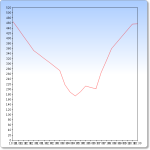
What jumped out at me about the curve is that at +11.5 he was at 455 which is soooo close to his AMPS. I expected him to go higher by PMPS, and he didn't -- PMPS was 456. I shot at that point exactly 12 hours after the morning shot with the assumption that he would not go higher anyway. Then, take a look at what happened during the early morning hours: I tried to get a test at 12 hours after the daytime nadir. I missed by about 15 to 30 minutes -- and the test was crazy high -- 458! I don't think it was a faulty test because 45 minutes later he was at 379 -- dropping after what should have been nadir. Then, 1/2 hour before shot time, he's at 299. So, I waited to see what would happen next, and one hour later he's at 301. I decided not to wait any longer, and I gave him the shot. So, it's possible that he held the 456 last night 1 full hour (or more) into the next cycle, too. Maybe I'm overdosing him all the time because the nadir is 1/2 to 1 hour late, and the next shot time is too early? I'll keep testing to see if this happens again and again.
As for the shed, I see an issue with it. It seems that when I miss a dose or I give a shot way too late, a few days later we have a good day, even some days too low to shoot. It's almost as if letting shed empty some is resulting in some lower numbers. Could this bolster the idea that I'm overdosing him? Only running curve after curve will tell me, but it is curious. I don't think I've ever had a number too low to shoot without having messed up on the timing of the dose a few days earlier. This would play into the possibility that the nadir is late and there is overlap which means I have two shots working at the same time until the first shot wears off. Too early to tell.
What I though I saw was that those lows happened when he wasn't eating well due to the constipation. Less food in with same amount of insulin resulting in a low. Then he feels better, eats and zoom, up he goes.
Remember that the shed is somewhat like a rolling average -
the effect of the sum of roughly 6 insulin shots divided by the number of hours, which should be 72. Shoot late and the rolling 3 day average drops a bit because more hours are being covered. Shoot early and the rolling 3 day average rises a bit because you have fewer hours being covered. (Sorry - math person here!)
Another way to visualize it is this sewing analogy - if you were gathering fabric in sewing, its like you are pulling it together on the thread in clumps, rather than smooth, even gathers. The result will have funky clumps of gathers with other sections that are barely wavey.
Maybe take a 2nd line for each day and note when you give fluids and when you feed. This may help clarify the relationship between fluids, eating, and glucose levels.