1/8 Farine : PS lower than nadirs? What's happening?

Status
Not open for further replies.

kimouette

Member Since 2012
Here's Farine spreadsheet :

https://docs.google.com/spreadsheet/ccc ... _web#gid=0

I'm starting to think Farine is having rebounds... which makes it hard to figure out what Alain and I should do!

Clearly this has been caused by the fact we decided to try to give only one shot of insulin a day to Farine. We know this is not recommended, but if you look at farine's results in December (and please read the comments!!!) you'll understand why we wanted to try one shot a day instead of no insulin at all.

Now the PS and nadirs are all messed up. And we are wondering if we should increase the dose a little (.15u instead of .10u)? Wait until she is stable before increasing the dose? Or is this some kind of weird rebounds that are hiding very low results?

I found this document on diabeticcatcare a while ago:
https://docs.google.com/document/d/1tyy ... sp=sharing

It does talk about rebounds, but honestly, I dont if Farine's case fits into one of the 3 categories.

Should we just wait ?

Thanks for your help!
Kim, Alain and Farine
 
This is just my opinion and others may differ. After 7 days in normal non diabetic cat numbers, you can reduce the dose, so after those 7 days from 12/25 to 12/31, I would have started another OTJ trial. I think she could be bouncing, just from getting that little bit of insulin. Let's see what others say.
 
Hi Dyana,

Alain and I both agree that we should have started an OTJ trial instead of a 1shot/day trial !! Now everything is messed up. But since we cannot reduce the dosage (.10u is the smallest dose Alain can measure), everytime Farine gets better the choice is either .10u or no insulin at all.

The 1shot/day trial was some sort of compromise between the lowest dose and nothin... But now we know that it's not possible to control a cat's BG levels that way!! Dont you guys worry, we'll never do that again.

:?: But that doesn't change the current situation... what should we do for the next injection?
 
When did you feed her? The 139 could be a food spike.

What time are you at, right now?

I think I would start another OTJ trial (if she continues to stay in normal numbers), at her next green pre-shot test.
I have seen that sometimes cats will get into the higher blue numbers during a trial from a food spike and the care givers just have to wait it out and hope the cat's pancreas kicks in and brings their numbers down without added insulin. I know if you see a number like that 139 and you just fed, you would want to see if she brings herself down into a normal range (50 to 120) about 3 to 4 hours after feeding.
 
When did you feed her? The 139 could be a food spike.
Impossible. Food actually makes her BG lower! For instance, when she eats a lot during the day, she has low and steady results. And when she sleeps the entire night (without eating enough) she has a higher AMPS, that will get lower about an hour after she eats.
What time are you at, right now?
Alain is the one living with Farine. He's asleep right now but he will take her PS and give her insulin in less than 50 minutes.
I think I would start another OTJ trial (if she continues to stay in normal numbers), at her next green pre-shot test.
That's weird cuz we were thinking of increasing her insulin dose... The results she got during the last 4 cycles were the worse in a while. What makes you think we should start another OTJ trial?

Again, could this be an episode of rebounds?
 
I just wanted to add that I agree with Dyana.

I think you are forgetting that a blood glucose reading of 120 or under is in normal range.

So in the last 2 weeks the only numbers above normal range are the 139 @ +3 on 1/7/14 and the 131 @ +3 on 1/5/14.

I think she could be bouncing, just from getting that little bit of insulin.


Also, we usually reduce the dose when we see any number below 50. On 12/19/13 she had a 41 @ +3. And on 12/25/13 she had a 43 @ +3.

This is my opinion, and I am no dosing expert or anything... but I would have reduced the dose then.


At this point, I see no reason to increase the dose....

I hope that others will also stop by with their opinion.

Have a great day!!
 
Also, we usually reduce the dose when we see any number below 50. On 12/19/13 she had a 41 @ +3. And on 12/25/13 she had a 43 @ +3.
Doesn't the protocol say that we should reduce the dose after THREE results between 40-50 ?? Not just once`?

This is my opinion, and I am no dosing expert or anything... but I would have reduced the dose then.
Like I said, since Farine is receiving 0.10u of insulin we CANT reduce the dose.It's either that or nothing
When we switched to just ONE SHOT a day of .10u it's like a huge reduction isn't it?

I understand that you guys think she is having a rebound because of the insulin shots (.10u only once a day, geez that cant be too much! unstable yes, but not too much!). And now that she has these solid blue values we are supposed to start an OTJ trial? I cant swear it's gonna happen, but I suspect things are just going to get worse if we do that now
 
This is the tight Regulation protocol (I am also posting the link to the tight regulation protocol > viewtopic.php?f=9&t=1581:

"General" Guidelines:
Hold the initial starting dose for 5 - 7 days (10 - 14 consecutive cycles) unless the numbers tell you otherwise. Kitties experiencing high flat curves or prone to ketones may want to increase the starting dose after 3 days (6 consecutive cycles).
Each subsequent dose is held for a minimum of 3 days (6 consecutive cycles) unless kitty earns a reduction (See: Reducing the dose...).
Adjustments to dose are based on nadirs with only some consideration given to preshot numbers.

Increasing the dose:
Hold the dose for 3 - 5 days (6 - 10 consecutive cycles) if nadirs are less than 200 before increasing the dose by 0.25 unit.
if your cat is new to numbers under 200, it is recommended to hold the dose for at least 8-10 cycles before increasing.
when your cat starts to see nadirs under 100, hold the dose for at least 10 cycles before increasing.
After 3 days (6 consecutive cycles)... if nadirs are greater than 200, but less than 300 increase the dose by 0.25 unit.
After 3 days (6 consecutive cycles)... if nadirs are greater than 300 increase the dose by 0.5 unit.
Reducing the dose:
If kitty drops below 40 (long term diabetic) or 50 (newly diagnosed diabetic) reduce the dose by 0.25 unit. If kitty has a history of not holding reductions well or if reductions are close together... sneak the dose down by shaving the dose rather than reducing by a full quarter unit. See additional notes in the next paragraph about drops into the 20s and 30s. Alternatively, at each newly reduced dose... try to make sure kitty maintains numbers in the normal range for seven days before reducing the dose further.

Please do not let yourself become complacent or blasé about drops into the 20s or 30s.
If kitty drops into the 20s, a full reduction of 0.25u (or 0.5u if kitty is on a higher dose) is strongly recommended.
If your cat drops into the 30s, a full reduction of 0.25u is recommended. There are very few exceptions given for caregivers who have collected years of data and KNOW their cat's response to the combination of insulin and food backwards, forwards, and inside out.
Caregivers whose kitties have "High Dose" conditions may find the need to reduce in whole units or more.
Please ask for advice.

If anyone suggests otherwise, they are putting your cat at risk! Our kitties are not just numbers. They are living beings who trust us to look out for them. The TR Protocol is an aggressive method in itself. The modified version of the protocol is slightly more aggressive.

Keeping YOUR cat safe is the #1 priority of the FDMB.
Let's keep all our kitties in the Lantus Tight Regulation ISG safe by suggesting and taking appropriate reductions.

If an attempted reduction fails, go right back up to the last good dose as soon as you see kitty's numbers trending upwards. You don't have to hold the reduced dose for a certain number of cycles before taking the dose right back up. The guidelines listed under the topic "Increasing the dose" do not apply to a failed reduction.

Please use common sense in this situation. The "last good dose" is not the dose that just dropped kitty into the 20s or 30s. You want to resume momentum by finding a dose in-between the dose that dropped kitty too low and the reduced dose.
Try to go from 0.25u to 0.1u before stopping insulin completely.


I am still trying to look over Farine spreadsheet and will also try to have some other experienced members take a look as well.
 
Impossible. Food actually makes her BG lower! For instance, when she eats a lot during the day, she has low and steady results. And when she sleeps the entire night (without eating enough) she has a higher AMPS, that will get lower about an hour after she eats.
That's actually exactly what you want to happen. It means her system is functioning the way it is supposed to. Initially the food would raise her BG, then her pancreas would produce insulin to make the numbers come down.

On the "3 times under 50" reduction thing.... Some people use that, but more with long-term diabetic cats, or those that have a history of failed reductions. Farine doesn't seem to fit that mold. So we would advise going with the "one time under 50" guideline.

I don't see any numbers that are alarming, or that I would say qualify as a "bounce". Almost ever number is within "normal" range of 40-120. I think I would try another OTJ trial as other have suggested and try to see if her numbers continue to come down an hour or two after she eats.
 
Hi Kim & Alain!!

A couple of thoughts....

What you're describing -- the pre-shot numbers being lower than the nadir -- is referred to as an "inverted curve." Inverted curves can be challenging to interpret since they can mean both that the kitty is getting either too much insulin or not enough insulin. However, this may be the first hint that Farine may be ready for a trial.

Carl's point is correct. If a cat's pancreas is functioning, low carb food will help to bring the numbers down. The food acts to stimulate the process of digestions including sending a message to the pancreas to release insulin to help glucose (the end product of digestion) enter the cells. Thus, food can help to lower BG numbers in a cat with a functioning pancreas. I suspect if you gave Farine a snack at +8 or +9, you'd see the pre-shot numbers drop lower. This is the second clue that suggests maybe it's time to start a trial.

As for the three drops into the 40 - 50 range, that is a modification of the Tight Regulation Protocol that is used by the German Lantus forum. Some people here use that approach. We have made modifications to the TR Protocol, as well. The formal version of the TR Protocol authored by Roomp & Rand does state that if a cat is in normal numbers for a week, you should reduce the dose.

Based on all of the above, it sounds like Farine may be ready for a trial.
 
Sienne, Carl and Jamie,

Alain is already following this thread. I'll talk to him about what you guys are suggesting.. to start an OTJ trial.
Even if he gives it a try, both of us are not really optimistic about the future results since all the other trials atleast started on a good basis! Starting it now means it would start with blue values!

And just for the info Farine... was first diagnosed with diabetes in 2011, she did get into remission for couple of weeks, but ever since then we've been struggling between remissions and insulin. So I dont know what a "long time diabetic cat" is, but I definitely wouldn't say she's part of the "newly diagnosed" ones!!

Oh and also... about the food helping her BG levels... we know that her pancreas is not completely asleep. But it does need a little help after couple of days OTJ (or atleast this is what we've experienced yet).

Thanks all for your help! I'll talk to Alain and will write you back if he still has question that I cant answer.
 
Kim --

There are some cats who just need a bit of help every so often. If the trial doesn't work, it may be that Farine may need a small dose of insulin on an "as needed" basis.

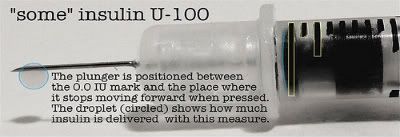
One other thought would be to see if Alain can practice a 1 drop dose. Usually, what this means in pushing the plunger of the syringe in as hard as you can before inserting it in the insulin bottle. Then, once the syringe is in the bottle, letting go of the plunger. A drop of insulin should then be in the needle. If Alain can then expel whatever is in the practice syringe onto a napkin or a non-absorbent piece of paper (e.g., plastic wrap), he'll be able to see if he was successful. The "some" insulin dose would look like this:
someinsulin-1.jpg
 
Sienne, may I ask what "as needed" means?
After every preshot above 120? After after every nadir above 50?
Wouldn't it create an inverted curve again? Cuz she won't have a depot and the next results might become unstable... That's something I wouldn't mind doing with Caninsulin, but with Lantus everything becomes so unpredictable when we are not being consistent!
 
Kim,
Thank you for the history, as I hadn't realized Farine was diagnosed that long ago. Yes, that would fit "long term diabetic". I think we consider one year or more as long-term.
 
Kim --

It's very hard to know and there isn't a clear answer to your question. It may be a matter of giving a shot once the depot is depleted to a certain point and numbers rise beyond a level that Alain is comfortable with. The "as needed" really depends on the cat and the caregiver. I'd also urge you to remember that you don't dose based on the pre-shot. The dosing is based on the nadir. If Farine has a pre-shot of 120 (or thereabout) but the nadir is in the green numbers, I don't know if I'd be anxious to give a shot.

And, you're right, this would be less complicated with a shorter acting, non-depot type of insulin like Caninsulin. It may also be that it's worth trying to find a dose that's less than 0.1u since that amount is dropping Farine's numbers a little too much.
 
Status
Not open for further replies.
Back
Top