Mariette
Member Since 2020
Previously
https://www.felinediabetes.com/FDMB...ial-day-10-amps-145-4-68.242013/#post-2727480
Buddy had a few bites at 5am. A little more than yesterday. But the AMBG remains persistently high. We'll keep trying this maybe for a week or so and see if we can get it under control. If not, I might start him back on a drop of insulin with some 6-8% carb food.
@Marje and Gracie continuing our conversation about TR and my concerns for repeated hypo episdes I found this article which outlines risks to the body:
https://www.ncbi.nlm.nih.gov/pmc/articles/PMC3784865/
Brain:
There is a possible association between repeated episodes of severe hypoglycemia and long term cognitive dysfunction.
In human autopsy studies, of patients dying after an episode of severe hypoglycemia, as well as in animal models, the superficial layers of the cerebral cortex, hippocampus and caudate nucleus, were reported to be affected.[51] More recently, Bree et al., reported that severe hypoglycemia causes damage in the cortex and the hippocampus regions and the extent of damage was closely correlated to the presence of seizure-like activity.[52]
Heart:
Hypoglycemia has profound effects on CV function. Acute hypoglycemia provokes sympatho-adrenal activation and release of epinephrine which in turn stimulates hemodynamic changes by increasing cardiac rate and peripheral systolic blood pressure, reducing central blood pressure and peripheral arterial resistance and by increasing myocardial contractility, stroke volume and cardiac output.[56]
Counter regulatory:
Several counter regulatory responses are induced by hypoglycemia including a decrease in pancreatic beta-cell insulin secretion, an increase in pancreatic alpha-cell glucagon secretion, an increased sympatho-adrenal response with acute plasma increase in adrenaline and norepinephrine, as well increased secretion of ACTH/glucocorticoids.[68] Hypoglycemia is associated with increased values of inflammatory markers including C-reactive protein, interleukin (IL)-6, IL-8, tumor necrosis factor -α and endothelin-1[69] that may result in endothelial injury and abnormalities in coagulation resulting in increased risk for CV events.
Eyes:
Animal studies and in-vitro studies, have reported that a decrease in glucose concentrations was associated with reductions in retinal sensitivity,[72] reduced viability of all retinal cell types,[73] retinal cell death,[74] loss of vision, reduction of retinal responses, increased retinal degeneration[75] and cone cell death.[76] More recently, Khan et al., demonstrated that acute effects of hypoglycemia in human eye led to significant reduction of central retinal function and contrast sensitivity.[77]
This article actually defines severe hypo starting at 40 mg/dl.
https://www.felinediabetes.com/FDMB...ial-day-10-amps-145-4-68.242013/#post-2727480
Buddy had a few bites at 5am. A little more than yesterday. But the AMBG remains persistently high. We'll keep trying this maybe for a week or so and see if we can get it under control. If not, I might start him back on a drop of insulin with some 6-8% carb food.
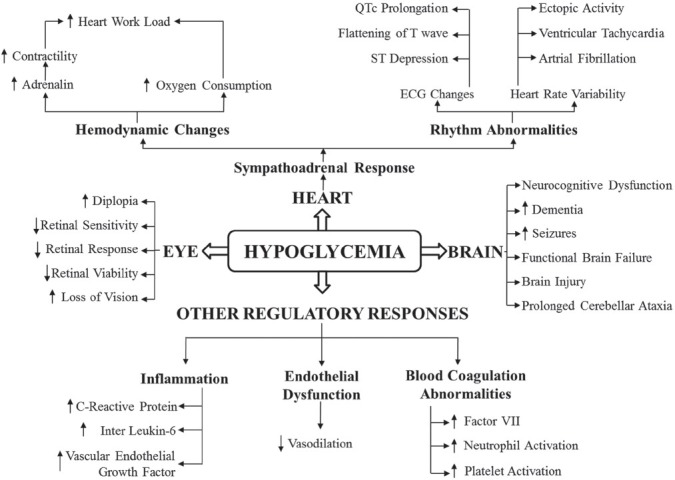
@Marje and Gracie continuing our conversation about TR and my concerns for repeated hypo episdes I found this article which outlines risks to the body:
https://www.ncbi.nlm.nih.gov/pmc/articles/PMC3784865/
Brain:
There is a possible association between repeated episodes of severe hypoglycemia and long term cognitive dysfunction.
In human autopsy studies, of patients dying after an episode of severe hypoglycemia, as well as in animal models, the superficial layers of the cerebral cortex, hippocampus and caudate nucleus, were reported to be affected.[51] More recently, Bree et al., reported that severe hypoglycemia causes damage in the cortex and the hippocampus regions and the extent of damage was closely correlated to the presence of seizure-like activity.[52]
Heart:
Hypoglycemia has profound effects on CV function. Acute hypoglycemia provokes sympatho-adrenal activation and release of epinephrine which in turn stimulates hemodynamic changes by increasing cardiac rate and peripheral systolic blood pressure, reducing central blood pressure and peripheral arterial resistance and by increasing myocardial contractility, stroke volume and cardiac output.[56]
Counter regulatory:
Several counter regulatory responses are induced by hypoglycemia including a decrease in pancreatic beta-cell insulin secretion, an increase in pancreatic alpha-cell glucagon secretion, an increased sympatho-adrenal response with acute plasma increase in adrenaline and norepinephrine, as well increased secretion of ACTH/glucocorticoids.[68] Hypoglycemia is associated with increased values of inflammatory markers including C-reactive protein, interleukin (IL)-6, IL-8, tumor necrosis factor -α and endothelin-1[69] that may result in endothelial injury and abnormalities in coagulation resulting in increased risk for CV events.
Eyes:
Animal studies and in-vitro studies, have reported that a decrease in glucose concentrations was associated with reductions in retinal sensitivity,[72] reduced viability of all retinal cell types,[73] retinal cell death,[74] loss of vision, reduction of retinal responses, increased retinal degeneration[75] and cone cell death.[76] More recently, Khan et al., demonstrated that acute effects of hypoglycemia in human eye led to significant reduction of central retinal function and contrast sensitivity.[77]
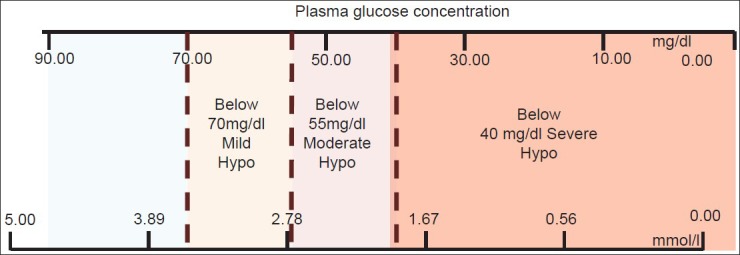
This article actually defines severe hypo starting at 40 mg/dl.