? Rapid fluctuations

DBSG & Lily

Member Since 2025
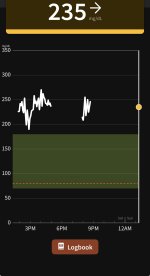
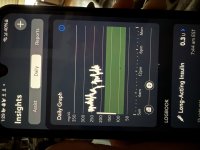
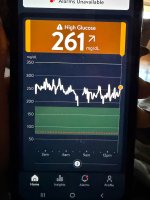
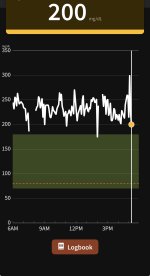
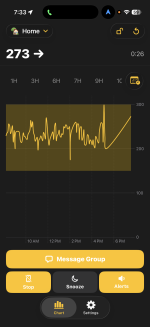
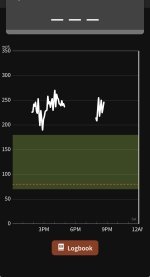
why is my poor girl rapidly fluctuating? I just applied a new sensor to her yesterday morning and it’s spending more time paused than on , it’s getting super frustrating. I just want her to go back to normal. I suspect that this is happening because on Fri night her BG Went from 286 to 119 in just 3 hours. Is this constant up and down happening bc of that right now? The other day, I found an mis-marked syringe that was WAY off and I suspect my husband must of used one - hence slightly overdosing her. We ended up finding a total of 24 in the whole box !
Posting pics below of her graphs.
TY
 

Attachments

  • IMG_1212.jpeg
    IMG_1212.jpeg
    123.3 KB · Views: 15
  • IMG_1216.jpeg
    IMG_1216.jpeg
    136.1 KB · Views: 14
  • IMG_1224.jpeg
    IMG_1224.jpeg
    1.8 MB · Views: 15
  • IMG_1225.jpeg
    IMG_1225.jpeg
    1.7 MB · Views: 16
  • IMG_1229.jpeg
    IMG_1229.jpeg
    162.6 KB · Views: 15
  • IMG_1231.png
    IMG_1231.png
    373.6 KB · Views: 15
Hello, how is the Libre acting today so far? And last night?

Is it any better?
Sometimes when there are rapid drops or increases, the sensor can’t keep up and it times out with an error.

I’ve also noticed when the sensor is in the LO range (and glucose is under 100 on a handheld meter) it can time out.
I feel it’s a safety feature of the sensor as it’s designed for a human. The sensor must give an error to protect the user so they either do something to correct the perceived low or change their sensor.
It’s something we have to deal with using it for a pet, since we are trying to get them to BG under 100 or low 100s as normal BG.

So, yes, there can be periods of errors where you don’t get readings. Sometimes it just happens for unknown reasons, and hopefully it will resume reading accurately and consistently again. Sometimes if you haven’t applied it quite correctly and it’s not making good contact that could be a problem since it’s a new sensor.

Have you joined the Facebook group Freestyle Libres for dogs and cats? They have lots of information on using a Libre for your cat and there’s so many people there that can answer questions specifically about a Libre. There’s also lots of helpful information on their Facebook page. Hope this helps and hope Lily is doing well today.

I know you work with vets, but to tell you the truth, many are very inexperienced with actually using a Libre. And they apply the sensors with surgical glue which floods the sensor and it fails inevitably all the time. It also damages the skin of a cat.

When I wanted to switch from a Libre 2 to a Libre 3, my IM vet had never used or prescribed a Libre 3 and begrudgingly gave me the prescription.
So I was a first for the hospital (requesting a Libre 3).
This was 3 years ago, so I guess most people just didn’t ask for anything other than what the vet handed out (and applied with glue).

Here is our document on using a Libre as well.
Getting Started With Continuous Glucose Monitors (CGMs) for Diabetic Cats

 
Hello, how is the Libre acting today so far? And last night?

Is it any better?
Sometimes when there are rapid drops or increases, the sensor can’t keep up and it times out with an error.

I’ve also noticed when the sensor is in the LO range (and glucose is under 100 on a handheld meter) it can time out.
I feel it’s a safety feature of the sensor as it’s designed for a human. The sensor must give an error to protect the user so they either do something to correct the perceived low or change their sensor.
It’s something we have to deal with using it for a pet, since we are trying to get them to BG under 100 or low 100s as normal BG.

So, yes, there can be periods of errors where you don’t get readings. Sometimes it just happens for unknown reasons, and hopefully it will resume reading accurately and consistently again. Sometimes if you haven’t applied it quite correctly and it’s not making good contact that could be a problem since it’s a new sensor.

Have you joined the Facebook group Freestyle Libres for dogs and cats? They have lots of information on using a Libre for your cat and there’s so many people there that can answer questions specifically about a Libre. There’s also lots of helpful information on their Facebook page. Hope this helps and hope Lily is doing well today.

I know you work with vets, but to tell you the truth, many are very inexperienced with actually using a Libre. And they apply the sensors with surgical glue which floods the sensor and it fails inevitably all the time. It also damages the skin of a cat.

When I wanted to switch from a Libre 2 to a Libre 3, my IM vet had never used or prescribed a Libre 3 and begrudgingly gave me the prescription.
So I was a first for the hospital (requesting a Libre 3).
This was 3 years ago, so I guess most people just didn’t ask for anything other than what the vet handed out (and applied with glue).

Here is our document on using a Libre as well.
Getting Started With Continuous Glucose Monitors (CGMs) for Diabetic Cats
Hi there. Thank you for your reply. I do know why the sensor pauses. That was not my question. My question was in reference to why she is rapidly fluctuating and if it has anything to do with her incident from Friday night.
In this post I mentioned that I applied the sensor. The vet never applies it. I do and I use skin tac. Not glue
Also, I absolutely despise that Facebook group as I never found them to be helpful and they are very rude. They don’t even give your post a chance to get any comments. The last time I posted in there recently, They automatically disabled my comments for me just simply asking what other locations are good to place on a cat. Other times they are just rude. Even looking at other people’s posts and replies.

Again, my question here is not about the sensor as I know how it works and why it does what it does. I’m asking what’s going on with my cat.

I work in a specialized 24 hour emergency vet hospital with every specialty that you can even think or dream of. They are well trained and quite knowledgeable in just about everything.

Thanks again for your detailed reply otherwise !
 
How long have you been using the Libre? I'm just wondering how these graphs compare, if you were used to seeing something smoother?

I don't know that this is helpful at all, but my vet says (and I tend to agree with her) that the bad thing about the Libre is that it may give us a little too much information, with the constant influx of data. Your spreadsheet doesn't look very dramatic to me, and with traditional blood testing, you wouldn't have nearly so many data points. I'm wondering if those fluctuations might be reasonably normal, and they just look dramatic because of the continuous readings.

(I've been using the Libre for less than two months, so I'm no kind of expert, to be clear.)
 
Back
Top